About     FAQ     Contact      Advertise With Us      Press   

Enjoy Valentine’s Day with a Prosecco from Mionetto

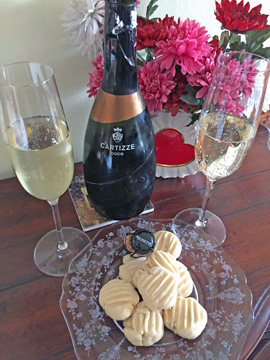
Mionetto Cartizze, D.O.C.G. wine with a plate of homemade Melting Moments cookies.

For Valentine’s Day enjoy a sparkling wine. Proseccos are a popular choice for wine drinkers around the world. They frequently offer a good price point and often Proseccos offer quality including good color, aroma and taste.

Last night we enjoyed a Prosecco produced by Mionetto, a long established winery. The winery was started in 1887 by Francesco Mionetto in Valdobbiadene, Italy.

The Cartizze, D.O.C.G. by Mionetto was produced with the Glera grape variety using the Charmat method. The wine had 11% alcohol with 24-26 g/l. This Prosecco was a yellow color and very aromatic of peach, apple, pear and floral notes. The wine had multiple columns of bubbles culminating in a thin circumference of bubbles. We found the bubbles to be small although not as small as some other high-end wines. The wine offered a mouthfeel that was crisp and lively with a melding of flavors.
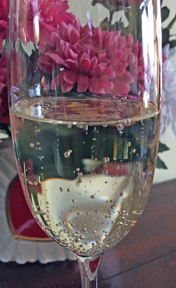
Multiple columns of bubbles rising to the surface.

The slight sweetness began in the wine from start to finish. The finish lingered with notes of apple and pear. 

We enjoyed the Cartizze, D.O.C.G. wine with a plate of homemade Melting Moments cookies. The slight sweetness of the Cartizze matched well with the slight sweetness of the cookies.

Mionetto suggests pairing the CartizzIe Prosecco with desserts, pastries, cakes, fruit salads and shellfish. 

Consider serving this Cartizze D.O.C.G. sparkling wine on Valentine’s Day with dessert.

Hint: Melting Moments are easy to make as the recipe calls for only four ingredients: flour, confectionary sugar, cornstarch and butter. This was the first time for me to bake Melting Moment. At first I had my doubts and wanted to add vanilla but I did a taste test and these cookies are great, especially when fresh. I discovered the recipe, Minnie’s Melting Moments, while reading Aunt Dimity and the Widow’s Curse by Nancy Atherton. Many recipes for Melting Moments are available on the internet.

Cheers!
Kathy and Terry
Discover Wineries Hosting Valentine’s Day Events

Why not visit a winery to celebrate Valentine’s Day?

Valentine’s Day is quickly approaching! To make this day special for your loved one,  consider celebrating Valentine’s Day week at a nearby winery or perhaps a distillery. Below is a list with links to numerous special activities to show how much you care. Since Valentine’s Day falls on Thursday, a work day for many people, many wineries are offering special events the weekends before and after. Check out the list below for many wine event ideas.

Hint: If you are not able to visit a winery to celebrate the day, consider celebrating at home with a special meal or dessert and a lovely glass of wine!

Cheers!
Kathy

Friday, February 8

Painted Stave Distillery, Delaware
Event: ‘My Tipsy Valentine’ Cocktail Class
Facebook Page

Saturday, February 9

Bon Niche Cellars, California
Event: “Vino Valentine!”
Website Information

Effingham Manor and Winery, Virginia
Event: Sweethearts Wine Trail
Website Information

Painted Stave Distillery, Delaware
Event: ‘My Tipsy Valentine’ Cocktail Class
Facebook Page

Pearmund Cellars, Virginia
Event: Sweethearts Wine Trail
Event: Valentine’s Wine Dinner

Website Information

Vint Hill Craft Winery, Virginia
Event: Sweetheart Wine Trail
Website Information

Youngberg Hill, Oregon
Event: Fondue of You: Wine Tasting and Fondue Dipping
Website Information

Sunday, February 10

Effingham Manor and Winery, Virginia
Event: Sparkling Cocktails and Quiche
Website Information

Effingham Manor and Winery, Virginia
Event: Sweethearts Wine Trail
Website Information

Pearmund Cellars, Virginia
Event: Sweetheart Wine Trail
Website Information

Vint Hill Craft Winery, Virginia
Event: Sweetheart Wine Trail
Website Information

Thursday, February 14

Duplin Winery, North Carolina
Event: Valentine’s Dinner at the Bistro
Website Information

Potomac Point Vineyard & Winery, Virginia
Event: Valentine’s Dinner
Website Information

Reustle Prayer Rock Vineyards, Oregon
Event: Valentine’s Dinner
Website Information

Saturday, February 16

Painted Stave Distillery, Delaware
Event: Don’t Go Bacon My Heart Brunch
Event: Shakespeare & St. Valentine at Painted Stave

Facebook Page

Potomac Point Vineyard & Winery, Virginia
Event: Sinfully Sweet: Dessert & Wine Pairing
Website Information

Youngberg Hill, Oregon
Event: Fondue of You: Wine Tasting and Fondue Dipping
Website Information

Discover a Boutique French Winery

Mazarin 2017 from Clos Guérin

Clos Guérin is located in the Côtes-du-Rhône appellation. The winery and vineyards are located on a plateau that is affected by the famed mistral winds. 

Clos Guérin has a long heritage in the wine growing industry. As far back as the 1800s, the family was growing grapes as well as many farm products including vegetables and fruits such as peaches and figs. During the mid 1900s, they added milk production and poultry to the farm. 

When the agricultural endeavors failed to provide a proper living, the descendants turned to other pursuits including sculpting wood/oak and iron/stainless steel. Many years past and the 4th generation formed a team together agreeing to return to the family’s traditions. The beginning of the foundation of Clos Guérin began in 2013.

Currently Clos Guérin has eight hectares (19.7 acres) of vineyards. The vineyards include the grape varieties: Grenache, Syrah, Cinsault and Mourvèdres. Beginning in 2017, the vineyards began to be cultivated using organic methods.

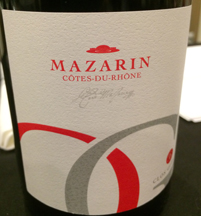
At the APVSA wine tasting in Washington DC, we had the opportunity to taste the Mazarin 2017 . This wine, with 14.5% alcohol, was produced with Grenache and  Syrah. Clos Guérin suggests this wine can be cellared for two to four years to reach its full maturity. Mazarin 2017 was a dark red blood color. The wine offered fruitiness notably black fruits. The wine was full-bodied and offered bold tannins. The finish was very fruity yielding to spices.

Importers and distributors may well want to represent the small boutique winery of Clos Guérin.

Cheers,
Kathy

Champagne Étienne Oudart’s Tasting in Washington DC


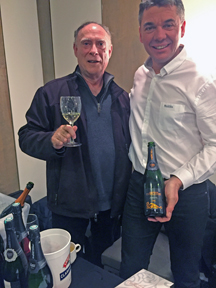
Terry enjoys a champagne with Jacques Oudart at the APVSA tasting in Washington DC, January 2019.

Champagne Étienne Oudart had several champagnes for tasting at the January APVSA tasting in Washington DC. This champagne house passed from father to son. It began in 1958 and has progressed. In 2018 the vineyards were certified “High Environmental Value” and “Sustainable Viticulture in Champagne.” The winery is located south of Épernay in Brugny.

Today, the champagne house is headed by Jacques and his wife Karinne. Last year Champagne Étienne Oudart celebrated its 60th anniversary. I met Jacques at the Washington DC tasting. Asked about his wine journey he said that at a young age he wanted to escape the champagne world. As a young adult at 22, he decided to return to the world of champagne. 

Jacques sees his champagnes as different than others. Many of the grapevines are 60 years old. He prefers to age the champagnes for a minimum of five years and he likes to go with less sugar in the dosage.

The Champagnes

I tasted three champagnes. The Extra Brut was an equal blend of Pinot Meunier and Pinot Noir with 20% Chardonnay. The dosage was only 2 g/L. This yellow colored champagne had multiple columns of tiny bubbles forming a mousse on the center and around the circumference of the glass. The aroma and taste was reminiscent of red berry fruits and citrus with freshly baked bread. The mouthfeel was lively. The wine retails for 17.10€.

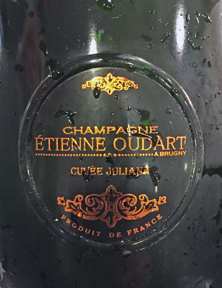
The 2008 Cuvée Juliana Millésimé was named after Jacques’s mother.

The Chardonnay Brut Millésimé was crafted with 100% Chardonnay from the 2010 harvest. Multiple columns of tiny bubbles formed a central and circumferential mousse on the surface of this pale yellow colored wine. Apple, pear and freshly baked bread were noticed on the aroma and taste. The mouthfeel was lively. With 8 g/L of dosage, there was a hint of sweetness on the fruity finish. The champagne had a long aftertaste. 

The 2008 Cuvée Juliana Millésimé was named after Jacques’s mother. The wine was a blend of 40% Chardonnay, 40% Pinot Noir and 20% Pinot Meunier. This yellow colored champagne had a gold hue. It showcased multiple columns of tiny bubbles forming a mousse in the center and circumference of the surface. The wine was aged for ten years and had 6 g/L dosage. It offered apples and citrus on the aroma and apples, citrus and freshly baked bread on the taste. The mouthfeel was creamy. This creaminess yielded to liveliness. The finish was crisp and refreshing. The champagne retails for 27.45€.

We hope Jacques can find importers and distributors along Eastern United States for his champagnes. 

Cheers,
Terry

Pineau François 1ER Wines

Pineau François 1ER

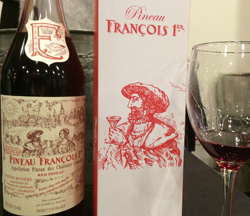
While at the APVSA wine tasting for importers and media, we  discovered and tasted two Pineau wines. Pineau wines are produced with a blend of grape juice and Cognac eau-de-vie. Frequently, the result is a wine that has fresh fruit notes. Pineau wines were first developed quite by accident in the late 1500s when someone added grape must to a partial barrel of Cognac eau-de-vie. When the Cognac barrel was opened, the taste was memorable and so the tradition of producing Pineaus began. Pineau wines are unique wines in a specific AOC  of France, Appellation Pineau des Charentes Contrôlée.

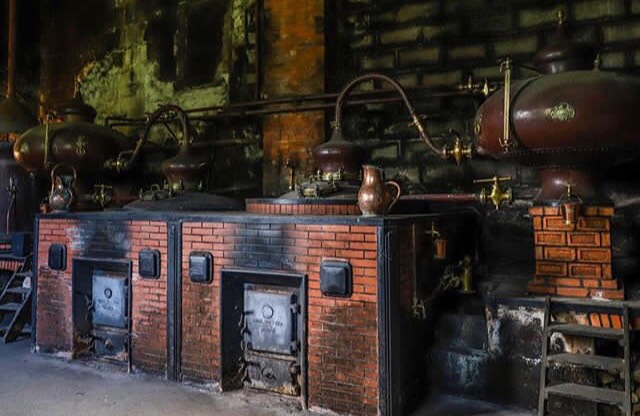
The first Pineau François 1ER Pineaus were produced during the 1930s by Gaston Rivière. Today Philippe G. Rivière continues the tradition of producing Pineaus using age-old methods that include using wood and coal for heating the distilling equipment.

Pineau François 1ER at APVSA

The Pineau François 1ER  White  Pineau, with 17% alcohol, was a light gold color. At the tasting, blue cheese and seafood were recommended for pairings. Other food pairings include roasted goose and muscle recipes. The White Pineau had an aroma and taste of dried apricots. This fortified wine offered a nice combination of acidity and sweetness. This full-bodied wine coated the mouth.

The Red Pineau Francois 1ER  also was 17% alcohol. The wine was a translucent red/purple color. The wine offered strawberry and raspberry notes. The fortified wine was medium bodied and also coated the roof of the mouth. The finish had a little heat but was balanced. Yum! Try a glass of this Pineau while sitting next to a fireplace. Food

Pineau François 1ER uses wood and coal for the still. (Photo provided by Pineau François 1ER)

pairings include melons, dark chocolate desserts and fruit salad.

Interview

Wine Trail Traveler: How long has Pineau François 1ER been producing wine? 

Pineau François 1ER: The brand was released in 1930’s by Gaston Riviere, it’s creator, decided to sell only the pineau aged in cask oak.

Wine Trail Traveler: How many hectares of vineyards does the winery own? What are the grape varieties in the vineyard? 

Pineau François 1ER:  The vineyard has 32 hectares of vine grapes. The grape varieties for the white pineau is Ugni Blanc and Colombard. For the red pineau we used Merlot, Cabernet Franc and Cabernet Sauvignon.

Wine Trail Traveler: To what do you owe the success of Pineau François 1ER?

Pineau François 1ER: The reputation of its production quickly extends beyond our borders of Charente. Even today this quality is still recognised. The pineau François is distilled in authentic red copper alambics and remain among the last to use wood and coal for heating. Also our very important stock of old pineau which aged in Limousin oak barrels.

Wine Trail Traveler: Currently where are the wines available?

Pineau François 1ER: The wines are available in the USA in San Francisco and New York City, in Belgium and in Slovakia.

Wine Trail Traveler: Are visitors encouraged to visit the winery? If so, what can they expect to discover at the winery?

Pineau François 1ER: We also organise some tours of the domain. It’s open to the public everyday of the year, they just have to call before for planning a day.

People will discover the vineyard, the distillery and the cellar. At the end we propose a free tasting of our pineau François 1er.

Wine Trail Traveler: What would you like the public to know about Pineau François 1ER?

Pineau François 1ER: Pineau François 1ER is one of the last families who still make pineau with wood and coal. They’re also the first brand created of Pineau des Charentes.

Our clients are gastronomic restaurant like Le Jules Verne (the Eiffel Tower restaurant), L’Astrance, le Plaza Athénée and famous wineries like la cave Augé, la grande épicerie de Paris …

Wine Trail Traveler hopes to see the Pineau François available in more areas of the United States. Importers and distributors should consider Pineau François 1ER.

Cheers!
Kathy

Champagne Colin Tasting in Washington DC


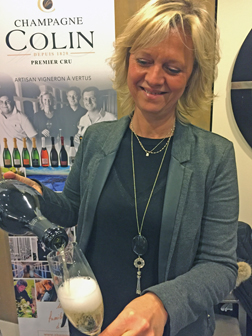
Delphine Colin pouring Champagne Colin at the APVSA tasting in Washington DC – January 2019.

Champagne Colin can trace their earliest wine growing to 1829 when Constant Piéton grew grapes. Constant was the great-grandfather of Geneviève Prieur who along with Marie-Louise Radet inherited vines from their parents. The estate remained in the family and in 1995 was taken over by brothers Richard and Romain Colin; Geneviève Prieur was their maternal grandmother. They changed the future for the estate from sending their grapes to a cooperative to becoming independent winegrowers. 

We met and spoke with Richard’s wife, Delphine at the APVSA tasting in Washington DC earlier this month. Delphine helps out where needed from the cellar to the office, administration and export. While on tour of the Eastern United States, Delphine hopes to meet with distributors who may want to carry Champagne Colin. 

I asked Delphine when she first became interested in wine. She recalled how important it was for her to be born in Champagne. She remembered walking in the vineyard with her grandmother. When she was older, she traveled around the world, but knew that Champagne was calling her back. Delphine married Richard who is now the winemaker.

Champagne Colin is in the village Vertus in the Côte des Blancs region of Champagne. Their vineyards are classifies as Premier Cru and Grand Cru. Most of the vineyards are planted with Chardonnay.

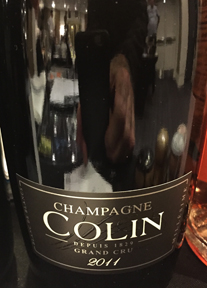
The 2011 Cuvée Grand Cru made from 100% Chardonnay.

I tasted three champagnes from their portfolio at the wine tasting. The Cuvée Alliance is a blend of Chardonnay 65% and Pinot Meunier 35%. The grapes came from their Premier Cru vineyard in Sézanne. The champagne had multiple columns of tiny bubbles forming mousse on the center and circumference of the surface. The wine had a lively aroma of apple and citrus. The champagne was creamy and offered apple and some berry fruit on the taste. Although a brut, it had a bit of sweetness with a dosage of 9 g/L. The mouthfeel was also very lively. The finish was crisp with a bit of mineral. The champagne sells for 23€.

The Cuvée Blanche de Castille, Premier Cru was crafted with 100% Chardonnay. The wine was aged on the lees between 18 and 30 months. It offered multiple columns of tiny bubbles forming a central mousse. It was noted that the aroma and taste offered apple, freshly baked bread and a hint of mineral. The mouthfeel was creamy and lively. The finish was crisp with a hint of salt. Yum! The champagne sells for 26€.

The third champagne tasted was a 2011 Cuvée Grand Cru made from 100% Chardonnay. It aged for at least six years before disgorging. The yellow colored wine had multiple columns of tiny bubbles forming a central and circumferential mousse on the wine’s surface. Freshly baked bread, apple and citrus were noted on the aroma and taste. The champagne had a very creamy mouthfeel that yielded to liveliness.  The wine had a crisp finish with a long aftertaste. The champagne sells for 37€.

Hopefully Champagne Colin can acquire a distributor in the United States so we can delight in their crafted champagnes.

Cheers,
Terry

Washington DC Tasting Includes Champagne Sourdet-Diot


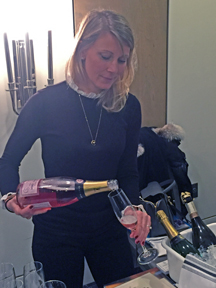
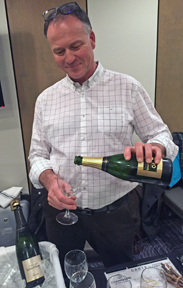
Amelie pours the Brut Rosé.

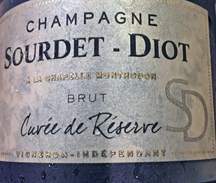
Champagne Sourdet-Diot is located at La Chapelle Monthodon in the Marne Valley. The first vines were planted in the 1960s by Raymond Sourdet who sold the grapes to champagne houses. Over the years the vineyards were expanded. During the 1980s, Patrick and Nadine Sourdet began to make champagne with their grapes while also selling some of the grapes. By the 1990s, all the grapes harvested were used by the Sourdets. In 2003, Patrick and Nadine’s daughter, Ludivine and her husband Damien joined the family champagne house.

While at the APVSA tasting in Washington DC, I had the opportunity to speak with Amelie Sourdet who poured three champagnes to taste. Amelie works in the champagne house’s export group. She said that her interest in wine started when she was young and was permitted to taste wine.

Champagnes

Champagne Sourdet-Diot Brut Cuvée de Reserva

The Brut Cuvée de Reserva was a blend of 80% Pinot Meunier and 20% Chardonnay. The yellow colored wine had multiple columns of tiny bubbles forming a mousse on the surface’s center and circumference. The aroma and taste were reminiscent of red berry fruits with a touch of mineral. The creamy mouthfeel yielded to liveliness. The finish was fruity.

The Brut Rosé was a blend of 60% Pinot Meunier, 30% Chardonnay and 10% coteaux champenois (a red still wine added to the blend for color). The champagne had a beautiful salmon color with a red hue. It would be a perfect champagne for Valentine’s Day. In the glass, there were multiple columns of tiny bubbles forming a central and circumferential mousse. The aroma and taste offered red berry fruits with a touch of citrus. The mouthfeel was very smooth and the smoothness yielded to liveliness. The finish was fruity.

The Brut Cuvée Prestige was a blend of 60% and 40% Pinot Meunier. It had a light yellow color with multiple columns of tiny bubbles forming a mousse on the center and the circumference of the surface. The creamy mouthfeel was accompanied by apple, red berry fruits and some freshly baked bread. The long aftertaste was very refreshing.

Champagne Sourdet-Diot is on tour of several cities throughout the United States with the APVSA. They hope to acquire a distributor.

Cheers,
Terry

Wine Tasting of Bordeaux Wines from Château des Mille Anges

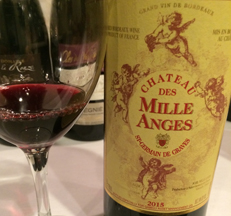
Château des Mille Anges red wine

At the APVSA wine tasting in Washington, I enjoyed sampling a couple of wines from Château des Mille Anges. The property is located in the Cadillac Côtes de Bordeaux AOC. According to the unique wine bottle label, the Château des Mille Anges is referred to as the “House of a thousand angels.”

Red Wines

The Cadillac Côtes de Bordeaux St. Germande Graves 2012 was was a red wine that retails for 9 euros. The wine was a light opaque red/purple color. The wine was light bodied with bold tannins. This dry wine offered dark fruit notes.

The AOC Cadillac Cotes de Bordeaux Mozart 2012 was a translucent dark purple with red color. This wine was full bodied with dark red fruit notes that reminded one of black cherries and blackberries. The aftertaste was long and tannins were on the finish.

Since purchasing the property 1994, Mrs. Heather van Ekris has added to and expanded the vineyard and facilities. 

Today the vineyards is 30 hectares (74 acres). The vineyard includes the grape varieties:  Merlot, Cabernet Sauvignon, Cabernet Franc, Sauvignon Blanc and Sauvignon Gris.

History of the Property

Prior to purchase by Mrs. Van Ekris, the Château des Mille Anges was the Sisters of the Assumption convent. The nuns of the convent grew grapes for Mass wine and for eating. The convent was also a place for children to be educated as well as protected.  Eventually the convent was closed due to World War II. According to the Château des Mille Anges website, “The name ‘Château des Mille Anges’ is in memory of the little children who were taught here.”

Today Château des Mille Anges is looking for importers/distributors for their products in the United States.

Address

S.A.R.L. Mille Anges
33490 St-Germain-de-Graves
Gironde, France

Cheers,
Kathy

Champagne Sylvie Moreau Tasting in Washington DC

One of the vineyards of Champagne Sylvie Moreau. Photo courtesy of Champagne Sylvie Moreau.

A half century ago, the origins of Champagne Sylvie Moreau began when Sylvie Moreau’s parents, Micheline and André Moreau planted grapes in the town of Saint Euphraise et Clairizet. In 1973, André sold the first bottle of champagne under the label of Champagne André Moreau. They continued to craft champagnes until the 1990’s when they decided to retire. It was natural for their daughter Sylvie to take over the champagne house. Today the champagne house is operated by Sylvie Moreau and her husband Olivier, the winemaker. The label was changed to Champagne Sylvie Moreau.

Total vineyard land comprises of three hectares (7.4 acres) in different areas ((Petite

Montagne de Reims, Vallée de l’Ardre and Vallée de la Marne) that showcase Pinot Munier, Pinot Noir and Chardonnay.

Olivier pouring champagne at the APVSA tasting in Washington DC, January 2019.

At the APVSA tasting in Washington DC, I had the opportunity to speak with Olivier. I asked him when he first became aware of his interest in wine. Oliver replied, “When I was ten years old, I use to play in the vineyards. I began to help my father with harvests. I have now worked on 38 harvests.”

When asked what he knows now that he wish he knew when he began crafting champagnes, Oliver responded, “The vineyard is always changing each year. I had to become flexible and mold myself to what the vineyard offered.”

Champagnes

Racines – Brut Tradition was a blend of Pinot Munier, Pinot Noir and Chardonnay with reserved wine. The yellow with gold hue colored wine had multiple columns of tiny bubbles forming a mousse around the circumference of the surface. The aroma and taste offered red berry fruits. The taste was delicious with a creamy mouthfeel that yielded to liveliness.  The finish was crispy and fruity.

L’Émeraude is an equal blend of Pinot Noir and Chardonnay. The yellow colored champagne had multiple columns of tiny bubbles forming a circumferential mousse. I noticed floral notes along with apple, red berry fruit and freshly baked bread. The mouthfeel was creamy and lively. The fruity finish also had hints of freshly baked bread.

Carré Or – Brut Réserve is a blend of Pinot Munier, Pinot Noir and Chardonnay with reserved wine. The wine was cellared between 7 and 10 years. It is like the first wine tasted but with longer aging. Multiple columns of tiny bubbles formed a central mousse on the surface of this yellow colored champagne. Red berry fruits and freshly baked bread were predominant along with a creamy and lively mouthfeel.

Incarnat – Brut Rosé had a salmon with red hue color. Multiple columns of tiny bubbles formed a mousse at both the center and circumference of the surface. Red berry fruits and freshly baked bread were noticed on the aroma and taste. The champagne had a lively mouthfeel and a long aftertaste. This champagne would pair nicely with Valentine’s Day.

Champagne Sylvie Moreau is looking for distributors in the United States. The champagne house sent us a few photos of their vineyard and winery. 

Winter at a Sylvie Moreau vineyard. Photo courtesy of Champagne Sylvie Moreau.

Harvest Photo courtesy of Champagne Sylvie Moreau.

Winemaking Photo courtesy of Champagne Sylvie Moreau.

Cheers,
Terry

Discover the Wines of Mas des Combes


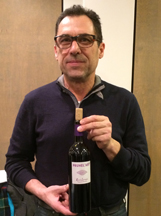
Rémi Larroque from Mas des Combes, France

Last week while attending the APVSA wine tasting in Washington, DC, I met Rémi Larroque, owner and winemaker at Mas des Combes. This winery with vineyards is located in the Appellation Gaillac Contrôlee in France’s Sud-Ouest region. Mas des Combes is producing red, white and sparkling wines using traditional grape varieties and ancestral varieties. Currently Mas des Combes is looking for importers and distributors.

Rémi is enthusiastic about the wines he produces at Mas des Combes. Rémi is a member of a family that has many generations of winegrowers, going back 16 generations. During the early 1800s, Jean Perre Larroque settled in Oustry where he produced wine and established a wine cellar. The winemaking and vineyard growing has passed down over the years and today Rémi with his wife, Nathalie, own and operate Mas des Combes.

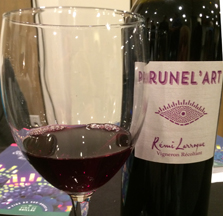
Prunel’Art wine from Mas des Combes

I tasted two wines produced by Rémi, a Prunel’Art and Mas Combes Gaillac Red 2017.  The Prunel’Art was produced with 100% Prunelart grape variety. It had 15 g/L of sugar and had 12% alcohol. The wine was a red/purple color. The aroma was robust and the taste offered notes of dark fruit. The finish offered fresh fruit notes. The Prunel’Art wine is produced with Prunelart an old type of grape frequently grown in Gaillac.

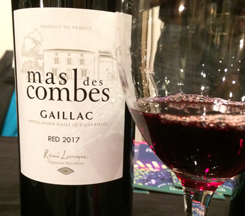
The Mas Combes Gaillac Red 2017 was produced with Merlot, Fer Servadou, Syrah and Duras grape varieties. It was a translucent red color. The wine, with 12.5% alcohol, was dry with red fruit notes including cherries and red raspberries. This dry wine offered a medium body with mild tannins leading into a long finish. Pairing suggestions included grilled poultry and meats.

An online interview with Mas des Combes provided this intriguing information.

Wine Trail Traveler: What are Rémi’s most enjoyable aspects of Mas des Combes?

Rémi Larroque: I particularly like the harvest time, which ranges from 3 to 5 weeks, in September and October. Each vintage is a discovery.

Wine Trail Traveler: You have 34 hectares of vineyards. What varieties are you growing?

Mas de Combes Red Wine

Rémi Larroque: We favour our own unique ancestral  varieties called Gaillac : Fer Servadou (also known as “Braucol”), Prunelart, Duras, for reds, Mauzac and Len de l’El for the whites. We also use varieties such as Syrah, Merlot, Gamay, Sauvignon blanc, Muscadelle. The Mas des Combes estate is composed of 60% reds and 40% whites.

Wine Trail Traveler: To what do you contribute the success of the winery?

Rémi Larroque:

Know how from several generations
-Our wines are present in several establishments in the Occitanie region and also in all the France.
-The qualitative regularity of the products
-A good price-performance ratio

Wine Trail Traveler: How will the winery change and grow in the next five years?

Rémi Larroque: We have built a new, more modern winery to sell more bottles of wine. Our two children, at this time are still young, will perhaps  take over the estate and we would like to give them the tools to start well. That’s why we are looking for importers, distributors in USA and CANADA

Wine Trail Traveler: I discovered the Prunel’Art wine to be delicious. Do you use the Prunelart grapes only as a straight varietal wine or do you use it in a blend?

Rémi Larroque: Prunel’Art is a varietal wine, 100% Prunelart (grape variety).        It’s an old forgotten grape variety typical from Gaillac. We replanted it 6 years ago.

Wine Trail Traveler: What types of foods do you like to pair with Prunel’Art wine?

Rémi Larroque: This full-flavoured wine, made from the traditional “Prunelart” grape, has delightful aromas of black fruit, plum, with a hint of spice and black olive. Mouthfeel is dense, and the fleshy tannins hold a hint of liquorice and fruit (raspberry, tart cherry, ripe fruit).

Drink with  duck meat, with a plate of cold, mixed meats (raw ham, dry pork sausage).
Aperitive, and also with dark chocolate pie. Should be served freshly (12—13°)

Wine Trail Traveler: What can visitors to Mas des Combes expect when visiting?

Rémi Larroque: Discovery of a hilly landscape, bordered with vineyards and wheat fields, it is called the “little tuscany” dotted with hamlets in white country stones.

They can visit the cellar on request, between June 1st and August 31st. Wine tasting in the sales cellar. Opportunity to walk on the vineyard paths

Wine Trail Traveler: What would you like the public to know about Mas des Combes?

Rémi Larroque: We are a family business since a several generations; we harvest, vinify our wines ourselves. We respect the environment with good grape culture principles to avoid vine diseases; we favour preventive rather than curative treatments. We respect our landscapes, lands and above all, the customer that buys our wines

Address:

Mas Des Combes
Nathalie et Rémi LARROQUE
391 chemin du Mas d’Oustry
81600 GAILLAC

Wine Trail Traveler wishes Rém Larroque much continued success with winegrowing, winemaking and marketing the Mas des Combes wines.

Cheers!
Kathy


info@winetrailtraveler.com            Sitemap                      Privacy Policy

Copyright: Terry and Kathy Sullivan 2006-2013