-1.5in.jpg)



Limestone blocks at Oliver Winery
In 2013 the Indiana Uplands AVA became the first approved AVA in Indiana. By 2017 this AVA with 4,800 square miles includes 17 wineries. For the consumer, this means that any bottle of wine labeled with the Indiana Uplands AVA must be produced with 85% of the grapes grown within the AVA.
On a map, the Indiana Uplands AVA looks like a long rectangle extending from its northern border in Spencer, Bloomington and Nashville, Indiana to the southern border near Corydon and Elizabeth, Indiana which is close to the Kentucky state line.

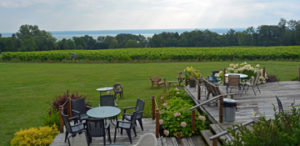
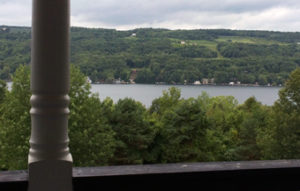
A great spot to enjoy a glass of wine at Brown County Winery
Wine enthusiasts are frequently interested in the land which includes hills and valleys with the elevation ranging to 1,033 feet above sea level. Other important landmarks include Monroe Lake and the Hoosier National Forest.
According to the Indiana winemakers we spoke with, the vineyards primarily sit on a base of limestone. However, there is also shale and sandstone.
The climate in the region significantly influences the vineyards including the grape varieties. The summers can be very warm while the winters get very cold. In 2014 and 2015 a polar vortex devastated many of the vineyards in the AVA. After growing grapes well for several years, it was a shock for the winegrowers to lose so many of their grapevines. Grape varieties grown in the Indiana Uplands AVA include vitis vinifera, hybrids and native American.
Vineyard growers need to be careful in choosing the grape varieties they want to grow and be successful. While visiting several of the wineries in the Indiana Uplands AVA we discovered that some of them are experimenting with different varieties to see what will grow well as well as produce quality wines. One newer variety we came across during our visit was the Cabernet Doré.
Indiana Uplands AVA Wine Trail
Currently nine of the AVA wineries belong to the Indiana Uplands AVA Wine Trail. While visiting these nine wineries in July, we learned that to belong to the Wine Trail, each winery must meet certain conditions. One of these conditions was how long the winery was opened as a commercial business. Another important consideration was the amount of time the winery was open to the public each week.
In 2017 the wineries on the Indiana Uplands AVA Wine Trail are:
Best Vineyards Winery
Brown County Winery
Butler Winery
French Lick Winery
Huber Winery
Oliver Winery and Vineyards
Owen Valley
Turtle Run Winery
Winzerwald Winery
We visited all nine of these wineries. To find out about these wineries, read our online reviews.
Cheers!
Kathy








Now is Great Time to Make Peach Wine
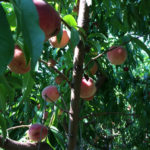
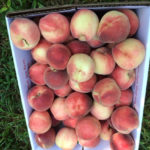
Fresh peaches will soon be turned into wine!
As mention in a previous blog, we began crafting a peach wine on Wednesday.
By Thursday night our fermentation bin, filled to about 2/3 of the five-gallon plastic container, was beginning to show signs of fermentation with the airlock bubbling about every 30 seconds. This morning the airlock is showing bubbles every 4 seconds. This is all good news as we wait for the fermentation to finish. It usually takes several days up to a week for this to occur. As soon as the fermentation is finished, we will press the must (peaches, skins, water and sugar mixture.) The resulting wine will be placed in a carboy for the lees to settle to the bottom of the carboy.
If you want to craft your own peach wine, detailed directions are available online. In addition to the peaches, white or yellow, the winemaking ingredients we used for our peach wine included: several pounds of sugar, distilled water, a yeast energizer, acid blend, grape tannins, pectic enzyme and potassium metabilsufite and a specific wine yeast. For all of the winemaking ingredients, check out your local wine and brewery shop. These stores will also have the five-gallon fermentation bin, airlock and hydrometer that you will need and that can be reused again and again.
We are excited about making a peach wine and hope to make 3 gallons of blackberry wine later this year!
Cheers!
Kathy