About     FAQ     Contact      Advertise With Us      Press   

Goat Cheese Stuffed Beggar’s Purses Paired with Cakebread Cellars Sauvignon Blanc


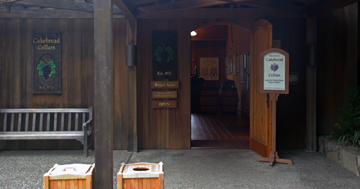
Cakebread Cellars in Napa Valley

Appetizers are great for entertaining friends and family at any time but especially for the holidays. Anyone who enjoys spending some time in the kitchen, crepes and goat cheese will want to try this recipe for Goat Cheese Stuffed Beggar’s Purses that follows from Cakebread Cellars in Napa Valley. This may be one of those recipes that is a “keeper” for your recipe box.

Cheers!
Kathy

Goat Cheese Stuffed Beggar’s Purses

Serves 4-6

Created by Chef Brian Streeter

Ingredients

½ c. + 2 T. all purpose flour
¾ c. milk
2 eggs
2 T. melted butter, plus extra for cooking the crepes
3 T. chives, chopped
pinch salt
6-12 chives
12 oz. goat cheese
1 tsp. tarragon, chopped
½ tsp. flat leaf parsley, chopped
½ tsp. lemon zest
black pepper

Directions

  1. To make the crepes, combine the flour, milk, eggs, butter, chives and salt in a blender jar. 
  2. Puree until smooth, scraping down the sides of the container and process until thoroughly blended. 
  3. Pour the batter into a small pitcher. Cover with plastic wrap and let stand for 1 hour. 
  4. Place a small non-stick skillet over medium heat and add ½ teaspoon butter. 
  5. Lift the pan off the heat and ladle about an ounce of the batter into the pan. Quickly tilt and rotate the pan so that batter covers the entire bottom of the pan with a very thin coating. Return to the heat and cook until the crêpe bubbles and the bottom is lightly browned, about 1 minute. 
  6. Flip the crepe or turn the crêpe over with a spatula. Return the pan to heat and cook the second side until lightly browned. Slide the crêpe onto a plate. Repeat with the remaining crêpe batter. Don’t be discouraged if the first couple of crepes don’t turn out right. It usually takes a couple tries to learn the technique.
  7. Preheat oven to 350ºF. 
  8. Blanch the whole chives in a small saucepan of boiling water for 10 seconds. Drain and run under cold water to stop the cooking. Pat dry with a towel and set aside. 
  9. In a bowl, combine the goat cheese, tarragon, parsley, lemon zest and a little cracked black pepper. Stir to combine.
  10. Lay 6 crepes out on a work surface, pale side up. Refrigerate or freeze the remaining crepes for future use.
  11. Spoon about 2 tablespoons of the goat cheese filling in the center of each crêpe. Gather crêpe around the filling and tie 1 or 2 blanched chives in a knot to close purse. 
  12. Place finished purses on a sheet pan rubbed with softened butter.
  13. Place in the oven to warm slightly for 5 minutes. 
  14. Serve accompanied with your favorite salad.
Suggested wine pairing: Cakebread Cellars Sauvignon Blanc
Recipe provided by Cakebread Cellars in Napa Valley
Wine and Spirits Education Trust Celebrated in NYC with Jancis Robinson MW

Jancis Robinson MW, the renowned wine expert from England, was recently in New York City, for a special dinner for the Wine and Spirits Education Trust (WSET.) Graduates and students of WSET from across the US and Canada attended the dinner at the Manzanilla Spanish Brasserie in Manhattan.

Speakers for the event included WSET Chief Executive Ian Harris and Jancis Robinson MW. Both Harris and Robinson commented on the valuable benefits of WSET. Robinson noted that “Without it (WSET), you just tend to stick to those regions or varieties that you personally like and you risk never being in a position to discover new things.”

With regard of the importance of the United States to WSET Harris said, “Of our total of over 48,000 students last year, ten percent are in the USA, making it our third biggest market after the UK and Greater China. But where Diploma is concerned, the US is our second most important market, and I’m delighted to be able to put on an event here.”

Wine and Spirits Education Trust

The Wine and Spirits Education Trust is a wine education organization. Currently WSET courses are offered in 62 countries and available in 17 languages. WSET covers wine and spirits education from beginners to experts. WSET is one way to learn about geography and history in relationship to wine. Terry wrote a review of the WSET intermediate course that he attended in 2007.

Jancis Robinson, MW

Jancis Robinson, MW is a wine critic journalist and author.  She is the Honorary President of the Wine & Spirit Education Trust (WSET.) A prolific writer, two of her most recent books are American Wine: The Ultimate Companion to the Wines and Wineries of the United States and Wine Grapes – a complete guide to 1,368 vine varieties. Robinson has co-authored The World Atlas of Wine and Wine Grapes. She is also editor of The Oxford Companion to Wine. Robinson’s comprehensive website is at JancisRobinson.com. A portion of the website is free while another area, Purple Pages, requires a paid subscription. She travels widely for wine events.

WSET and Jancis Robinson’s website are just two of many ways to learn about wine. Check them out and see if they meet your wine education needs.


Cheers! Kathy

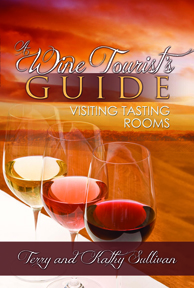
Wednesday Holiday Gift Idea Give a Book: “A Wine Tourist’s Guide: Visiting Tasting Rooms”

The holidays are approaching. Yesterday while in Sears shopping for a rake to use on fallen leaves, I noticed the staff putting up the Christmas decorations. It seems earlier and earlier every year; however, it is November already. You might think that the ideal gift for anyone that likes wine is wine. But there are several advantages of giving our second book that was published last month. You can order our book A Wine Tourist’s Guide: Visiting Tasting Rooms from Amazon and starting today you can order it from the Wine Trail Traveler site along with our first book, A Wine Journey.

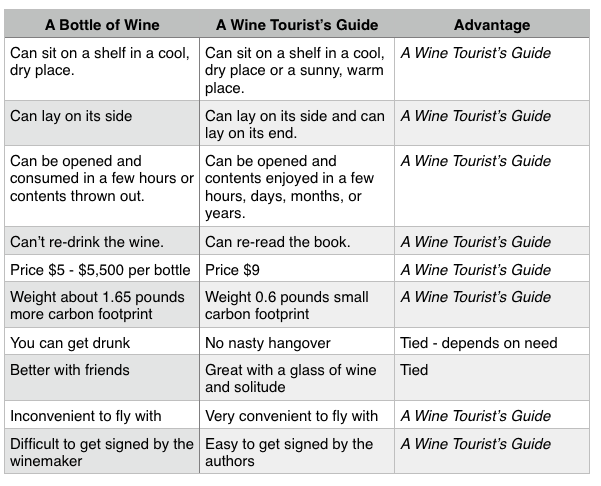
In case you have some doubt as to a book vs a bottle of wine, check out what has the most advantages in the following chart.

The book has many more advantages than a bottle of wine. Order your copy today and have it by next week, in plenty of time for the Holidays.

Cheers,
Terry

Celebrate Thanksgiving with Local Food and Wine

Harwood, Maryland

While planning your Thanksgiving dinner, will you be supporting the eat  and drink local movement? Many people purchase local fresh turkeys, vegetables and fruits so why not consider local wines or hard ciders?

Kevin Atticks, Executive Director, of the Maryland Wineries Association sent out an email with a list of several Maryland wineries producing hard ciders. If you are planning on hosting Thanksgiving Dinner here are his suggestions for locally produced hard ciders.


The wineries and cider list includes:

  • Distillery Lane Ciderworks: Kingston Black
  • Great Shoals Winery: Spencerville Red Hard Apple
  • Millstone Cellars: Bramble
  • Linganore Winecellars: Spiced Apple
  • Loew Vineyards: Apples and Honey
  • Orchid Cellar Winery: Lumberjack

Also the Marylandwine.com website has an article highlighting wines from several Maryland wineries. The article is at http://www.marylandwine.com/news/News-and-Information.

  • Big Cork Vineyards: Chardonnay
  • Basignani Winery: Riesling
  • Port of Leonardtown Winery: Chambourcin Reserve
  • Elk Run Vineyards and Winery: Syrah
  • Crow Farm and Vineyard: Barbera Rosé
In addition, Maryland is home to a boutique winery with the delightful holiday name Thanksgiving Farm Wines. Of course, a bottle of wine with the winery name Thanksgiving Farm would add to the holiday spirit.

Whatever region you live in shop at your local wineries for wines to celebrate Thanksgiving. Every state has a winery!

Cheers,
Kathy

Children’s Free Care Charity Benefit at Grand River Cellars


Grand River Cellars, Madison, Ohio

On November 11, the 10th Annual Children’s Free Care Charity Benefit starts at 5pm at Grand River Cellars.

Included in the event are a homemade spaghetti and meatball dinner, Chinese auction, 50/50, and door prizes.

Tickets are only $10 and available by calling Howard Hanna at 440-428-1818.

The proceeds from the event will help children who have no healthcare pay for their needed medical treatment. Proceeds benefit the University Hospital Rainbow Babies, Cleveland Clinic Children’s Hospital, Metro Health Hospital and Akron Children’s Hospital.

Groups and organizations helping support the Children’s Free Care Charity Benefit include donated foods from Grand River Cellars, Hillcrest Foods, Gordon Food Service and C.A. Curtzee Co. The people working the night of the event are donating their time.

Will you attend the dinner and fun to support children in need?

Grand River Cellars is located in Madison, Ohio.

Cheers! Kathy

Fall is in the Air Time to Start Cooking

I always enjoy cooking in the fall and using ingredients like butternut squash, cranberries, apples, and pumpkin. I’m always on the lookout for turkey recipes, too! Adding wine to recipes is also an option. The recipe below is for Butternut Squash Risotto from Butterball. Check it out as it also uses white wine. Serve the remaining wine with dinner.

Cheers! Kathy

Butternut Squash Risotto

Ingredients

2 tbsp. butter
2 tbsp. olive oil
½ cup finely chopped onion
2 cups chopped butternut squash
1 tsp. saffron threads
2 cups Italian Arborio rice
1 cup dry white wine
6 cups chicken broth
½ cup (2 oz.) grated fresh Parmesan cheese
3 tbsp. coarsely chopped fresh sage leaves
½ cup lightly toasted squash or pumpkin seeds, optional

Directions

  1. Heat the butter and oil together on medium-high heat. Cook and stir onion 5 minutes or until softened.
  2. Stir in the squash and saffron. Cook 4 additional minutes.
  3. Stir in rice and coat evenly with the vegetables.
  4. Stir in the wine. Cook, stirring constantly, 5 to 6 minutes or until the wine is almost completely absorbed.
  5. Gradually add the broth ½ cup broth at a time. Simmer, stirring constantly, until the broth is absorbed by the rice before adding more broth. Continue adding broth and stirring until the rice is creamy and firm but not hard in the center, about 20 to 30 minutes total cooking time.
  6. Remove from heat. Stir in the Parmesan cheese and sage leaves.
  7. Serve garnished with toasted squash or pumpkin seeds.

Recipe provided by Butterball http://www.butterball.com

101 Objects that Made America Includes Wine

A little twist on the words “made in America” can become “made America.” The Smithsonian Institution has 137,000,000 artifacts held by 19 of the museums that make up the Smithsonian. In an article on smithsonian.com, also in the Smithsonian Magazine, 101 objects were identified that made America. Artifacts include the Star Spangled Banner that flew over Fort McHenry during the War of 1812. A little searching of the 101 objects reveals two wines, made in America.

Vineyard at Stag's Leap Wine Cellar

Think for a moment about our history of wine. What are the two most important wines that would be among the elite list of 101 objects that made America? The wines are in the grouping of artifacts that showcase America in the world. The wines are grouped with the Spirit of St Louis from 1927 (Air and Space Museum), a sign from the television series M*A*S*H (American History Museum), an engraving of Pocahontas (Portrait Gallery), a photo of a Giant Panda (National Zoo), a jersey from the 1980, U.S. Olympic Hockey Team (American History Museum) among others. Then there are the two bottles of wine also in the American History Museum.

The wines that made the list of 101 Objects that Made America include the Chardonnay from Chateau Montelena and the Cabernet Sauvignon from Stag’s Leap Wine Cellars that put Napa, California and the United States on the map as a producer of world-class wines. These two wines shocked the French at the 1976 Judgement of Paris, where two California wines beat out all the French competition in the white and red categories. Winemaker Warren Winiarski crafted the Cabernet Sauvignon at Stag’s Leap Wine Cellars in 1973. Mike Grgich was the winemaker at Chateau Montelena who crafted the winning white Chardonnay. The chardonnay may be better known due to the movie Bottle Shock, however the role of Mike Grgich was not emphasized in the movie.

When we reflect on the history of American wine, it was the Judgement of Paris in 1976 that put American wine on the lips of consumers around the world. Patrons in restaurants across America began asking for the winning wines, and restaurants soon had to reach out to the California wineries and inquire about the wines. prior to this event there were not many California wines on wine lists that were dominated by French and other European wines. Things have changed. Those wines should be highlighted in the collection 101 Objects that Made America.

Cheers,
Terry

Wine Related Holiday Gift Ideas: Part 1

It is the last few days of October and I am hearing advertisements for Black Friday. Not only Friday, but this year we are going to have a Black Thursday. So I guess that it isn’t too soon to start thinking of holiday gifts. Of course wine is a great gift for wine enthusiasts. For the next several Wednesdays our blog will feature gift ideas.

You could go to a wine shop and stare at hundreds of bottles screaming, “buy me.” What do you select? Another option is to purchase a wine gift membership through the Wine of the Month Club. The Wine of the Month Club was established in 1972. They evaluate hundreds of wines each month and provide the best for their clients.

You can custom make the gift you want to send. You decide how many months you would like to include in the gift membership and the intervals the deliveries will be made. For example you can send a gift membership for four months with deliveries every three months. You can decide if your gift membership will include one white and one red wine for each shipment or two whites or two reds. There are five different series of membership to choose with prices ranging from $34.00 to $83.00 per month including shipping. The series include:
Classic Series
Vintners Series
Limited Series
California Wine Series
Cellar Series

Check out the Wine of the Month Club’s website for information about club membership for yourself or as a gift. You can also purchase individual bottles of wine at the site’s wine shop and there is an assortment of gift baskets that would also make perfect gifts for the holidays in the gift basket section of the website. While at their website take a moment to view a few of their entertaining videos. The videos are between eight and eleven minutes in length.

Cheers,
Terry

1,000 Wineries/Vineyards: Book Connections

In yesterday’s post I mentioned that it took seven years to visit and write about 1,000 wineries and vineyards. We started writing in 2007. Several years prior to that, we just visited winery tasting rooms because we liked the experience. We never fathomed the idea in 2007 that we would end up making wine at home and at two wineries on the East Coast and a winery in Eastern Europe. Another thing we never thought of in 2007 was that we would someday write a book or books.

The writing phase has three chapters. We write articles about wineries/vineyards and other educational wine related themes. This writing to a degree is formulaic and addresses the who, what, when, where and why. Also in 2007 we started a blog. Blog posts are more opinion related and we noticed we used a different form of writing. Our first book demanded another form of writing. Our challenge was to co-author a book with one voice.

A Wine Journey, 2012

Our first book A Wine Journey, was published in 2012. Although we wrote it over several months that year, it really took six years to accumulate the experiences we related in the book. A Wine Journey encourages ordinary people to learn about wine, make wine and get involved in wine travel. The motivation to write the book came from someone we met at a writer’s conference. At the time of our first book we created several outlines for additional books. They were sidelined in 2013.

A Wine Tourist's Guide: Visiting Tasting Rooms 2013

Our second book, A Wine Tourist’s Guide: Visiting Tasting Rooms was a result of a business partnership between Wine Trail Traveler and a wine travel agency in Montreal, In Vino Veritas. We were exploring things that we could do for the travel agency. We came up with the idea of a book, because the most read article for seven years on our website is Tasting Room Etiquette. Several wineries have asked for permission to use the article. Although we physically wrote the book in five weeks, it also took years of accumulating experiences and wine knowledge. The chapters examine tasting room expectations, etiquette, how to taste a wine, common international grapes, misconceptions about wine and how to find wineries to visit.

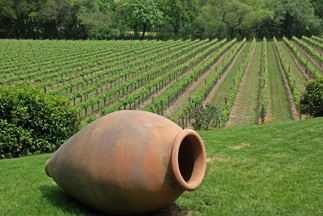
We are now completing the final chapters of our third book: Georgia, Sakartvelo: the Birthplace of Wine. The motivation for this book came as a result of tasting Georgian wines for the last two years and visiting the country for two weeks in September 2013. While in Georgia, we had opportunities to harvest grapes, clean and sanitize a qvevri and make wine in the qvevri. We also believe that the world needs to become aware that wine making and vineyards began 8,000 years ago.

Traveling to and writing about wineries have opened up doors for us. We enjoy the travel, the people we meet and the wines. Travel also afforded us the opportunity to become bloggers, writers and authors.

Cheers,
Terry

Knowledge Gained from Visiting Wineries and Vineyards

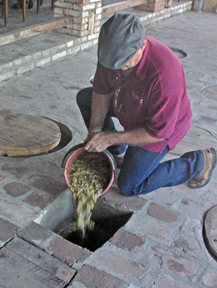
Terry filling a qvevri with Rkatsiteli grapes. The juice will ferment on its skins. The wine will the age on its skins for six months.

You are at a vineyard and notice the rather messy ground. Tall grasses and weeds fill the rows between the vines and many weeds are under the vines. You then visit another vineyard that is very clean. No weeds grow under the vines or between the rows. Impressions without knowing why may lead one to conclude that the clean looking vineyards are the better vineyards. In our travels we have learned that creating biodiversity in a vineyard is best for the vineyard. This biodiversity is not just plant life, but also includes insects. Some vineyards follow biodynamic or organic practices rather than using the herbicide Roundup to keep the vegetation at bay under the vines and between the rows. Other vineyards may frequently plow between the rows and weed whack under the vines. Some may even pull the weeds out by hand.

Wine enthusiasts that travel to wineries and vineyards usually learn a thing or two. Travel to enough wineries and vineyards and you can learn a lot. Kathy and I have visited and written about over 1,000 wineries and vineyards, not a small feat. We have learned a lot in the seven years it took for all those visits. I recall that back in 2007, we did not possess the wine knowledge base that we have today. At that time, I had no idea where our wine journey would lead us. Our journey took off on its own with many twists and turns along the way. For example, in 2008 we thought that if we were writing about wine, we should make wine.

So eventually Kathy and I made a kit wine at home. It taught us what the British wine term “plonk” meant. However, our first winemaking experience led us to make more wines. Eventually we were making wines from high priced kits that were turning out quite nice. Then we made wines from juice followed by making wine from grapes. Our winemaking journey then took a turn; we made wine at Vint Hill Craft Winery in Warrenton, Virginia. At the same time we had an opportunity to join a group and make a wine at Tin Lizzie Wineworks in Clarksville, Maryland. Last year we made a barrel of Cabernet Sauvignon from grapes at Tin Lizzie. This year our travels took us to the country Georgia. We are making a qvevri (earthen vessel buried underground) wine at Twins Wine Cellar of Napareuli. Back in 2007, we never knew that our wine journey would include making wine at home, or at wineries or in Eastern Europe. Travel affords many opportunities to learn. Wine travel will enrich your understanding of wine and may open doors to other experiences.

Cheers,
Terry


info@winetrailtraveler.com            Sitemap                      Privacy Policy

Copyright: Terry and Kathy Sullivan 2006-2013