About     FAQ     Contact      Advertise With Us      Press   

Grand Valley Wines

Many of the Front Range wineries source their grapes from growers in the Grand Valley. Palisade is within this Grand Valley AVA and has several wineries. There are a variety of wines produced from dry whites and reds to the sweeter wines, ports, meads and fruit wines.

For the dry red enthusiasts try the DeBeque Canyon’s Claret. It is a blend of 49 percent Merlot, 40 percent Cabernet Sauvignon, 4 percent Malbec, 4 percent Cabernet Franc and 3 percent Petit Verdot. The color is a deep reddish purple. The taste is fruity and the fruit lingers on the finish. The tannins are mild. I enjoyed this wine in a local restaurant with swordfish.

Varaison Vineyards and Winery only handcrafts a few wines that are all dry. The first thing you’ll notice about their estate Chardonnay is its golden color. There are apples and butter nuances on the nose and the taste and aftertaste are layered with apples, citrus, vanilla and butter.

Garfield Estates’ Syrah is an excellent wine offering blackberries, black cherries and slight earthiness on the aroma and taste. It has mild smooth tannins. This food friendly wine can be paired with many foods including steak as well as stews, pastas and many more.

In Grand Junction, Two Rivers Winery and Chateau makes a Cabernet Sauvignon with a black fruit nose and taste with good tannins. I enjoyed this wine at a local restaurant with Italian pasta. It also would be a great match with steaks and mushrooms.

As we traveled through Colorado, we kept hearing of the best port in Colorado made by Graystone. Graystone winery is just outside Palisade in Clifton. They produce two ports made from a blend of Cabernet Sauvignon and Merlot, and a port made from Pinot Gris. This one caught my eye because of its tawny color. The aroma was port-like with a hint of grapefruit. The port has a dried fruit taste and the finish was crisp and fruity.

Possibly the largest selling wine is a sweet red called Road Kill Red.  It offers a red berry aroma and taste and the taste lingers. This sweet wine is ideal for white wine drinkers who aren’t use to red wines as well as people who prefer a sweeter wine. However it is versatile enough to be enjoyed by dry wine drinkers when paired with food such as fried chicken or chili.

Carlson Vineyards make a fruit wine out of Montmorency cherries. The cherries are grown in Colorado and this wine is sweet and tart. I sampled it in a glass dipped in dark chocolate. When you drink the wine you also get the taste of chocolate and have a chocolate rim on your face. Because of the wine’s sweetness and tartness it can be paired with smoked meats.

Temperatures in the Grand Valley seldom freeze when grapes are on the vine. Making an ice wine is difficult, however Grand River Vineyards did have a chance to do so in 2005. The ice wine has a tropical fruit aroma and taste and the sweetness is cut by the crispness of the finish. There is a long mango, strawberry and melon aftertaste.

The Meadery of the Rockies produces several meads. Their King Arthur has a wildflower and orange blossom aroma. It is sweet but then dries and offers an orange blossom and honey suckle aftertaste.

Colorado is fortunate to have the climate, soil and intense interest of winemakers and grape growers.

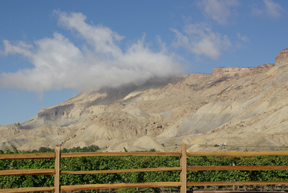
Over the weekend I’ll post some photos of the Grand Valley area. On Monday I’ll write about some of the wineries in the mountain region of Colorado.
Wines in Colorado? Of Course!

With 85 percent of the grapes grown in Colorado’s Western Slope, where are the urban wineries in the Front Range purchasing their grapes? For the majority of these urban wineries, the grapes are sourced from the Western Slope.  The Western Slope has the high altitudes and the right number of degree days to grow excellent grapes for producing Colorado wines.

So you may be wondering, how are the wines? In our visit to 22 wineries in the Front Range and Western Slope, we have discovered many good wines. There really is a wine for everyone’s taste. We have encountered wineries that focus on the traditional, classic wines. While other wineries include slightly sweeter wines and fruit wines hoping to have a wine for everyone who visits their tasting room. Wines we discovered worth trying included Merlot, Cabernet Sauvignon, Cabernet Franc, Riesling and several choices of fruit wines. No matter what kind of wine you enjoy, we believe you will discover that Colorado wines deserve national recognition.

Today we’ll mention just a few of our favorites from Front Range Wineries. The 2006 Ciatano’s Wineries Vino Rosso Cambiani is and excellent blend of Merlot, Cabernet Sauvignon and Cabernet Franc. The aroma and taste is very fruity and the bold tannins give way to fruit on the finish. Balistreri Winery’s Colorado Little Feet Merlot, named Little Feet because children stomped the grapes, had a dark purple color. The aroma was of dark red fruit and the taste was creamy and fruity. The finish was balanced, not hot despite the alcohol level being 15 percent. Tannins were very noticeable on the finish. This wine was simply delicious.

Trail Ridge Winerie’s Gewurztraminer 2007 offered a very aromatic and floral aroma. The taste had apple pie spices including ginger, cloves and there were apple nuances. The finish was crisp, spicy and dry.  Bookcliff Vineyard’s Allegretto, produced from American orange Muscat, had an aroma with orange nuances. The taste was smooth with orange and a slight sweetness. Allegretto dried on the aftertaste.

Augustina’s Winery makes a cherry wine made with 100 percent organic Montmorency cherries. It was an outstanding cherry wine. The cherries are fermented with cold fermentation and the pits and skins of the cherries add additional character to the wine. The finish of this wine was light and fruity. 

These are just a few of the great wines from Colorado’s Front Range wineries. Tomorrow I’ll look at some of the favorite Grand Valley wines.

Is Palisade the Next Napa?

Steve Smith, owner and winemaker of Grand River Vineyards in Palisade, Colorado was instrumental along with others in the development of vineyards and wineries in the Palisade area of the Grand Valley AVA. There are fourteen wineries to visit in this majestic scenic area. However, until recently there were few lodging possibilities. That changed this fall with the opening of the first hotel, the eighty room Wine Country Inn. This inn was built in a vineyard owned by Steve who sold a section of vineyards to Richard and Jean Tally. The Tallys dreamed of a first class hotel built near the wineries in Palisade.

The Wine Country Inn is set on seven and a half acres adjacent to Grand River Vineyards. The inn also has its share of vineyards. Vineyards that had been destroyed by construction equipment have been replanted. The inn is an island surrounded by vineyards. Nearby the Bookcliffs tower over the inn, providing one of the most scenic areas on the planet. The vineyards are used to produce wine for the Wine Country Inn. Presently four wines are made with the Wine Country Inn’s grapes. The Meritage White is a blend of Sauvignon Blanc and Semillon. The wine has a pale light color with a light floral and citrus aroma. The crisp citrus taste dries on the finish. The Ten Acre Red is a blend of Merlot and Cabernet Sauvignon. It presents a blackberry and plum aroma and taste and a fruity finish with soft tannins. The Wine Country Inn also produces a Chardonnay and Merlot.

Palisade, Colorado may very well become the next Napa. It is incredibly beautiful with many vineyards and wineries for people to visit. Now there is a great hotel to meet lodging needs. There are so many wineries within a short distance of the hotel that outdoor enthusiasts may elect to ride bikes to the wineries. Check out this area of Colorado.

Pairing Wineries and Businesses

You’ve heard of pairing wine with food, however in Colorado some wineries are pairing with businesses. Bookcliff Vineyards tasting room in downtown Boulder shares its tasting room space with Belvedere a Belgian Chocolate Shop. Upon entering the room, one sees the shelves of chocolate confectionaries on the side and wines on another side. One option that tasters can pursue is two wine chocolate pairing flights. Local wines are matched with locally made chocolates.

Although pairing food and wine is obvious, pairing a winery with clothes is unique. Trail Ridge Winery in Loveland shares it space with Adobe Designs a boutique clothing shop that also sales home and garden items. Visitors can walk around the retail shop with wine in one hand as they peruse unique and charming items.

Two Denver Wineries Are Local Favorites

Although the beautiful countryside is often a setting for wineries and vineyards, don’t cast out cities as a site for urban wineries. We visited two Denver wineries and enjoyed the labors of local winemakers.

We met Paul Bonacquisti owner and winemaker for Bonacquisti Winery in the Denver community of Sunnyside. Paul lives in Sunnyside and creates a wine he labels Sunnyside. The 2007 Sunnyside was a blend of Sauvignon Blanc, Chardonnay and Muscat Canelli. The aroma and taste was citrus especially grapefruit. It was crisp and had a long grapefruit aftertaste. This refreshing wine is supported by the community. In addition to wine, local artists display the work at the winery. In a short time the winery has become a fixture in the community.

Reaching out to the community is second nature to John and daughter Julie Balistreri of Balistreri a winery only a ten minute drive from Bonacquisti. Both John and Julie make wine in a somewhat unique way. All their wines are made with natural yeasts, no sulphites added, and there is no racking, fining or filtering. The results are excellent wines. One in particular is the 2007 Colorado Little Feet Merlot. Grapes for this wine were stomped by children aged three to twelve. Over 1427 children stomped on 8000 pounds of grapes. The children had a great time, so much so that their parents wanted to also help crush the grapes, but the stomp was limited to little feet. Some of the parents buy futures of the wine for themselves and sometimes they’ll buy the wine for their children and let it age until they reach 21.

Some may cringe at the thought of wine crushed by so many children’s’ feet. However this is an excellent wine that if you happen to be at the Denver International Airport, you should make the 25-minute drive to Balistreri to purchase it. The dark purple Merlot had a black fruit aroma with a creamy fruity taste. The big fruit and big tannin finish was delightful and well balanced. Although the alcohol was 15 percent it wasn’t hot.

A few surprises about Colorado wines is their ability to have high brix levels in the grapes. Many wines are 15 percent alcohol or greater and many we’ve tasted we balanced and you don’t notice the alcohol levels.

Black Ankle Vineyards Opens Today

If you happen to travel on Interstate 70 in Maryland, today, don’t pass up an opportunity to stop at Black Ankle Vineyards for a tasting at their green tasting room. The tasting room opens today for the first time. The structure is amazing. Bales of straw are used for insulation and a living roof helps with water run off and insulation. The wines have been aging for years and are ready for your enjoyment.

Hours of operation are:
Wednesday – Friday: 12pm – 5pm
Saturday: 12pm – 6pm
Sunday: 12pm – 5pm

Wine Trail Traveler article

Black Ankle Vineyards Green Tasting room article

Wine Website Focuses on Drinking Local Wines

A new website http://www.drinklocalwine.com/ is set to debut next week. The emphasis on this site is to encourage consumers to drink their local wines. One statement we often hear at wineries is, “The community doesn’t know they have a winery in their own backyard.” Getting the community to accept and support a local winery is a challenge met by many wineries. Some wineries embrace the challenge wholeheartedly.

As written in yesterday’s blog, The Winery at Holy Cross Abbey in Cañon City Colorado produces a community wine made from grapes that over 100 families in the community grow and bring to the winery.

Childress Winery in Lexington, North Carolina listened to their community when the community asked for a wine that would pair with the community’s famous pork barbeque. The winery answered with a wine called “Fine Swine Wine.” It is only sold on the day of the Lexington Barbecue Festival in October. Last year the five hundred cases were sold out by early afternoon.

Fulkerson Winery in Dundee, New York reaches out to the home winemakers in their community, of which there are many. Each year Fulkerson crushes grapes and notifies the local home winemakers that juice is available for them to purchase. Fulkerson Winery has over 5000 local winemakers on their email list. Although many buy the juice to make wine, there are those who buy the juice and freeze it, then drink the unfermented juice. Some in the community enjoy the taste of grape juice made from wine grapes.

When Does a Local Winery Become a Community’s Winery?

If you own a winery, you know you have done something right when the local community refers to your winery as “their” winery. This is the case in Cañon City, Colorado. Owner Matt and Sally Cookson, The Winery at Holy Cross Abbey, produce an unusual wine that creates a lot of enthusiasm in the community. The Cookson’s create a rosé table wine from different grapes brought in by members of the community. The minimum requirement is twenty pounds of grapes. In 2007, over 100 families brought grapes to the winery to go into the production of Wild Cañon Harvest. That number is expected to increase in 2008. Organizations such as Girl Scout troops and 4H Clubs also brought grapes to the winery.

In addition to making a true community wine, the Cookson’s are also collecting data about the grape varieties that grow in the Cañon City area.  If residents are interested in planting grapes, they can tell them the varieties that are planted and doing well. With the thousands of grape varieties available this is very helpful information.

Wine Trail Traveler article about the Winery at Holy Cross Abbey

The Winery at Holy Cross Abbey website

Eat and Drink Regionally

October is a month of harvest and bounty. All kinds of fruit and vegetables are available locally at farms, farmer markets and some grocery stores. The 2007 vintage wines are available at local wineries. Why the push to buy locally?

One reason is that locally grown foods taste better. They are harvested closer to the time they are ripe since they generally do not need to travel hundreds or thousands of miles to a seller. Wines produced from locally grown grapes show the terroir of an area. When you purchase local products, you reduce the carbon footprint of the those items. There is a higher carbon footprint to purchase wines from regions around the world as opposed to purchasing wine produced locally.

During the week of October 6th, many wine bloggers are going to write about local wines. Wine Trail Traveler is going to cover wines and wineries from Colorado. In 2007,  there were 72 wineries in Colorado and the number is increasing. Most of the vineyards are planted between 4000 and 7000 feet high. Colorado is an up and coming wine region that we will continue hearing more about.

Changes at Copia

Copia: The American Center for Wine Food and the Arts is a large facility devoted to food and wine. Despite the support of Robert Mondavi, the Copia center has been losing money over the years. Recently, cuts have been announced including staff and hours.

It was interesting to learn that they intend to expand by opening a satellite location in San Francisco. Is this symptomatic of the bailout plan that the US government is attempting to push on to people without explaining it fully? Isn’t it rather presumptuous that a company with a vast amount of startup money, finds itself continually losing more and then decides to open a “satellite” location?

I remember reading last year that some people were suggesting that the location of Copia was a problem. When people visit California, they want to visit wineries and experience wine country. Are they sure that the satellite proposed in San Francisco is a “good” location?

Perhaps Copia should focus on their current location and what they can do to increase its use by the public. Whether or not Copia goes through with this new venture, I wish them and their staff the best.

Want to learn more about Copia? Visit the Copia article on Wine Trail Traveler.
Click here for more information about Copia in the news.


info@winetrailtraveler.com            Sitemap                      Privacy Policy

Copyright: Terry and Kathy Sullivan 2006-2013