September 29, 2008 – 1:42 pm
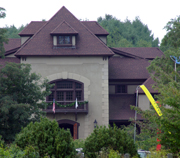 We recently visited Château Morrisette located in the little heard of Rocky Knob Appellation. According to Appellation America, only two other wineries are located in that appellation, Villa Appalaccia and Petit Chateau Winery.
On our visit to Château Morrisette, one staff member referred to Château Morrisette as a “castle in the mountains.” The location of the winery and its architecture inspire one to conjure up fairytales or to think of Hans Christen Andersen tales.
Located just off the Blue Ridge Parkway near milepost 172, Château Morrisette is a destination stop. The winery offers visitors good wines, an array of gifts to choose from and an onsite restaurant.
With salvaged timbers from the St. Lawrence Seaway and a warehouse in Washington, the winery is environmentally friendly and has used old to create new.
What wineries have you visited that use salvaged timbers in their construction?
September 24, 2008 – 3:03 pm
As we travel across the country visiting wineries and writing about the winery “experience” we come across family owned farms that once were worried about development overtaking their farm lands. Intent to keep the property in the family, they consider the options available. With today’s industrialized farming methods, it’s difficult for the smaller farms to continue.
We’ve discovered a number of farms that have turned to vineyards. After much research and perhaps planting a few vines to test the idea, small farm farmers are planting a few acres. One of the difficulties in changing a farm to a vineyard is the upstart cost and that the vineyards normally don’t begin to produce well for about five years. On the upside of things, once the vineyards are established, with proper care they will survive for decades. Some vineyards remain as vineyards and the farmers sell their grapes to wineries. Occasionally, vineyard owners decide to establish a winery. Gord Mitchell, owner and vineyard manager for Sprucewood Shores Estate Winery in Ontario’s Lake Erie North Shore use to sell grapes to nearby wineries. Those wineries kept winning medals for years using Gord’s grapes. Gord recently established a winery and opened the tasting room in 2006.
Frank Hobson, RagApple Lassie Winery and Vineyards in the Yadkin Valley region of North Carolina use to grow tobacco. He replaced the tobacco with vineyards and now makes excellent wines.
West Wind Farm Vineyards and Winery located in southern Virginia is another winery we recently visited. As the owners saw development encroaching upon their region, they decided to take action by planting a vineyard. Today they are producing wines including: Pinot Gris, Chambourcin and Cabernet Sauvignon.
Either way, the family farm stays in the family.
September 22, 2008 – 12:28 pm
As we travel from winery to winery, we notice an array of structures used for wineries and tasting rooms. Some are built specifically to house a winery and can vary from the opulent, often Tuscan-style building down to a simple building with one or two rooms. In its own way, each winery shows its own passion for wine.
Fascinating are the wineries that make use of old structures and rather than destroying what is structurally sound, a building is renovated into a useable facility to house a winery and tasting room. Frequently dairy barns are renovated. In North Carolina, Laurel Gray Vineyards is in a renovated “milking parlor.” Other unusual structures renovated for winery use are tobacco barns, historic homes and bank barns. We have visited wineries in towns that were originally a brick ice warehouse, slaughterhouse, and mercantile buildings.
When visiting a winery to taste their wines, ask about the building in which it is located. You can discover a sense of history that adds even more to your wine tasting experience. Have you visited any unusual renovated buildings?
September 19, 2008 – 11:24 am
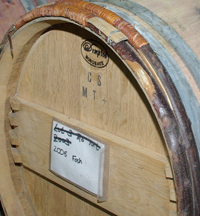 The Internet is quite interesting. Connections are made where one may never thought to have looked. Recently a link to Barrel Making, one of the Wine Trail Traveler learning modules, was made from the blog Avebury Chat. Avebury is a village about 84 miles west of London. When I searched the forum for wine, the word swine appeared in several discussions. When I think about swine and wine, I do see a connection between swine and a bottle of Chianti. The discussion at hand though led to a question of wooden hoops used on barrels instead of metal hoops.
My understanding is that wooden hoops today are used more for aesthetic purposes. At one time however, cellar masters, to watch for signs of insects and rodents, may have used barrels with wooden hoops. The wood used for a hoop is softer than the wooden staves of the barrel. Insects and rodents will chew on the softer wood first, thereby giving the cellar master a heads up to a potential problem.
September 18, 2008 – 12:41 pm
In 2007, Wine Trail Traveler visited wineries in North Carolina along the coast and in the Piedmont area. At many of the wineries, staff advised us, “You have to visit Yadkin Valley.” By spring 2008, another AVA was established within the Yadkin Valley AVA – Swan Creek. Swan Creek AVA currently consists of five wineries: Buck Shoals Vineyard, Dobbins Creek Vineyards, Laurel Gray Vineyards, Raffaldini Vineyards, Winery, and Shadow Spring Vineyard. These wineries are also part of the Yadkin Valley AVA that was established in 2003.
How should the wineries located in both AVAs label their wines? Yadkin Valley has more name recognition however Swan Creek wineries have a different terroir and could use that in their marketing strategy.
In any event, we discovered that the wineries we visited in Swan Creek AVA offer delicious vitis vinifera wines. Since we had traveled to Italian wineries last year, we were delighted to taste some very good Sangiovese and Chianti style wines.
With beautiful scenery, friendly staffs and delicious wines, Swan Creek AVA is definitely a great place to visit.
September 17, 2008 – 12:58 pm
Winery tasting rooms can affect community neighborhoods in positive ways. Visitors to area tasting rooms may need lodging whether traditional hotels or bed and breakfasts. Stores selling touristy items will also benefit. However, we have discovered a unique idea that we wish more winery tasting rooms would take advantage of – local artists. While many tasting rooms offer local paintings and some offer locally created pottery, we discovered a small winery in southwestern Virginia where the tasting room is actually a whole lot more. At Rural Retreat Winery and Vineyards , the tasting room is a combination of a deli with seating, consignment shop featuring locally made items and a tasting counter. In fact, beautiful woven scarves were available and the owner of the Rural Retreat told us that the creator of these scarves spun, dyed the wool and created the scarves. These are great sellers.
Other items available in the consignment part of the tasting room included: pottery, specially woven baskets, baby wreaths, and jewelry. Every time an item is sold, it benefits the creator and the winery. We hope more wine tasting rooms will consider setting aside an area for their community to share their creative arts.
-1.5in.jpg)


“We Don’t Serve Teens” House Resolution 1042
The U.S. House of Representatives passed House Resolution 1042 in recognition of the campaign, “We Don’t Serve Teens.” Sponsored by the Federal Trade Commission and supported by public officials and private individuals, the campaign was designed to decrease underage drinking. Visit the “We Don’t Serve Teens” website at http://www.dontserveteens.gov/ to view informative information including statistics.
It was interesting to note that at one winery, Raffaldini Vineyards & Winery, we visited recently in North Carolina, every visitor must show a photo ID. We were past the age of looking under 21 and we still needed to show ID. According to their website, “To encourage responsible enjoyment of our wines, we ask that you have photo ID available to present to our staff.”
In recent months, a group of college presidents has proposed lowering the legal drinking age from 21 to 18. They believe that the current age of 21 encourages binge drinking.
How do you feel about the drinking age? Should 18 year olds be allowed to drink responsibly?