About     FAQ     Contact      Advertise With Us      Press   

Urban Wineries in Restored City Buildings

As I mentioned in yesterday’s blog, urban wineries create an easily available experience for urban dwellers. Urban wineries also may make use of restoring older buildings rather than razing and building anew.

Winemaking has a long history behind it and it seems appropriate that new wineries use available historical buildings. Preservation of the past has benefits for today’s society. We have visited several urban wineries that winemakers established in buildings 50 to 100 years old.

Examples of these preservationist wineries include Pentamere Winery in Michigan, St. Michael’s in Maryland, Frederick Cellars in Maryland and Old North State in North Carolina. Check out these articles for detailed information about these wineries.

Pentamere Winery in Tecumseh, Michigan was the location for the Anderson dry grocery built in 1871. Later the building became a clothing store followed by a diner. The Pentamere Winery partners purchased the building in 2000.

St. Michaels Winery located in the tourist town of St. Michaels, Maryland is making use of an abandoned flour mill. Tourists and residents enjoy stopping by St. Michaels for a tasting and winery events.

Converted from a brick 1904 ice warehouse, in addition to the tasting counter Frederick Cellars has a small stage for entertainment. Check out their entertainment schedule.

Old North State Winery in Mt. Airy, North Carolina combines a winery and restaurant in a restored 1890’s mercantile building. Prior to the mercantile, the building was a hardware store. The site was also believed to have been a saloon. By the way Mt. Airy, was home to Andy Griffith.

When you visit an urban winery, take note of what the building may have been in a previous time period. How much of the building still keeps its original character. You may be very pleasantly surprised. All of the above wineries benefit from foot traffic.

What’s the most intriguing renovated urban winery you have visited? Email me at kathy (at) winetrailtraveler.com.
Urban Wineries

Urban wineries are a unique opportunity for the public to taste wines and learn about wine production. Depending on their exact location, urban wineries also benefit from passing foot traffic.

The biggest benefit of urban wineries is that they allow more people to visit a winery without traveling far thereby saving gas and time. If you aren’t able to visit a winery with vineyards, I suggest you visit an urban winery near you. You will find an enthusiasm for winemaking just as at other traditional wineries. You are likely to discover a winery that has space for public and private events, entertainment, and/or food. Every urban winery offers a unique experience for visitors. If you are concerned about terroir and “taste the place” you may want to find out before you visit where the urban winery is sourcing its grapes.

Tomorrow, I will be blogging about three urban wineries that are making use of restored buildings. On Friday I will blog about wineries in industrial parks.

If you know of an urban winery, please email me at kathy (at) winetrailtraveler.com.
What’s the Best Way to Buy Wine?

What’s the best way to buy wine? While there is no right answer for all people, here are some ideas to think about. Personally, I like to purchase wine directly from a winery I visit. There is something about remembering the experience and the occasion of visiting a winery. Will it cause you to remember the winery tasting room, vineyards, staff, camaraderie with other visitors or the landscape? Whatever you remember will add to the experience of tasting the wine as you pair it with dinner or sip it after dinner.

If you can’t buy wine at a local winery, consider joining a club membership. There are many different wine club memberships. Some wineries charge for a membership while others do not charge. Benefits vary from winery to winery but usually include several wine shipments to your home. Unfortunately due to archaic laws in some states, some consumers in the US are unable to avail themselves of this opportunity.

Consider becoming involved with a barrel program. Some wineries encourage people to purchase an oak barrel and they are rewarded with benefits. Benefits vary with each winery. For an example of a barrel program, visit The Winery at La Grange in Virginia for details.

Wine stores can be a good source of wine and if you’re looking for wine outside of the US, a good wine store is the place to go. We have two local wine stores that I consider to be good, because the owners are very knowledgeable about the wines in their stores. If you are looking for a wine to pair with a particular food, just mention it and they can quickly guide you to a selection of wines. Curious about a wine you heard about but not tasted, the owners are not afraid of telling you what they really think about the wine. Compare that to walking into a wine store where the staff members don’t know much about wine and just want to make a sale. Choose your wine store carefully.

You will most likely discover that one of the most expensive ways to purchase a bottle of wine is at a restaurant where prices may be three times what you expect to pay. Consider purchasing a wine and enjoying it with a home cooked meal and candlelight.

Sounds good to me.

Restaurants Should Stock Local Wines

Located on Rt. 13 in Salisbury Maryland, Chesapaeake Steakhouse offers a wonderful menu with a fine selection. Noting a small sign that with a list of a few wines, Kathy asked the waiter if they had any local wines. His response was that they have a Beringer. That winery is about 3000 miles away, not quite what I’d consider local from Maryland. European vineyards are just 3600 miles from Maryland. On the other hand, the closest Maryland winery is less than 15 miles away.


There seems to be some confusion about the difference between drink local and drink domestic. It appears that many restaurant employees do not know the difference. Some restaurateurs are not even aware of local wineries and the wines they produce. It appears to be easier to just accept a wine list that someone else has developed and then use only that list with customers. This procedure may have been acceptable a few years ago, but today’s wine drinkers are more intelligent about wine than previous generations.


The eat local and drink local movements are becoming more popular and should not be ignored. Drink local wines means using wines from wineries that are within close proximity as opposed to wineries that are 3000 or more miles away. Not only does this close proximity give wine drinkers a “taste the place” experience but it also affects the environment. What is the carbon footprint for transporting wine from the west coast to the east coast compared to the carbon footprint of transporting wine from an instate winery? One can make the argument that transporting a case of wine fifteen miles has a higher carbon footprint than transporting thousands of cases thousands of miles.


Restaurants often make the claim that the customers are unaware of local wines, so they only stock wines from well known regions. It would be refreshing if a waiter could say, “We carry some local wines, you might be interested in discovering what a Cabernet Franc from Maryland vineyards tastes like.” As the number of people who want to taste local foods and wines increase, restaurants should explore the local wines.

Wine and Food, the Perfect Tasting

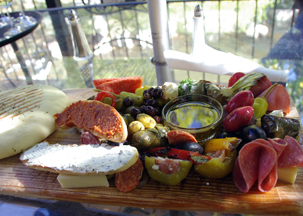
Our last stop in Colorado was Creekside Cellars Winery & Italian Café in Evergreen. This charming town is about an hour’s drive from Denver International Airport, but seems a world apart. During our travels in 2008 we’ve come across more wineries with restaurants than we did in 2007. We think this is a good idea since wine itself is a food. It was the lunch hour and we ordered the Italian Antipasto Platter. An array of colors and flavors was eye catching and flavorful especially with a glass of Creekside wine. The imported cheeses, olives, meats and vegetables were served with fresh focaccia and dipping oil. Perfect for an everyday meal or a celebration. Our wine tasting and food platter took us about three hours. This was the perfect closing to our second trek into Colorado wine country.

When it comes to pairing food and wine I’m not big on rules. I select a wine that I like to drink with whatever food I have. We tasted several Creekside Cellars wines and they all matched with something on the antipasto platter. The dynamics of sharing wine and food with friends is where the magic comes into play. Too often in tasting rooms only one of the three is present, wine, and the taste seems to be missing something. If you visit a winery that has a restaurant, spend the time to combine food with your wine. It is a much different experience.

Red Rose Café only Carries Local Wines

The Red Rose Café in Palisade, Colorado only carries wines from local wineries. Twenty-seven wines from wineries in the Grand Valley are represented in this Italian, Vietnamese and American Cuisine restaurant. Tom and Rose Casabona operate this family restaurant. According to Rose, “We want to support the local wineries.” They also support the local agriculture in the area purchasing much of the food locally. A visitor can really experience the “taste the place.”

This was my second time I’ve eaten at the café and both times I decided to go with one of the daily specials. I ordered swordfish and with it I decided to pair the DeBeque Canyon Winery’s Claret. The Claret was a blend of 49 percent Merlot, 40 percent Cabernet Sauvignon, 4 percent Malbec, 4 percent Cabernet Franc and 3 percent Petit Verdot. The color was a deep reddish purple. The taste was fruity, lingering on the finish. The tannins were mild. Even though I had swordfish, I like red wines with dinner. The wine and fish matched nicely.

I believe it is important to point out that not all Colorado restaurants offer local wines made with Colorado grapes. One restaurateur, who carries some local wines, admitted that the wineries need to approach him about their wines. I’ve also heard that the reason a restaurant doesn’t carry local wines is that their customers want something that they are familiar with, i.e. wines from California. I think the American palate is changing though, and people are willing to try wines from the region. The excuse of drink familiar rather than drink local is somewhat misguided in this day and age. What do you think?

Discover Local Colorado Restaurants that Carry Colorado Wines

As we travel to wineries we are surprised at the number of restaurants that do and do not carry local wines. II Bistro Italiano in Grand Junction, Colorado has a six page wine list with many wines from Italy, not surprising for an Italian restaurant. A quarter of a page was a listing of local Colorado wines from Plum Creek Winery, Carlson Winery, Two Rivers Winery and Bookcliff Vineyards.  For dinner we settled on the local wines and I ordered a Cabernet Sauvignon from Two Rivers Winery to pair with Puttanesca, a Southern Italy pasta with a sauce of fresh tomatoes, anchovies, capers and olives. Personally although I can drink and enjoy any wine, frequently I have a Cabernet Sauvignon with meals. This Cabernet didn’t disappoint.

Kathy had the traditional lasagna made with spinach pasta and a meat sauce. She had a glass of Plum Creek Palisade Rosé which was too sweet for my tastes especially with Italian food but the wine did work well as a before dinner wine.

When visiting a restaurant inquire about local wines and local foods. Try to challenge yourselves to taste the place.

October – Virginia Wine Month – Reminder

Wineries in Virginia are busy celebrating Virginia wines during October with a variety of activities for visitors.

Recently I received an email from Chateau O’Brien in Virginia about an additional promotion they are having for the whole month of October. “October is Virginia Wine Month. In celebration, Chateau O’Brien at Northpoint is offering a special promotion for the whole month of October. Purchase a case of wine (12 bottles – mix/match) and be entered in a drawing for a beach house getaway in the Outer Banks (1 week stay).” Be sure to check out this special promotion.

If you live in Virginia or will be visiting Virginia during October, check out our Virginia winery partners. We visited all of these fine wineries. You will enjoy a visit to them. Our partners in Virginia include: Barrel Oak Winery, Chateau O’Brien at Northpoint, Pearmund Cellars, The Winery at La Grange and Veritas Vineyard and Winery.

Since no two wineries are alike and each visit offers unique perspectives on winemaking, wine varieties and events, consider visiting several wineries during the month of October. You will be glad you did.

Here is a coupon for a complimentary wine tasting at Barrel Oak Winery, Virginia.

Other events you will find at various wineries throughout Virginia include winemaker dinners, Halloween activities, movies, picnics with food baskets, and murder mystery nights. The Virginia wineries are creative in coming up with new activities each month. Be sure to check them out.

Other states featuring October as wine month include Texas and New York State.

Colorado’s Mountain Wineries

Some of Colorado’s wineries that are placed in the Front Range group of wineries, however are really in the mountains. One case is Creekside Cellars in the beautiful town of Evergreen. The winery produces wine in Evergreen at an elevation of 7200 feet and they own vineyards in the Grand Valley area of Colorado. This is a great winery to visit. There is an Italian Restaurant in the same room as the tasting counter and visitors can taste wines, purchase a flight that includes food or have a glass of wine with a meal.  The wines are great. The reds are bold and not skimpish on the tannins. Two favorites include the 2005 Cabernet Franc and the 2005 Robusto. The 2005 Cabernet Franc presented a black fruit aroma and taste with tannins. This wine was a gold medal winner. Robusto 2005, a blend of Cabernet Sauvignon and Cabernet Franc, had black fruit nuances and tannins. These two wines paired well with the antipasto platter.

The tourist town of Estes Park near an entrance to Rocky Mountain National Park has two winery tasting rooms. You can walk the ten-minute walk from one tasting room to the other while enjoying the views of a stream and mountains. Snowy Peaks Winery and tasting room are in the same building. One wine of interest was the 2006 Élevé, a blend of Syrah, Mourvedre, Cinsault and Viognier grapes. The resulting aroma was blackberries, licorice and earthiness. The taste was fruity and the finish was crisp, with tannins and fruit. Valley of the Wind Winery’s tasting room is located next to a mountain. A deck makes the perfect spot to enjoy a glass of wine. Of note was the Viognier Blend Garfield’S2 which was a blend of Viognier and Semillon. This was a dry white wine with a pale yellow color. The aroma had floral and honey nuances. The taste was smooth and light, with a long finish and nuances of honey. Suggested pairings included oriental, spicy Thai and Mexican foods.

In Salida, Mountain Spirit Winery has two tasting rooms. One at the winery and the other on US Highway 50 which also has an artists gallery and restaurant. A wine enjoyed was the 2004 Chardonnay that was aged in oak for nine months. The result was a crisp wine with light oak on the finish. Another wine was a blend of Riesling and Chardonnay. This wine had a light residual sugar with a long aftertaste. It would be lovely for a hot summer day and would pair well with quiche.

These mountain wineries and tasting rooms provide visitors with many wines and food possibilities. It is easy to spend one to several hours taking in the scenic beauty and aromas and flavors of food and wines.

Grand Valley, Colorado Photos

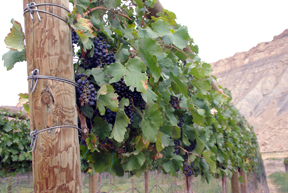
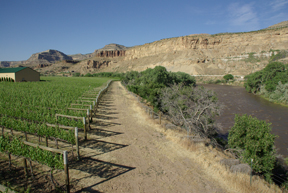
In addition to very good wines the Grand Valley area of Colorado offers stunning views of vineyards and their backgrounds. The first photo was taken at Canyon Wind Cellars. The Colorado River flows pass these vineyards at 4710 feet above sea level.


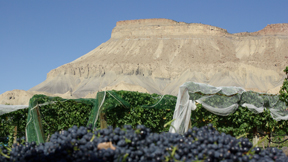
Harvest time at Garfield Estate Winery shows Mount Garfield in the background. In the foreground grapes are ready for the crush. Netting is used to protect the grapes from birds.


Grand River Vineyards has grapes nearing harvest. The Bookcliffs provide the background for these vines. This section of vineyard will be harvested as late as possible to allow the sugars to increase in the grapes. During harvest season, visitors may sample these grapes from the vine.


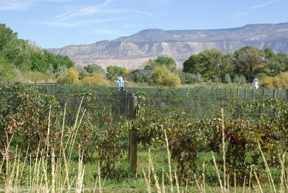
A couple of scarecrows stand guard over the vineyard at Graystone Vineyards. The Grand Mesa provides a background. Graystone makes three wonderful ports.


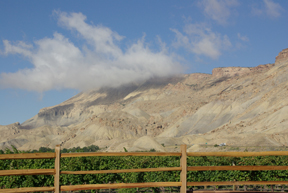
Next to the Wine Country Inn the vineyard basks in the sunlight. A stray cloud drifts towards the Bookcliffs. The natural beauty of the area adds to the landscape of vineyards. Although grapes are grown between 4000 and 6000 feet, they mature and often have high sugar levels at harvest time.


info@winetrailtraveler.com            Sitemap                      Privacy Policy

Copyright: Terry and Kathy Sullivan 2006-2013