About     FAQ     Contact      Advertise With Us      Press   

August Newsletter from Wine Trail Traveler

Wine Trail Traveler publishes a monthly newsletter. Topics include anything related to wine, wineries and vineyards. This month’s newsletter focuses on visiting wineries near to home. A review is included of Garlic Mike’s restaurant in Colorado where a wonderful food and wine pairing occurred. It was a terrific dinner, ambiance and conversation. Are you looking for a Shish Kabob recipe? Check out the recipe from Cottonwood Cellars. The August newsletter can be viewed at http://www.winetrailtraveler.com/newsletter/newsletter.html.

If you have any ideas you would like added to the Wine Trail Traveler newsletter, let me know by adding a comment to this blog.
Cheers!
Kathy

Muscadine Wine

Last night for dinner, we decided to experiment with a food and wine pairing. We chose to have a sweet wine with dinner as one of our family members likes a sweet, white wine. Our choice was Midnight Magnolia from Duplin Estate Wines in North Carolina. According to the label this is a Mid Harvest White Table Wine. A member of the muscadine family (V. rotundifolia,) Magnolia is an early, bronze grape, suitable for juice or wine. Midnight Magnolia is medium to heavy bodied and semi-sweet on taste.

For dinner we were having tacos and all the fixings. I know what you’re thinking why in the world would you pair a sweet wine with tacos? We like to experiment with pairings and usually they work out because we are drinking a wine we like. However, in this case the body of the wine was too heavy and the wine was too sweet. Most likely a dry white wine would have enhanced the flavor of the tacos. What food mismatches have you tried?

“Acquired” Taste of Wines

How many times have you been told a wine is an “acquired taste?” Traditionally many wine connoisseurs say that consumers start drinking white, sweet wine and gradually move on to red wines. For myself, I started with sweet fruit wines, and now I can appreciate a dry, red wine with an Italian dinner or sizzling steak, hot off the grill. However, when I want a wine to sip and relax with, a sweet fruit wine is my favorite. I suppose one could say I “acquired” a taste for dry, red wines.

More specifically, two other wines come to mind when I hear the words “acquired” taste: Scuppernong and Rechina. While visiting wineries in North Carolina, we discovered Scuppernong. Scuppernong does not grow in colder climates and has a foxy taste to it. Some, including myself, believe it has a similar but different taste than Niagara. Wineries we came across continually proclaimed the health benefits of Scuppernong wine due to its high antioxidant levels.

In Virginia, we discovered Rechina, an Americanized version of Retsina, at Mediterranean Cellars. It was unique with a resinated character. We talked to a neighborhood wine storeowner and were told that it is an “acquired” taste. If you have a chance, give it a try.

Tasting wines can be a great adventure. When you have the opportunity, try different wines even though you might be told they have an “acquired” taste. Sipping a variety of different wines opens up your taste buds from the mundane everyday wines to the exotic and makes tasting wines an adventure. Have you tried Scuppernong or Rechina? What wines have you had that you believe have an “acquired” taste?

Apologize for Liking Sweet Wine?

Whenever we gather with a group of friends discussion eventually comes to wine. Almost apologetically someone mentioned that she has tried many wines and prefers to drink only sweet wines. Most of the others in the group indicated that they would drink sweet wines although the preferences were to drier reds. Why would one need to apologize for drinking what they like?

Part of your wine journey is to search for the wines you like. If you keep an open mind along the journey and try many different wines, what types of wine you enjoy is a personal choice. No one has a right to tell you not to drink any particular wine. If you like a sweet wine then drink a sweet wine. If you like a dry wine then drink a dry wine.

Most wine and food pairing charts are suggestive in nature. Often the suggestion is to drink what you like. Although there are sound reasons behind the suggestions in wine pairing charts, what you like trumps all of those suggestions. Challenges arise when two or more people share a meal and they each have their own wine favorites. Look at this as an opportunity to try something new and different and see how the food and wine complement each other.

You also have an opportunity to explore different wines by visiting wineries in your community and as you travel. Most wineries have tasting rooms and you often can taste a wide range of their portfolio. Other tasting rooms limit tasting to five or six wines, if you go with another person you can double that number and share. When in a tasting room, don’t limit yourself to the types of wine you know you like, explore other wines. If you don’t like them, that’s fine. The experience is your wine journey. Wines that you don’t like are just as important as wines that you do like. There are always surprises. I am not a big fan of a single varietal Cabernet Franc. I like it in a blend but not as the single variety. While visiting wineries in Ontario, I had the opportunity to taste Cabernet Franc icewines. They were wonderful. So I discovered an exception.  Be open to discovering exceptions.
Buyer Beware

An article on Decanter.com this week discusses the temperatures in stores where wine is sold. In particular, the article is referencing England. Here in the United States, we also seem to have difficulty guaranteeing that wines will be kept in a controlled environment.

As one winemaker said to me, “I can almost guarantee that the wine is good when it leaves the winery door, but not what happens to it once it leaves.” What happens if the truck breaks down on a hot summer day between the winery and the delivery point?

You have probably noticed that wine stores vary a great deal. Some are established to just sell wine and beer off the shelves. Others are knowledgeable and seek to have their customers return time after time. They are concerned about protecting the quality of the wine.

On the downside, we became aware of a store that did not have air conditioning in one room and yet was storing bottles of wine there that were worth several hundred dollars. It would be sold to some unsuspecting customer.

How do you protect yourself? Whether you purchase wine in a grocery store, liquor store or winery, if it has a wine fault, return it. Wine faults include wine that has an aroma or taste of rotten apple, glue, vinegar, soap, onion, cauliflower or moldy cardboard (cork taint.) After tasting the wine, if it has a fault, return it to the place of purchase. Leave the rest of the wine in the bottle. It looks a little suspicious if you return an empty bottle saying it’s corked or has some other fault. Where did the wine go? Just because you don’t like a wine doesn’t mean it has a fault. It’s not fair to others if you return a wine just because you don’t like it. What do you do when you discover you have purchased a wine with a fault?

Sustainability in the Vineyard

A recent article in Wines & Vines talks about what the Central Coast Vineyard Team is doing in terms of sustainability. In part, the CCVT mission statement states they “will identify and promote the most environmentally safe, viticulturally and economically sustainable farming methods, while maintaining or improving quality and flavor of wine grapes.” Certainly, these are very laudable goals.

In 1996, CCVT established a Point System for vineyards to help the growers monitor their own progress towards sustainability. By 2002, members began to discuss the idea of changing to a third party evaluation.

The result of these discussions and planning is the establishment of a pilot program this summer. By following standards, providing documentation and submitting to a third party auditor. CCVT is hopeful that by 2009, wines labeled with “Certified Sustainably Grown” fruit will be available for consumers.

Obviously, a lot of work has gone into this sustainable vineyard concept. How much will it add to the cost of a bottle of wine? Are consumers willing to pay more for a bottle of wine labeled “Certified Sustainably Grown?”

Riesling Scale

How many Rieslings have you had in the last six months? If you haven’t had any, is it because you think all Rieslings are sweet? The International Riesling Foundation wants consumers to know that Riesling wines can vary between sweet and dry. As I travel from winery to winery in different wine regions, I’ve noticed that there is a dramatic difference between Rieslings. Some are Riesling Icewines that are very sweet and others are dry. Tastes and aromas differ also. Consumers may notice floral, fruity or perhaps even petrol.

The International Riesling Foundation is proposing a Riesling scale. Under consideration is a scale with sweet, medium sweet, medium dry, off dry and dry. However, Riesling wine is so much more than a level of sweetness. If I wanted just sweetness, a spoonful of sugar is all it takes. With significant differences in the floral, fruity or petrol tastes and aromas, I would like a scale that would include these qualities. A very fruity Riesling may be dry but taste quite sweet. After all, sweetness is very subjective for the consumer.

What kind of scale would you like to see for Riesling wines?

America’s Alcoholic Preferences

The Gallup organization recently released the results of a poll indicating that beer now has a significant lead over wine. The poll was further divided between 30 to 49 year olds and those aged 50 and above.

The younger group favored beer 47 percent, wine 27 percent and liquor 21 percent. The second group favored beer at 45 percent, liquor at 33 percent and wine at 19 percent. These are interesting statistics which leads to further questions including does income affect the type of alcoholic beverage one drinks?

According to the article by Gallup, they discovered that higher economic status, higher income and age plays a significant role into how frequently alcohol is enjoyed. Does that mean the higher the income the more stress comes with money or that more money means the affordability of the drink?

I have visited several wineries that diversify their wineries. Three Brothers in the Finger Lakes region of New York has three wineries and a brewery at the same location. One tasting room is an upscale wine tasting room. Passion Feet is the tasting room geared towards women and the third is for those just out for a good time and just beginning to learn about wine. The brewery offers beer and a non-alcoholic root beer. Three Brothers definitely caters to wine and beer lovers. Jack Rabbit Hill and Peak Spirits in Colorado has diversified by producing wine and adding a distillery in a separate building just a few feet from the winery. Peak Spirits uses a copper still to produce spirits using only fresh fruit. The distilled spirits include Pear Aperitifs, Riesling Grappa, Organic Vodka and Coffee Flavored Grappa.

Diversification helps everyone. Unfortunately, states have different laws regarding what can be produced on winery property. Some states will not permit a distillery to be located with a winery. Will we ever see the end of Prohibitionist type regulations?

Woodbridge by Robert Mondavi and America’s Second Harvest

After establishing the Robert Mondavi winery in Napa Valley, Robert Mondavi returned to Lodi, California where he established Woodbridge by Robert Mondavi winery. Last year, the winery began supporting America’s Second Harvest, a large organization that fights hunger in America. In keeping with Robert Mondavi’s generosity, Woodbridge will again support America’s Second Harvest this year from October 1 to December 31, 2008. The winery plans to match donations of up to $50,000.

In addition, Woodbridge plans to have a charity auction on eBay between November 13 and November 23. Specialty packages are being designed that included “celebrity encounters, culinary experiences, vacation getaways, spa and golf retreats, unique gift items and dinners in top restaurants around the country.”

The mission statement of America’s Second Harvest “is to feed America’s hungry through a nationwide network of member food banks and engage our country in the fight to end hunger.” According their website, More than 35 million Americans are food insecure, hungry or at risk of hunger.” America’s Second Harvest helps children, seniors, families, homeless, newly unemployed, disabled, mentally ill, working poor and victims of disaster.

As I went through the website, I kept thinking of the nightly news that frequently focuses on other poor areas of the world particularly third world countries. How is it that we can be so blind to the poor in our midst? Do we truly believe that there are no hungry in America? What is behind closed doors – people too ill, too young or too embarrassed to ask for a helping hand? Alternatively, is it just easier to say, “People should help themselves?” How many of us would say that to those who are hungry in third world countries?

Cheers!

Need to Cool Down?

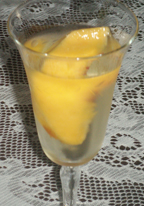
I always look forward to the first peaches of the summer.  The cool and refreshing peach is nature’s answer to hot summer days. After spending hours cleaning an old house, it was time for a refreshing pick-me-up. I had a chilled bottle of Knapp George’s Peach wine. I added a peach slice to the wine and presented the wine to my fellow cleaners. It was an immediate hit. Everyone commented on the presentation and how good the wine and peach slice was. Although not my favorite, the Knapp peach wine was semi-sweet, cool and refreshing. We drank the entire bottle in minutes and seemed to have the energy, at least our spirits were higher, to continue cleaning.

Winemakers often make fruit wines during the summer. Unlike grape wines, most fruit wines do not need to age. My favorite peach wine is made by Piedmont Vineyards and Winery, Inc.,  The Plains, Virginia. Their peach wine is made from peaches and is bone dry with a great peach nose and taste with a long peach aftertaste. The dryness of this wine was a departure from other fruit wines that tend to be sweeter. If near The Plains, Virginia, stop by and give their peach wine a taste.


info@winetrailtraveler.com            Sitemap                      Privacy Policy

Copyright: Terry and Kathy Sullivan 2006-2013