-1.5in.jpg)


As the last days of March tick away, I am reminded of the qvevri that we brought from the country Georgia. It is buried near the side of the house and has had a wine in it for the past six months. During the autumn, we kept the opening to the qvevri open during fermentation. After fermentation I sealed it with a lid that had an airlock in it. By the end of December, we sealed the qvevri and its contents with a solid lid and covered it with several inches of sand.
It slept for the past three months, undisturbed by humans. This week, Kathy and I are going to open the qvevri and experience our second vintage from it. While in Georgia we met numerous people. Many were rather poetic about life, country, religion and wine. It is not surprising that it is suggested that opening the qvevri in the spring marks the birth of the wine. Six thousand miles away from the ancient cradle of wine, we are looking forward to experiencing our wine’s birth.
To help celebrate the birth, we invited Nina K to help open the qvevri. We met Nina last year. Nina had an epiphany about Georgian wine while visiting Dadiani Old Cellar in Samegrelo, Georgia where she tasted a red wine made from the Ojaleshi grape. When Nina met us, we opened a wine we had received from the monks at Dadiani Old Cellar and enjoyed the Ojaleshi wine.
Nina was born in Georgia. She sent us a picture of her when she was a little girl. Notice the closed qvevri in the lower right. Although living in Georgia, Nina did not have the experience of opening a qvevri in Georgia to experience a wine’s birth. Her parents moved to Maryland when she was a teenager, and this week marks the first opportunity she has to open a qvevri thousands of miles from her birth country.
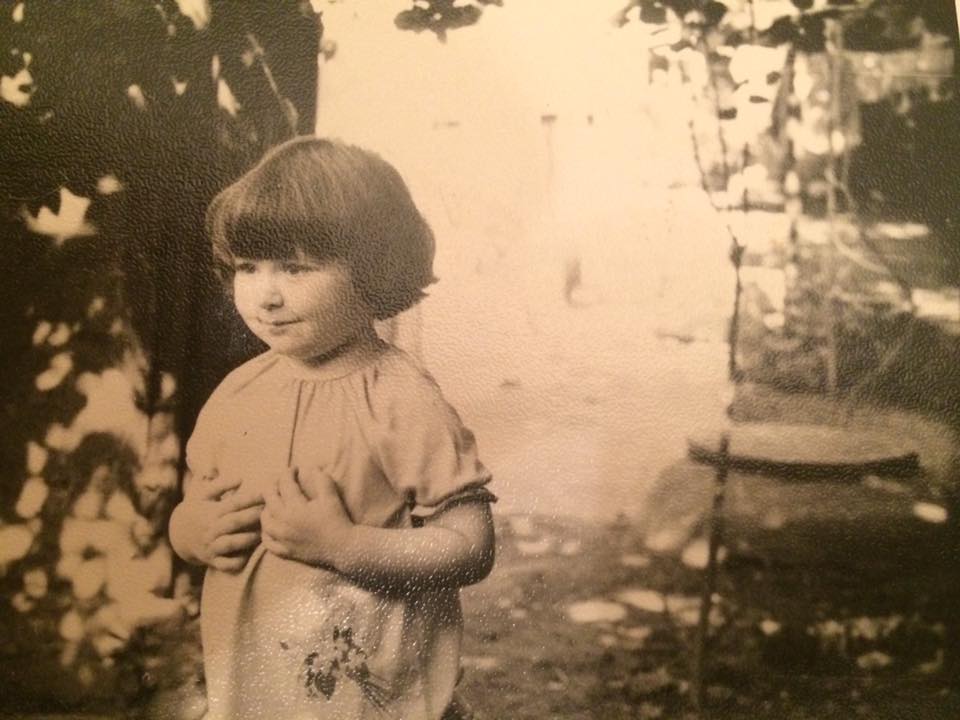
Nina K. while in the country Georgia, notice the qvevri in the ground in the lower right of the photo.
There is a bit of a risk opening the qvevri after not experiencing the state of the wine for a few months. Last year, Kathy and I were surprised to see grape skins gather at the opening of the qvevri. The wine was not at all clear. Later we learned that the wine was probably in a vortex all winter. I racked the wine to a carboy and it started clearing up within an day. We will be ready in case we need to do the same this year. Perhaps the word birth is an appropriate word for the opening of the qvevri and the wine’s next stage of life – bottling.
Cheers,
Terry
Wine’s Birth, Part 2
After a long winter’s rest and at times a covering of several feet of snow, the time for opening the qvevri is at hand. Our late winter in central Maryland was a roller coaster of temperatures. Some cold and a few days later quite hot for this time of year. The ground is still cool even though daffodils, hyacinths and narcissus are blooming. It is time to experience the birth of the Rkatsiteli wine that has been buried in a qvevri for six months.
Nina K. removes the qvevri lid
After removing the marble top, used so that someone will not fall in, I shoveled the several inches of sand covering the lid of the qvevri. The further I dug, the wetter the sand became. On the positive side, the clay used for sealing the lid to the qvevri’s rim did not dry out and crack. It was still quite moist and sticky. I used brushes to brush the sand away from and off the lid. With the area around the opening clear of sand, Nina K. opened the qvevri by prying the glass top off. It did not come off easily. There was a strong seal between the glass and the qvevri. Nina was successful though. Then, love at first sight.
Already there was a change from last year, when we opened the qvevri. Last year, there were grape skins at the top of the qvevri. This year you could see the grape skins, but they were a few inches below the clear wine. I used a measuring glass to scoop out some wine and pour into wine glasses. The wine was somewhat clear with a yellow color. You could see some tiny particles floating around. Kathy, Nina and I smelled the wine. It definitely smelled like Rkatsiteli. We then tasted the wine. Smiles came to our faces as we all said that the wine was surprisingly good. This is our second vintage made in qvevri and I still do not have the confidence that every vintage will turn out spectacular.
Tasting the 2015 qvevri Rkatsiteli
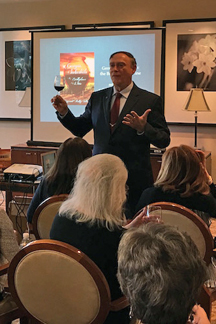
The Rkatsiteli was floral with hints of jammy yellow fruits. The mouthfeel was silky, everyone seemed to like that. The aftertaste had layers of floral and cooked jammy fruits. Needless to say, we were happy with the birth of the wine. We will only bottle a case of the Rkatsiteli and it will be used during author talks about The Birthplace of Wine.
My next task was to rack the wine into a carboy. I had to use a hand pump to pump the wine out of the qvevri. I filled a three gallon carboy. Like last year, I’ll let the wine settle before filtering and bottling in a week or two. Nina asked if we were going to make cha cha with the leftover skins, stems and seeds. Unfortunately, Kathy and I do not have a still, so cha cha is out of the question. Kathy did suggest that we make pomace jelly. We have had great success in making a wine jelly with the pomace.
It was delightful that Nina, who was born in the country Georgia, opened our qvevri. We were also pleased to see a few inches of clear wine at the top of the qvevri. We were really excited about the aroma and taste. Perhaps more winemakers in the United State, both professional and amateur, will begin making a qvevri wine. Qvevri winemaking is the only winemaking process on the UNESCO list of Intangible Cultural Heritage.
Cheers,
Terry