About     FAQ     Contact      Advertise With Us      Press   

Flying Over Vineyards Into San Luis Obispo

Wine Country sign at San Luis Obispo Airport

Wine Country sign at San Luis Obispo Airport

On Tuesday we flew into the smallest airport we have ever been to. The last small airport we were at was in Colorado and we still are delighted to tell others about how friendly and low key it was. However, the trip to the San Luis Obispo airport was also outstanding.

As soon as we departed the 50 passenger plane, we were guided to the two-room building where we discovered one small luggage carousel. On the top was an oak barrel with a sign

San Luis Obispo Airpot

San Luis Obispo Airpot

welcoming visitors to wine country. While Terry waited for our luggage, I  walked through a doorway and saw four car rental agencies waiting to help travelers. One sure doesn’t get tired walking around the airport to locate anything. There were no shops or restaurants.

However, what struck us as one of the most beautiful views we have seen were the dynamic views of green vineyards attractively climbing the beautiful hills of Edna Valley.

After arriving at Autrey Cellars, less than two miles from the passenger terminal, we met Steve Autrey who explained that a little earlier the colors of the hills were even more dynamic with wildflowers including orange poppies 41316eIMG_9063contrasting with the vibrant green. We watched as another plane flew over rolling hills of vineyards. Then we felt the shock waves as they gently kissed the vines.

As with other areas of California, we learned that in a few short months the green of the hillsides will turn brown as summer’s lack of rain dictates.

Claiborne & Churchill winery in San Luis Obispo

Claiborne & Churchill winery in San Luis Obispo


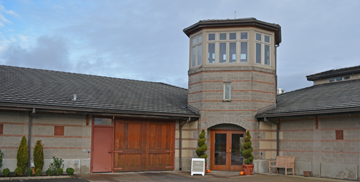
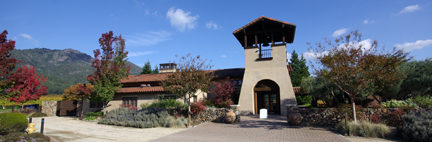
We had another view of the Edna Valley AVA from Claiborne & Churchill Winery. They have a few acres of Riesling and Pinot Noir, where we could get close and photograph the vines. The Edna Valley is a beautiful and photographic wine region.

Cheers!
Kathy and Terry

May is Oregon Wine Month

Enso Winery in Portland

Enso Winery in Portland

Oregon wineries begin celebrating Oregon Wine Month May 1st. A special sweepstakes will provide the two grand  prize winners with two night’s lodging for two in a wine country hotel, dinner for two, a $100 gas card and a special “Meet a Maker” experience at one of Oregon’s wineries. It’s easy to enter the sweepstakes. Details and entry are available online.

Oregon offers wine lovers great wines and

Adelsheim in Willamette VAlley

Adelsheim in Willamette Valley

great winery experiences. Visit the online reviews of many of Oregon’s wineries.

Special winery events include: a wine and cheese pairing, a Marechal Foch Vertical Tasting, spring wine releases, a barrel tasting, a painting party, wine and food events and more. If you have a favorite Oregon winery, check their website to discover their events.

If you will be visiting wineries in the Willamette Valley and look for an exceptional lodging experience, take a look at the Youngberg Hill website.

Cheers!
Kathy

The Amazing Race: Cleaning Qvevris in Georgia

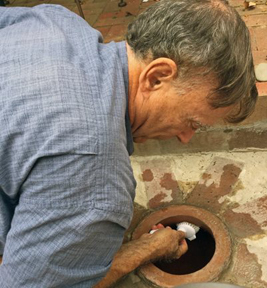
Terry cleaning a 24 liter qvevri at home in Maryland

Terry cleaning a 24 liter qvevri at home in Maryland

Last week, millions of “The Amazing Race” fans may have had their first glimpse of the only winemaking technique that is on the UNESCO list of Intangible Cultural Heritage. Some of the teams opted to go to Iago’s Wine in Chardakhi, Kartli, Georgia and clean a qvevri. Qvevris are earthen vessels that are used for fermentation, maceration and aging of wines. Making wine in qvevri is a protocol that is thousands of years old. So is cleaning them.

The contestants had to climb into the qvevri, remove the cha cha (left over skins, stems and a bit of wine) and then wash the sides of the qvevri with water. Owner and winemaker, Iago Bitarishvili, inspected the qvevri after the cleaning. Two of the teams had to do a little more cleaning before they passed this task.

Cleaning a qvevri does take a bit of time. We have a qvevri from the country Georgia in our yard. I clean it after the wine is removed in the spring, and clean it again before grapes are placed into it in the fall. Unlike the qvevris shown on The Amazing Race, my qvevri is small and I can reach the bottom. It still takes some scrubbing with fresh water and a brush. After scrubbing the sides, I discard the cloudy water and repeat the process until the water is clean after scrubbing the interior. It did not appear that the contestants in the Amazing Race cleaned to that level. Iago will still have some cleaning to do.

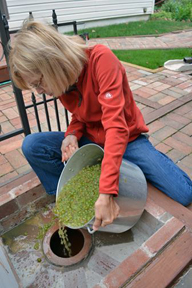
Kathy filling the qvevri with Rkatsiteli grapes. The Amazing Race did not show this part.

Kathy filling the qvevri with Rkatsiteli grapes. The Amazing Race did not show this part.

The Amazing Race task was about cleaning the qvevri, not tasting the wine made in it. The teams removed white grape skins from the qvevris, so it seems that white wines were made in them. The white wine process involves placing the grapes into the qvevri after harvest for fermentation. The white grapes are fermented on their skins and sometimes stems are added. How many skins and stems are used during fermentation is regional. After fermentation, many of the Georgian winemakers leave the wine, skins and stems in the qvevri for several months. We left our white wine on the skins and stems for six months. The resulting white wine is often a dark yellow to amber color. It often has a medium/full to full body and tannins. Depending on the grape variety, one may notice floral hints and jammy yellow fruit.

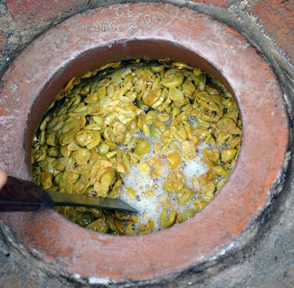
Fermenting grapes in a qvevri, after six months the wine is removed and clean up begins.

Fermenting grapes in a qvevri, after six months the wine is removed and clean up begins.

If any of the Amazing Race teams would like to get the experience of cleaning a qvevri, let me know. I have one that needs its spring cleaning.

Cheers,
Terry

Mark your Calendar: Annual NYCWFF!

The New York City Wine & Food Festival (NYCWFF) is a large, annual event focused on helping the hungry. This food and wine celebration, which takes place in October over four days, benefits No Kid Hungry and the Food Bank for New York City. All of the net proceeds go these two charities.

While it’s too early to get your tickets, it is not too early to mark your calendar for the event that takes place October 13 – October 16. The tickets will be available online in June. In past years many of the tickets sold out early, so you may want to make a note on your calendar to watch for the festival ticket sales in June. You can also signup to receive emails from the New York City Wine & Food Festival.

Check out the NYCWFF website for details including photos of the 2015 festival which raised more than $1 million for those who are suffering from hunger.

In 2015 I wrote, “Events during the four days include: dinners, walk-around tastings, late-night parties, hands-on classes, seminars, brunches and roof-top events at Pier 92.” By June 2016 specific events will be listed for the fall festival. So be sure to check out the numerous events offered and signup quickly before they are sold out

Organizations are also encouraged to consider a sponsorship with the 2016 NYCWFF.

Cheers!
Kathy

Mission Style Beef Stew Recipe

St. Francis Winery & Vineyards

St. Francis Winery & Vineyards

As the cold continues to sweep down across much of the US, wholesome hot food seems to be ideal for meals. Below is a recipe for beef stew from St. Francis Winery & Vineyards. The winery is located in Sonoma County, California. If you are planning to visit Sonoma, read the online review. In the meantime warm up with this easy-to-make stew.

Wine Pairing at St. Francis Winery

Wine Pairing at St. Francis Winery

Cheers,
Kathy

St. Francis Mission Style Beef Stew

Suggested Pairing: Cabernet Sauvignon

Ingredients

1 teaspoon salt
1/4 teaspoon ground black pepper
1/3 cup flour
2 pounds stewing beef cut into 2 inch pieces
4 tablespoons olive oil
1 tablespoon soy sauce
1 cup St. Francis Cabernet Sauvignon
3 cups beef stock
2 carrots, cubed
1 yellow onion, cubed
3 ribs celery, cubed
8 small red potatoes, cut into eighths
1 tablespoon herbs de Provence
1 tablespoon garlic, chopped

Preparation

  1. Season the beef with salt and pepper. Toss the beef in the flour to coat evenly; shake off excess. Heat the oil in a Dutch oven or heavy bottomed pot with a lid. When the oil is very hot, add the beef. Brown on all sides. You may need to do this in batches to keep the oil hot.
  2. Add wine, soy sauce and stock to cover. Bring liquid to a boil. Cover with the lid and simmer 1½ to 2 hours or until beef is tender.
  3. Add the remaining ingredients and cook 20 minutes uncovered or until the potatoes are tender.

Recipe provided by St. Francis Winery & Vineyards, Sonoma Valley, California.


Grandes Pagos de España Wine Tasting

At Oylmel in Washington DC

At Oyamel in Washington DC

This week we attended the Grandes Pagos de España wine tasting seminar in Washington D.C. We were delighted to have the opportunity to attend the seminar at the bright and cheerful Oyamel restaurant, focused on Mexican cuisine. Oyamel appears to be a popular restaurant as, closer to the lunch hour, people were arriving for lunch and vibrant conversations.

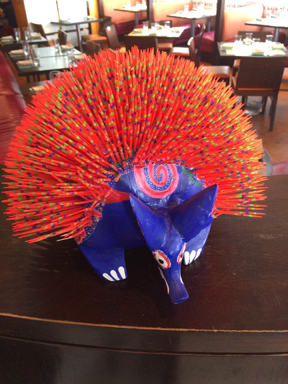
The restaurant is conveniently located only a couple of blocks from the Archives metro stop which we reached by way of the Green Line. Upon entering Oyamel we were in a restaurant colorfully decorated with orange and yellow colors.  A portion of the ceiling seemed to explode with summer flowers colored with orange hues. Throughout the bright restaurant numerous models of animals added to the decor. The room set aside for our wine tasting had a ceiling filled with small colorful animals. The colors and shapes made one wonder if they were representative of real animals.

Yesterday Terry wrote a great article about the Grands Pagos de España event describing the special features of Grands Pagos d Expaña and descriptions of the nine wines we tasted. I was very interested in the wines, but I was also interested in the wine and food connection. Part of the wine tasting included several appetizers created at the Oyamel Cocina Mexicana.

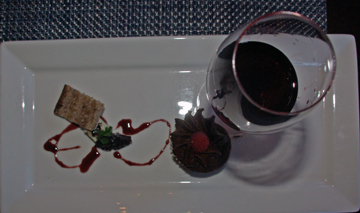
Mexican appetizer

Mexican appetizer

We enjoyed several appetizers provided by Oyamel.

  • Mini quesadilla de chicharrones
    Crispy local pork belly, Chihuahua cheese and five chile salsa
  • Gorditas de pato
    House-made masa cakes topped with duck confit and salsa chile árbol and served with a relish of local apples, habanero, and piloncillo
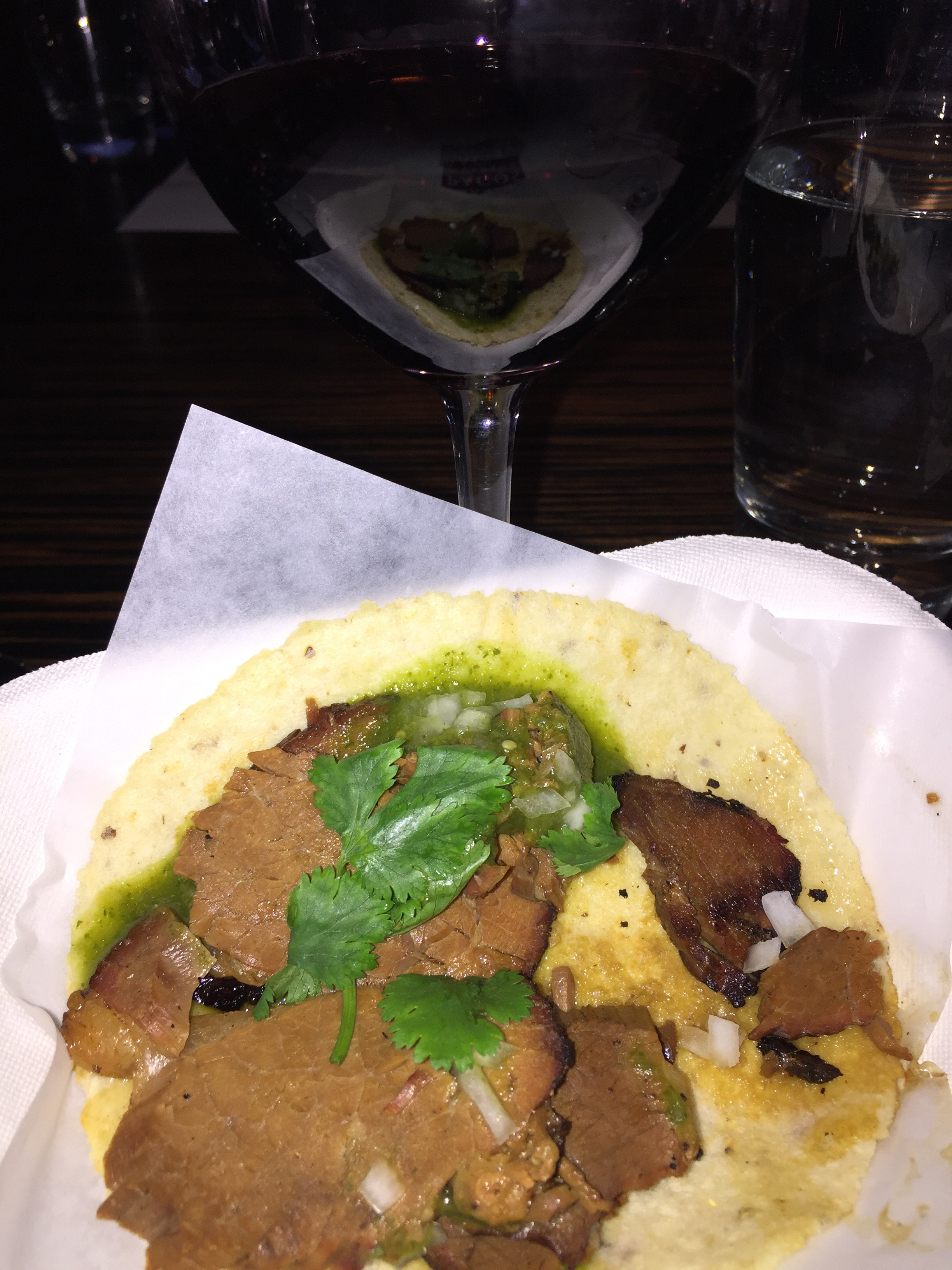
  • Taco de suadero
    Braised, roasted and grilled local brisket in a house made tortilla with salsa verde, onions, and cilantro
  • Taco pescado Baja California
    Seared Mahi Mahi with fresh cabbage, house-made mayo, pickled ancho chiles and onions
  • Empanada de hongos y queso
    Sautéed local mushrooms and Chihuahua cheese in a crispy handmade corn tortilla
  • Sopes de papas con chorizo
    A crispy house-made masa cake topped with potato, black beans, house-made chorizo with Mexican crema

Terry wrote about his favorite wines. Wines touch people’s senses in different ways, and so at this tasting my favorite wine was the second one from Palacio Quemado. To me it was unique and special.

Anyone interested in Grandes Pagos de España wines should visit the organization’s website. The wines from these participating wineries are making their way into the US.

Before the seminar I asked Jean Belondrade, from the Belondrade winery, if the Belondrade wines are distributed/imported on the East Coast. He explained that the wines are available on the West Coast and will eventually be available in New York, Washington DC and Maryland. However, some of the Grandes Pagos d España member wineries already have distributors/importers in New York, Atlanta and Washington DC. Others are searching for importers for their wines.Gramona, Palacio Quemado, Los Aguilares, and Cérvoles are seeking distributors in New York, Atlanta and Washington DC.

When visiting your favorite wine shop ask about the wines from Grandes Pagos de España.

Cheers!
Kathy

Tasting Wines from Members of Grandes Pagos de España

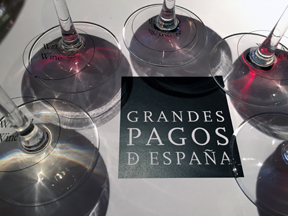
A 9 wine flight tasting of Grandes Pagos de Espana wines

A 9 wine flight tasting of Grandes Pagos de Espana wines

We attended a seminar in Washington DC at Oyamel restaurant. Nine wines from producers that are members of Grandes Pagos de España were tasted. The tasting took place in a private room at the restaurant. We attended the first seminar. Jean Belondrade Lurton of Belondrade winery introduced those attending with the concept behind Grandes Pagos de España. We were reminded that Pago is a Spanish word for a single vineyard whose characteristics set it apart from others in the same area. In order to belong to the exclusive group, wineries must meet certain qualifications that include:
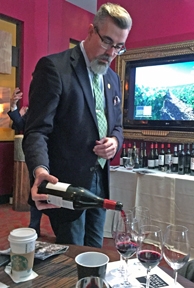
Andy Myers, Master Sommelier

Andy Myers, Master Sommelier

•Wine must come from an exceptional single vineyard
•Winery should have attained  a demonstrable fame with at least five years of recognized prestige in the marketplace
•High marks in national and international competitions
•Winery must undergo a meticulous inspection
•Wines must surpass the quality requirements set at a vertical tasting

Jean pointed out that this organization is more than a marketing attempt by the member wineries; it also focuses on each member helping each other to elevate the wines to a high standard. After the introduction, Andy Myers, Master Sommelier, led the tasting.
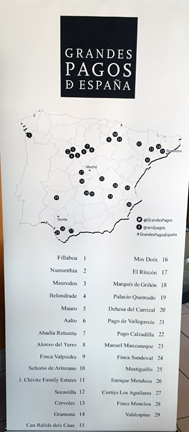
Grandes Pagos de Espana producers throughout Spain

Grandes Pagos de Espana producers throughout Spain

Wines

Our first wine was a cava from Gramona. The Gramona III Lustrous 2007 was a blend of Xarel-lo 75% and Macabeo 25%. The sparkling wine had a yellow color and had green apple, pear and freshly baked bread notes. There was a hint of nuts and lemon on the finish. This sparkling wine was complex and was a great start to the flight of wines in the seminar. It awakened our perception at 11:00 am.

Our second wine was a 2014 La Zarcita, a blend of Cabernet Sauvignon and Syrah. There were small amounts of a couple other varieties in the blend. The wine by producer Palacio Quemado was a dark ruby color. The wine aged in large 500 liter barrels for eight months. The wine reminded us of black fruits, leather and licorice. The wine had medium tannins and a medium/full body. The finish was crisp and the fruit lasted a long time.

The third wine was one of my favorites. The 2012 Petit Verdot was crafted by Dehesa del Carrizal.This dark opaque ruby to black colored wine emphasized black fruits. The wine spent 15 months in new French oak. The full bodied wine had kissing tannins (your lips pucker as if you were going to kiss someone). This wine had its own personality and was simply delicious. Terry would drink this as an aperitif while others would like a juicy steak.

Our fourth wine by Enrique Mendoza was the 2011 Estrecho. This ruby colored wine was made with 100% Monastrell and spent 15 months aging in French oak barrels. It offered red and black berry fruit along with violets. The wine had medium/bold tannins and a medium/full body. Some oak influences were noticeable on the finish, then yielded to fruit notes on the aftertaste.
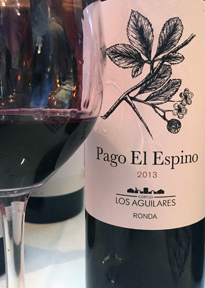
040716dThe fifth wine in the flight also captured my interest. Cortijo Los Aguilares produced a 2013 Pago el Espino. The dark ruby to black colored wine was a blend of Petit Verdot 53%, Tempranillo 30% and Syrah 17%. Violets and black fruits were picked up on the aroma and taste. The wine had bold tannins and a full body. The fruits were luscious and there was a subtle influence of oak.

We spent a few minutes dumping our wines for the next part of the flight, four additional wines.

Finca Valiera crafted the 2009 Finca Valiera Reserva. This slightly translucent ruby colored wine was a blend of Tempranillo 92%, Graciano 4% and Maturana Tinta 4%. The wine had some floral notes to accompany the black and red fruits. The wine had bold tannins and a medium/full body. Oak influenced the wine with a bit of leather and licorice. There was mineral and fruit on the finish and aftertaste.

Cérvoles winery crafted the 2009 Cérvoles a transparent ruby colored blend of Grenache, Tempranillo, Merlot and Cabernet. The wine spent 12 months aging in new French oak barrels. There were light aromas of red and black fruits. There was a perceived sweetness from the fruit forward wine that had bold tannins and a medium/full body.

Mas Doix winery produced the 2012 Salanques, a red blend of Grenache 65%, Carignan 25% and Syrah 10%. The opaque dark ruby colored wine offered dark fruits notably black raspberries. There were bold tannins on this full-bodied wine with some oak influences in the background.

The last wine was another favorite for me. The 2012 Pago Valdebellón was produced by Abadia Retuerta. The opaque dark ruby to black colored wine was 100% Cabernet Sauvignon. The wine offered cassis and blackberries. The wine had bold tannins and was full-bodied. There were licorice notes mostly on the finish. The wine had a long aftertaste.

Cheers,
Terry

Gloria Ferrer’s Pinot Noir Clones Tasting

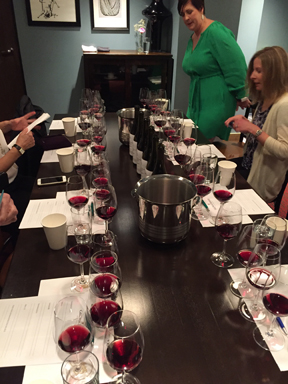
Gloria Ferrer Tasting of Pinot Noir Clones

Gloria Ferrer Tasting of Pinot Noir Clones

Last Thursday, March 31st, we made our way to a special wine tasting focused on diverse Pinot Noir clones growing at Gloria Ferrer Caves & Vineyards. To arrive at the The Carlyle Hotel where the Riggsby restaurant is located, we boarded two metro trains before reaching the Dupont Circle station. From the station it was only a short walk to The Riggsby, a well-known restaurant in the area.

We arrived at the Carlyle Hotel and entered into a bright, well-maintained area covered with shining marble flooring. To our immediate right was the bar that was quiet upon our arrival. We were immediately welcomed and within a minute or so, the Gloria Ferrer marketing specialist, Eva Bertran met us. As we were a bit early, we were gracefully asked to have a seat in the restaurant bar.

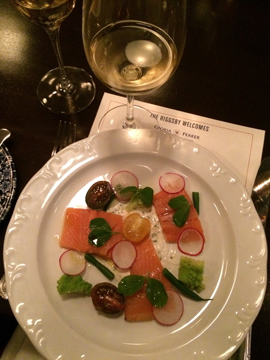
A delicious 1st course at the Riggsby Restaurant in Washington, DC

A delicious 1st course at the Riggsby Restaurant in Washington, DC

A short time later we were escorted to a quiet, private dining room, where eight places settings with Pinot Noirs produced with five clones had been poured. Each setting offered information regarding the Gloria Ferrer clones and wines. A printed placemat identified each of the wines. A map detailed the many acres of vineyards at Gloria Ferrer. Everyone at the event was cordial and we were quickly seated. The Gloria Ferrer winemaker, Steven Urberg  began talking about Gloria Ferrer and the Pinot Noir clones that the winery has been researching for years. He included comments on the climate that affects the vineyards including mentioning how the wind comes through the pass and that at some locations the wind causes the trees to grow at a 45 degree angle.

The wine and food experience was delightful especially since it was a small, friendly group who were focused on wines. Isn’t wine also about food and friends? Everyone was interested in the various Pinot Noir clonal wines and appeared to appreciate the opportunity to learn about Gloria Ferrer’s wines.

Steven spent about an hour discussing the attributes about the wines and allowing us to ask numerous questions. After he finished his presentation, we were asked to return to the restaurant’s bar area for a few minutes to enjoy appetizers paired with a glass of Gloria Ferrer’s 2007 Royal Cuvée. By this time the restaurant appeared full and the noise was a bit overwhelming in the bar. However, after tasting several Pinot Noirs, the Cuvée was a delightful change of pace.

The appetizers included Homemade Potato Chips with Green Onion Dip and Deviled Eggs with Calabrian Chiles & Crispy Chicken Skin. The potato chips were large and crispy. For me, they were a tad bit too spicy. The deviled eggs were delicate but also spicy hot. Perhaps the spiciness of the appetizers emphasized the cooling, deliciousness of the Gloria Ferrer Cuvée.

Soon we were asked to return to the original private dining room for dinner. The three course dinner began with Lightly Smoked Trout with Spring Vegetables. The fish was very tender with hints of smokiness. This was paired with the 2014 José S. Ferrer Chardonnay. This  2014 Chardonnay is being launched by Gloria Ferrer during April.

The second course was Fresh Spaghetti with Truffled Maitake paired with the 2013 Carneros Estate Pinot Noir. The pasta was very soft and offered a delicious flavor of truffles.

The third course was Roasted Chicken with Broccoli Rabe, Roasted Potatoes and Mustard. The entrée was paired with the 2013 Gravel Knob Pinot Noir. The chicken was tender and succulent and the petite potatoes and broccoli were prepared perfectly. Unfortunately after the pasta dish, the amount of food was a bit overwhelming.

The evening ended with a cheese plate which included handmade crackers flavored with sea salt and rosemary. The cheese plate was paired with the 2013 Rust Rock Terrace Pinot Noir. The entire evening was educational and entertaining. The wines paired well with the foods. What can be better than wine, food and friends?

Be sure to check out the Gloria Ferrer website which is very informative. Also, if you are in the Dupont Circle area, check out The Riggsby restaurant which offers delicious selections on their menus.

Cheers!
Kathy

Pinot Noir Clones with Gloria Ferrer

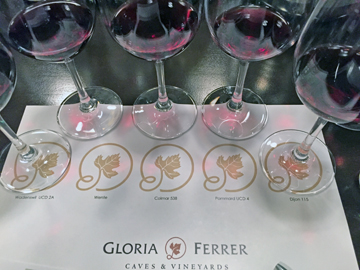
Tasting 5 Pinot Noir wines made from different clones

Tasting 5 Pinot Noir wines made from different clones

I have learned about a few of the different clones of Pinot Noir while traveling to wineries in the Willamette Valley in Oregon and Santa Barbara County in California. Both areas have wineries that produce pinots specifically from a single clone of Pinot Noir. Last week, Kathy and I were invited to a Pinot Noir clone presentation, tasting and dinner sponsored by Gloria Ferrer. Our last visit to Gloria Ferrer was in February 2007 and at that time the emphasis of the visit was on sparkling wine.

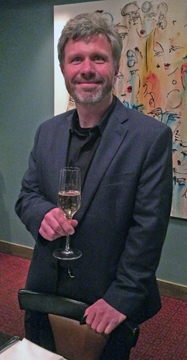
The Pinot Noir clone event took place in Washington DC at the Riggsby restaurant on New Hampshire Avenue NW. This is a popular restaurant that becomes a bit noisy with enthusiastic patrons. Eight of us were ushered off to a private dining room that was quiet and tailor made for discussion. Gloria Ferrer winemaker, Steven Urberg talked about the history of Gloria Ferrer and the research the Ferrer family did when scoping out land to build a winery in California.

Steven Urberg with a Gloria Ferrer 2007 Royal Cuvée just before the start of dinner

Steven Urberg with a Gloria Ferrer 2007 Royal Cuvée just before the start of dinner

The Ferrer family were accustomed to making cava in Spain; however, they knew they did not want to use the Spanish varieties Xarel-lo, Parellada and Macabeo in California. Instead, they searched for an area where they could grow Pinot Noir and Chardonnay. The location of the Gloria Ferrer vineyards are in Sonoma in the Carneros area just a few miles from San Pablo Bay. The influence of the bay helps cool the evenings during the summer with temperatures often falling into the 50s. This provides ideal growing conditions for Pinot Noir and Chardonnay.

Steven explained that the research took them to other wineries to examine different clones. On a trip to France, the team was given twelve clones by French researchers. Four acres of the nearly 335 acres are used for researching clones. For our tasting, Steven brought samples from barrels of five different clones of Pinot Noir that are used in the blends of the still wine program.  The still wine program accounts for about 20 percent of the wine production; sparkling wine accounts for the rest of the production.

During the presentation, we tasted wines made from five pinot clones: Wadenswil UCD 2A, Wente, Colmar 538, Pommard UCD 4 and Dijon 115. These were all Pinot Noirs and they were all different. For example, I enjoy bold tannins and the Pommard and Dijon clones delivered those tannins. Colmar had a wonderful mouthfeel. Wente had an outstanding aroma and the Wadenswil offered plenty of fruit. As we were tasting wines produced from different Pinot Noir clones my mind wandered to blending. Kathy and I had a blending experience in Oregon where we learned that just a small one percent can make a difference in the blend.

After tasting and discussing the five clones, I experimented making a rude blend of two of my favorites. Since the Pommard had the bold tannins that I like, I used that as my base. I was also enjoying the mouthfeel of the Colmar so I added a splash of the Colmar to the Pommard, then another splash. I enjoyed what I created in seconds from just this rudimentary blending of two clonal wines.

After the clonal experience, we had appetizers paired with the 2007 Royal Cuvée. The sparkling wine matched well and cleansed our palates. We then had a three course meal paired with a Chardonnay and three Pinot Noirs. The intimate evening was a perfect setting for learning about some of the Gloria Ferrer Pinot Noir clones. Our group was impressed with the chef at the Riggsby. The chef altered the dishes to specifically match the wines offered for each course, The pairings were wonderful.

Cheers,
Terry

Has Anyone Made a Rkatsiteli Wine Jelly?

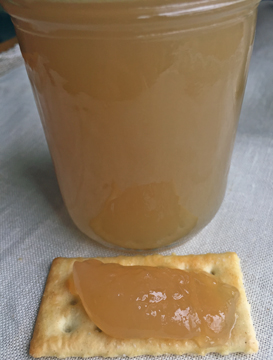
Rkatsitel Wine Jelly

Rkatsitel Wine Jelly

Earlier this week we opened our small qvevri here in Maryland. After retrieving the Rkatsiteli wine, as Terry detailed in earlier blogs, we had the chacha left. The chacha is what the Georgians call the grape skins, seeds, stems and lees that is left at the bottom of the qvevri. In the country Georgia, the winemakers know exactly what they will do with it. It is customary to distill the chacha for what can be a delicious spirit. This wasn’t an option for us as we do not have a still.

It seemed a shame to waste the chacha, so I pointed out that we should make a jelly with it. We allowed the chacha to drain for 24 hours and then pressed the chacha for the 5 1/2 cups of juice needed for the recipe. For the pectin that is required, I used a box of SURE JELL Premium Fruit Pectin for less or no sugar needed. The recipes for jelly and jam included cooked and freezer  jellies and jams. For the Rkatsiteli chacha, I used the Grape (Concord) cooked jelly recipe. The only ingredients included prepared juice, sugar and Sure Jell pectin. To prevent too much foaming as the jelly boils, I added a 1/2 teaspoon of butter as recommended.

The resulting Rkatsiteli was sweet but I noticed some of the same notes of the Rkatsiteli grape variety also in the jelly.

If you have ever canned fruit or made jelly or jam, you will find it easy to make wine jelly. If this is your first time making wine jelly, read the directions and follow them carefully.

If you really like making your own homemade jelly, just think what great gifts you can give your family and friends for Christmas or other holidays.

Note: The Wine Trail Traveler website also has a recipe for making your own mulled wine jelly.

Cheers!
Kathy


info@winetrailtraveler.com            Sitemap                      Privacy Policy

Copyright: Terry and Kathy Sullivan 2006-2013