-1.5in.jpg)


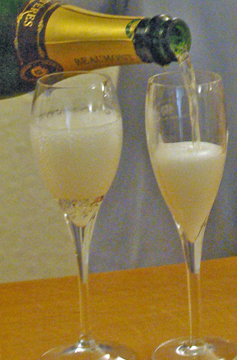 The sparkling wine, champagne, as we know it today evolved over hundreds of years, as opposed to being invented by a single person at a single time. Although the Champagne region of France excelled at making champagne, once embraced, other people were deliberately making wine that had effervescence a century before the Champenois. The French Wine Society’s course on Champagne mentions the rural method of making sparkling wine.
In Champagne during the centuries prior to making champagne, still wines were fermented in the autumn. Champagne can be cold and at times there fermentations stopped. It was simply too cold for the yeast to turn sugar into alcohol. The yeast did not die, they just went into hibernation until the weather turned warmer in the spring. If the wine was bottled prior to fermentation starting up again in the spring, when fermentation did start again, carbon dioxide had no escape from the enclosed bottle and dissolved into the wine. Upon opening, the wine had an effervescence.
Rural sparkling wine refers to a wine made during the interrupted fermentation. To many winemakers, this was considered a flaw in the wine. In the 1500s in the Languedoc, monks at the abbey Saint-Hilaire in Limoux were deliberately making their wines sparkle. This was a century before the birth of Dom Pérignon, a monk that some wrongly credit with the invention of sparkling wine. The rural sparkling wines were different from the champagnes of today. Although the fermentation continued in a closed bottle, the dead yeast cells were never removed. The sparkling wine was cloudy. This is considered a flaw to many. To coverup the cloudiness, it became popular to serve the sparkling wine in colored glasses.
During the 16th century, the monks did not control the amount of sparkle in their wines. If the wine was fermented dry before the cold temperatures became entrenched, there would be no sparkling wine come spring. Different years yielded crops with different sugar levels. They were not able to control how much sugar there was in the bottle to finish fermenting. Too much sugar to ferment in an inclosed bottle had its problems. Glass typically exploded if the pressure were too great. It took many decades to control what became the secondary fermentation, bottles that were capable of handling the increased pressure and enclosures for those bottles.
The story of Champagne’s champagne production is fascinating. It is one that evolved from a region that made only still wines to become the predominant world sparkling wine region. The Champagne region of France will be the focal point for the seventh International Wine Tourism Conference on April 8th and 9th, 2015 in Reims.
Cheers,
Terry








Counoise as a Single Varietal Wine
Winemaker Cameron Stark has many talents!
Unionville Vineyards in New Jersey has released a 2013 Counoise. The label name is Amwell Ridge Vineyard Counoise and is bottled as a single varietal wine.
The Counoise grape variety is typically found in the southern Rhone region of France. According to the National Grape Registry the Counoise grape is also known as Aubon, Caula, Conese, Connoges, Connoise, Counese, Couneso, Counoiso, Counoueiso, Damas noir, Grosse Rogettaz, Guenoise, Moustardier and Quennoise.
A few regions in the US are planting the Counoise grape. Look to the West Coast of the United States particularly California and Washington State for most Counoise vineyards. Frequently Counoise is found in wine blends. A very few wineries are also bottling Counoise as a single varietal.
According to the Rhone Rangers website: “It [Counoise] is a deep purple-red, and has a rich spicy character, with flavors of anise, strawberries and blueberries. Counoise’s moderate alcohol and tannins make it a good complement for Syrah, balancing that grape’s characteristic intense spice, strong tannins and high alcohol.”
Unionville Vineyards located on the East Coast in New Jersey is producing Counoise as a single varietal wine. The winery describes their recently released Amwell Ridge Vineyard Counoise in the following way. “Aromas of rose petals, violets, blackberries, and blueberries, all surrounded by a note of white pepper. Beautiful. On the palate, notes of blueberry and blackberry, hints of sweet vanilla, again with the white pepper surrounding. The finish is long with flavors of blueberry and a lasting white pepper glow.”
For those interested in food and wine pairings, Unionville Vineyards and Winery suggests pairing Counoise with vegetable stew, squash soup or duck.
This 2013 Counoise is available for $26 at the winery which is open daily. Shipping Unionville Vineyards’ wines is also available online from the winery.
Want to know more about Unionville Vineyards? Check out our online article on Wine Trail Traveler.
Happy St. Patrick’s Day!
Kathy