-1.5in.jpg)


Below is a recipe from Casa-Dea Estates Winery for Shrimp and Orange Salad with Pomegranate. Paul Battilana, winemaker, at Casa Dea Estates Winery suggests pairing this recipe for Shrimp and Orange Salad with the Casa-Dea Estates Winery Cabernet Franc Rosé. If you have the opportunity be sure to visit Casa-Dea. The ambiance is great!
Enjoy! Kathy
Shrimp and Orange Salad with Pomegranate
paired with Cabernet Franc Rosé
You can use any sweet oranges for this appetizer and if you don’t have fresh mint, add 1 tsp dried mint to the dressing.
According to Paul, “A rosé is not just for summer. Our beautiful dry Cabernet Franc Rosé will pair nicely with this appetizer.”
Ingredients
• 1 pomegranate
• 1/3 c extra-virgin olive oil
• 2 T balsamic vinegar
• Pinch salt
• Dash hot pepper sauce
• 3 oranges
• 1/3 c finely sliced sweet onion
• Mixed greens
• ¼ c chopped fresh mint
• Shrimp
• 4 thin slices fresh ginger
• 4 thin slices lemon
• 2 bay leaves
• 1 T coriander seeds
• 1 ½ t salt
• 1 t black peppercorns
• 12 oz shrimp, peeled and deveined
Directions
- Cut pomegranate in half crosswise. Using juicer, squeeze 1/3 cup juice from half. Whisk juice with oil, vinegar, salt, pepper and hot pepper sauce; chill.
- Remove seeds from remaining pomegranate half; set aside.
- Cut off ends of oranges; cut off peel and white pith. Cut segments out of membranes; chill.
- Rinse onion under cold running water.
- Shrimp: Bring 2 cups water, ginger, lemon, bay leaves, coriander, salt and peppercorns to a boil over medium heat; boil for 5 minutes.
- Strain through a sieve, discarding solids. Return liquid to pan; bring to boil.
- Add shrimp; reduce heat to low. Poach, below simmer, until just cooked through, about 3 minutes. Drain and chill.
- Arrange mixed greens on salad plates; top with orange segments, onion slices and shrimp. Whisk dressing; drizzle over salad. Sprinkle with reserved pomegranate seeds and mint.
Recipe provided by Paul Battilana, winemaker at Casa Dea Estates Winery, Prince Edward County, Canada
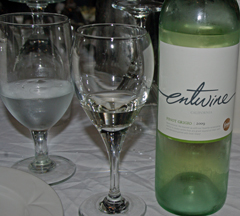
Are “Bad” and “Good” Meaningless Wine Descriptors?
How helpful are the words “bad” or “good” when referring to a wine? Some writers are quick to use these words when discussing a wine. How do their readers interpret the words? When it comes to wine, the use of words like “bad” and “good” are not as simple as they seem. Often the word bad means the writer doesn’t like the wine. Conversely the word good means the writer liked the wine. If a reader shares the same likes and dislikes as the writer, than the use of bad or good could prove helpful. However, just because one person dislikes a wine doesn’t imply that the next person will dislike the wine. For example, someone from the southeastern part of the United States who was raised on Muscadine grapes may like and enjoy a glass of wine made from the Nobel grape. Give that person a glass of Shafer Hillside Select and they may think it is bad. Wine is a personal preference and good and bad as used to describe wine is a personal interpretation and therefore not useful. Let’s try not to bash a wine unless it has a “wine fault.” Consider that a review of a wine that criticizes the wine based on what the writer likes is not helpful to the reader. Of course if the wine has a fault that should be noted.
When can the word “bad” literally mean bad? Some wines are faulted. Jean Lenoir’s wine faults kit Le Nez Du Vin lists 12 faults that a wine may have. These include:
Vegetal
Rotten Apple
Vinegar
Glue
Soap
Sulphur
Rotten egg
Onion
Cauliflower
Horse
Mouldy-earthy
Cork
While making wine at Vint Hill Craft Winery in Virginia, we had an opportunity to taste a wine that had a strong cauliflower and onion aroma and taste. The fault was traced to the vineyard. The new vineyard owner did not follow directions on a spray that was applied to the vineyard. Grapes were harvested prior to the number of days stated in the directions for the spray.
I’ve run across a few faults not on the above list including geranium taint and smoke taint. The first wine I made, from a wine kit had a distinct geranium taint. Others didn’t pick it up though and the taint was completely covered up if the wine was mulled. I’ve tasted a 2008 smoke-tainted wine from Mendocino County in California. There were terrible forest fires prior to and during the 2008 harvest and it did affect the wine. Using the word “bad” to describe a fault is entirely different than using the word to describe a wine the writer doesn’t like.
Readers be aware. If a writer uses the word “bad” or “good” see if the writer tells why the wine was bad or good. If the author doesn’t give details, then the words “bad” and “god” are meaningless. If the writer does state why he or she thinks a wine is “bad’ or “good” then the reader must interpret if their palate agrees with the writer.
Cheers,
Terry