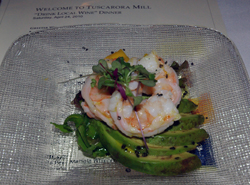
 Last night a special winemaker dinner event for the drink local wine.com conference was enjoyed in Leesburg, VA at the Tuscarora Mill restaurant. A special menu was planned for the event and accented local wines and local foods. The two really go hand in hand. If one is going to support the eat local food movement then it follows one should support the drink local wine movement.
Last night’s dinner was a five-course meal prepared with local foods and local wines. As we entered the restaurant, we were offered a Sauvignon Blanc from Veritas. A short time later we enjoyed an avocado, mango and shrimp dish served with two local Petit Manseng wines. The second course was Truffled Ayrshire Farm Organic Chicken Galantine. This wine was served with two local Viogniers. The third dish was Baker Farms Pork “Blanquette” and the two wines offered with this were a Nebbiolo and a Cabernet Franc. The fourth course was Roasted Martin’s Angus Beef. Meritage wines were served. Finally, the dessert-strawberry shortcake! Yum, it was so good. However as Terry mentioned to me, that when I make strawberry shortcake at home, don’t make it this small. Yes, it was good and despite it being the fifth course of the meal, I could have found room for a little more. Dessert was paired with Pearmund Cellars Late Harvest Viognier.
Last night we enjoyed a bottle of Cabernet Sauvignon from a New York State winery, Brotherhood, America’s Oldest Winery. This 2005 vintage Cabernet Sauvignon, aged in oak for six months was delightfully fruit forward with a very smooth taste and finish. Dark fruit berry nuances followed from the aroma through to the finish. It’s a wine that is enjoyable with or without food.
Brotherhood, America’s Oldest Winery is located in Washingtonville, New York, the Hudson River Valley region of the state. A visit to the winery and tasting room will allow visitors to taste wines produced at Brotherhood as well as imported wines.
When visiting be sure to take the tour that should include a walk through caves built in the mid 1800’s. Tours also include numerous pieces of historic wine equipment, now no longer used. A review of the winery is available on the Wine Trail Traveler website.
Have a wonderful weekend!
Cheers! Kathy
April 23, 2010 – 11:21 am
Yesterday we decided to visit Elk Run Vineyards in Maryland. This winery is one of the Maryland wineries that will have wines offered at the DrinkLocalWine.com Conference in Virginia this weekend. Elk Run offers a variety of wines from dry to sweet but their portfolio focuses on dry wines of which they have listed 15 dry wines. The winery focuses on quality wines from quality fruit. Their wines have won numerous awards from such competitions as the Maryland Governor’s Cup, World Wine Comp, Pacific Rim Competition, Tasters Guild International and Atlantic Seaboard. We enjoyed tasting their wines and hearing about the techniques they use in the vineyards to grow the best fruit possible. The Riesling 2008 was from their Cold Friday vineyard. This Riesling offered a floral aroma. The taste reminded one of a fruit salad with nuances of peach, apple and pear. There were hints of minerality on the fruity finish. If you will be at the Drink Local Wine conference be sure to try the wines from Maryland.
Cheers, Kathy
Four Maryland wineries from the central part of the state will participate in the Twitter Taste-off at Sunday’s Drink Local Wine Conference in Landstowne, Virginia. Black Ankle Vineyards, Elk Run Vineyards, Serpent Ridge Vineyards and Sugarloaf Mountain Vineyard will join twenty-one Virginia wineries also pouring wine at the event. During the Twitter Taste-off, each winery will pour two wines. Conference attendees can sample the wines. During last year’s Drink Local Wine Conference in Dallas, Texas, participants voted on their favorite dry red, dry white, sweet red and sweet white wines. During the Twitter Taste-off twenty-six media representatives including wine and food bloggers and wine writers will write posts and send out tweets about the wines.
Sugarloaf Mountain Vineyard, located in Dickerson (Montgomery County), Maryland specializes in wines made from the five Bordeaux grapes as well as Chardonnay and Pinot Gris. Black Ankle Vineyards in Mt. Airy practices biodynamic farming and produces old-world styled wines. Elk Run Vineyards, also in Mt. Airy is the oldest of the Maryland wineries to pour at the conference. It will be interesting to compare and contrast Elk Run wines made from mature grapes with wines from the newest Maryland winery, Serpent Ridge. Serpent Ridge Vineyards located in Westminster planted vineyards beginning in 2002.
There are a few tickets available for the conference. Check the Drink Local Wine website.
A photo collage from late year’s conference can be seen here.
April 21, 2010 – 10:51 am
Yesterday we returned from a week’s stay in Detroit where we were the recipients of wonderful wines and dinners at numerous fine area restaurants. In fact we had a return visit to Bucci Ristorante in Grosse Pointe Woods and learned that they were one of the few area restaurants to earn a coveted 5 star rating. It’s enjoyable to eat, drink and talk with friends and family at these restaurants.
During the week we enjoyed several wines including a Cabernet Sauvignon from Darioush in Napa Valley. I neglected to tuck a tiny notebook into my small leather purse so I pulled out a pen and started writing wine notes on a napkin. We enjoyed a Napa Valley Cabernet Sauvignon 2006 from Darioush. The color was a very dark purple/black. The nuances were of dark fruit including hints of dark cherry and currants. There were mild tannins and the finish was smooth.
After sharing this wine with others, I was anxious to check out the Darioush winery website. The story is fascinating and the photos of the visitor center show a very elegant building. According to the website this 22,000 sq foot winery is “the first in America to combine architecture, design and Persian culture…. Reminiscent of the great noble architecture that once existed, the imagery of the Darioush building evokes Persepolis, the illustrious capital of ancient Persia.”
We enjoy visiting all types of wineries, those small enough to be housed in a home and the large estate wineries. Darioush is a winery I would enjoy visiting not only for its Bordeaux type wines but also for its style and architecture.
Cheers! Kathy
By Kathy
|
Posted in Wine Notes
|
Tagged ....Restaurants, Bucci, Cabernet Sauvignon, Darioush, Detroit, Grosse Pointe Woods, Napa Valley, Persia, Persian, red wine, wine
|
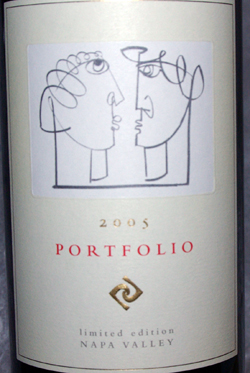 Genevieve and Luc Janssens approach art from different perspectives. Genevieve is a winemaker with an impressive background. In 1979 she began working at Robert Mondavi Winery. Ten years later she became the director of production at Opus One. Then in 1997 she became the director of winemaking at Robert Mondavi Winery. Luc captured images as he traveled throughout Asia. These photos have come to life in a process called photogravures. During their “home time”, the couple has extended their artistic passion creating a small production wine called Portfolio.
Portfolio is a blend of Cabernet Sauvignon and Cabernet Franc. The Cabernet Sauvignon grapes are grown at the Hendry Ranch Vineyard in southwest Napa while the Cabernet Franc grapes are sourced from Weitz Vineyard in the Oakville Bench. The hand harvested grapes are placed in 35 pound lugs and and taken to the winery where they are double sorted, once before and then after destemming. During fermentation, punch down is done several times a day. Genevieve and Luc sample the wine frequently during maceration determining at what point to drain and press. The wine is then barreled in new French oak barrels for 18 to 20 months. During the process, the wine is never pumped but moved by gravity flow. Bottling is done by hand and is unfined and unfiltered.
I had the Portfolio 2005 recently and enjoyed it. I thought about the Opus One I had previously and much prefer the Portfolio. Opus One is a good wine but my enjoyment was clouded by the hype surrounding it. I expected bells, whistles and fireworks. Instead I had a good wine. I thought this was my unique disappointment however discovered that it was shared by others at the dinner table. In talking to winemakers and their spouses, I’ve discovered that many of them also believe that Opus One is a good wine but were disappointed in it. There was no disappointment with Portfolio though. The Portfolio 2005 offered small dark berry fruit on the aroma and taste. The fruity finish had a hint of sweetness with spice nuances and food friendly tannins.
You can order both the wine and photogravures from the Portfolio Winery website.
-1.5in.jpg)


The Grapes that Do Well in Virginia
What grapes work best in Virginia? Jennifer mentioned that, “We should be growing grapes that we want to grow in our region.” Matthew suggested that all research funds for the wine industry should be placed in the vineyard. He believes that it is critical to know what grows well in the different Virginia regions. The first discussion centered on the hybrids and natives that the panelists use at their wineries. Several grape varieties were mentioned including Vidal Blanc, Seyval Blanc, Traminette and Norton. Matthieu explained that he is from France and doesn’t grow hybrids or native grapes at King Family Vineyards. Of the vinifera grapes, several were mentioned that do well in Virginia. These include: Chardonnay, Merlot and Cabernet Franc. All panelists were excited about the potential of Merlot in Virginia.
Other varieties of grapes that do well in Virginia include Petit Verdot, Malbec, Tannat, Viognier, Petit Manseng and Albarino. These grapes are well suited for the Virginia regions.
What grapes should probably not be grown in Virginia? Matthew thinks that Cabernet Sauvignon grown in Virginia can’t compete with the Cabs from other areas and questions if it should be grown in Virginia. Jennifer and Matthieu agreed with Matthew’s assessment of Cabernet Sauvignon. The panelists also question whether growers should grow Sauvignon Blanc and consider Pinot Gris boring.