About     FAQ     Contact      Advertise With Us      Press   

Happy Memorial Day Weekend!

Happy Memorial Day Weekend!

Below are cocktail recipes that use DeLeón tequila. If you are celebrating the start of summer, you may want to consider making one of these cocktails to enjoy.

Please remember “drink in moderation” and to use a designated driver or to use a taxi!

Cheers!
Kathy
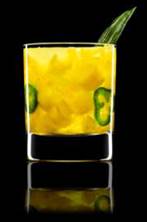
 

Platinum Pina Cocktail

Platinum Pina Cocktail

Platinum Pina

“A nuanced tropical cocktail with a kick that allows DeLeón Platinum’s delicate complexity to shine.”

Recipe:

1 ½ oz. DeLeón Platinum tequila
1 oz. fresh pineapple juice
½ oz. fresh lime juice
1 dash of jalapeño syrup

Shake and strain over the rocks in a rocks glass. Garnish with a slice of jalapeño.
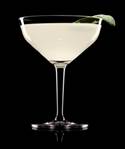
 

Platinum Sage Cocktail with Tequila

Platinum Sage Margarita with tequila

Platinum Sage Margarita

“A modern play on the traditional margarita, the Platinum Sage Margarita uses clarified lime juice to give this drink an incredibly silky mouthfeel, highlighting the smoothness of the Platinum tequila.”

Recipe:

2 oz. DeLeón Platinum tequila infused with fresh sage
¾ oz. clarified lime juice
¾ oz. fresh cane syrup

Stir all ingredients in a mixing glass over cracked and cubed ice until thoroughly cold. Strain into a chilled coupe and serve up garnished with a sage leaf.
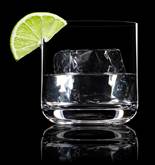
Platinum Lime Cocktail

DeLeón Unadulterated

DeLeón Unadulterated

“To fully experience the subtle complexity of DeLeón Platinum, serve neat on a clear rock, chilled with a squeeze of fresh lime.”

Recipe:

Pour 1 ½ oz. of DeLeón Platinum over a large, clear cube of ice. Stir seven times to thoroughly chill and serve with a squeeze of fresh lime to complement the bright citrus notes of the tequila.

Many thanks to Page Jeter at PMKBNC for these recipes!

Cheers!
Kathy
 

Wines of Uruguay Offers Tannat Tasting Tour

Wine Trail Traveler with Erin Sullivan at Wines of Uruguay tasting, Washington, DC

Wine Trail Traveler with Erin Sullivan at Wines of Uruguay tasting, Washington, DC

If you haven’t heard yet of Uruguay as a wine producing country, plan to learn about the wines they are crafting soon! Uruguay is an undiscovered South American wine region. Today many of the winemakers are 4th generation family.

Yesterday we attended a tasting of wines from Uruguay. Tannat wines were featured but there were also a number of blends as well as a few white wines. Eighteen wine producers from Uruguay were present.

If you want to know more about the wines from Uruguay, plan to attend the next Wines of Uruguay event in New York on May 27 at the South American Wine Conference, “City Winery”, 155 Varick St. This special event is for media and trade members.

The country of Uruguay has been producing wines for a long time but most of it has been kept in the country. Now the wineries are looking forward to exporting more of their wines.

In addition to the wine tasting, we enjoyed a seminar by Gilles De Chambure, MS. He talked about the country of Uruguay before delving into the wine industry that was accompanied by a tasting of eight tannat wines from eight different wineries.

Facts About Uruguay

  • Population: 3.4 million
  • The size of the state of Washington
  • Literacy: 98%
  • Located in the southern hemisphere between the 30th and 35th parallel. (This includes wine regions of Chile, South Africa, Argentina, Australia and New Zealand.)
  • One of the purest natural ecosystems in the world.
  • 475 species of birds
  • 82% of the land is agricultural
  • In addition to wine the country also produces olive oil.

The primary wine regions of Uruguay include: Colonia, Canelones, Montevideo, and Maldonado.

The main grape variety grown in Uruguay is tannat. Other red varieties include Merlot, Cabernet Sauvignon and Cabernet Franc. Other minor red grape vareties include Tempranillo, Syrah, Zinfandel, Petit Verdot, Sangiovese, Pinot Noir, Nebbiolo, Marselan and Arinarnoa.

The major white grape is Chardonnay. Other white varieties include Sauvignon Blanc, Semillón and Viognier with minor plantings of Albarino, Petit Manseng and Roussanne.

Interested in finding wines from Uruguay? Check out your favorite wine shop or Total Wine!

Later we will be writing about some of the specific wines we tasted yesterday.

Cheers!
Kathy

Tannat on My Radar

Screen Shot 2015-05-21 at 7.53.09 AMI enjoy many different wine grape varieties and the wines they make. I do have a short list of favorites though. Among my favorites are red grapes including Cabernet Sauvignon, Sagrantino,  Saperavi and Tannat. Today I have the opportunity to taste Tannat from Uruguay.

I was first introduced to Tannat in Virginia, where it is beginning to gain a foothold. Several producers in the state are making single variety Tannat wines, while others are using the grape in a blend. What call me to this variety was the dark purple almost black color and the outrageous tannins that many of the single variety Tannat wines possessed. I like tannins, especially those that I call kissing tannins because they pucker your lips.

The emphasis at the Wines of Uruguay Tannat Tasting Tour is on this variety originally from France but now has found a home in Uruguay. Of the 22,000 acres of vines in Uruguay, one-third are planted with Tannat. Other varieties also thrive in this South American country along the Atlantic Ocean and wedged between Brazil and Argentina.  Merlot, Syrah, Cabernet Sauvignon, Tempranillo, Sauvignon Blanc, Albariño and Viognier all do well in Uruguay. If one looks at a map of the positioning of vineyards in Uruguay, they are roughly equal to vineyards in Chile, Argentina, South Africa, Australia and the North Island of New Zealand.

I am looking forward to tasting different Tannats. I enjoyed this grape variety so much that in 2010 I made a blend of Lake County California Cabernet Sauvignon 80% and Virginia Tannat 20%. I want to make a bold wine bolder. I succeeded.

The Wines of Uruguay Tannat Tasting takes place today in Washington D.C. at the Sofitel Hotel, Lafayette Square, 806 15th Street Northwest, Washington, DC 20005. The tasting is open for members of the press and trade from 12:00 noon until 4:00 pm.

For more information visit: Wines of Uruguay and Uruguay Wine Tours

Cheers,
Terry

Sparkling Wine Anyone?

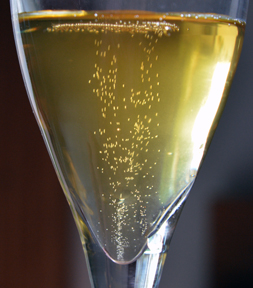
A carbonized Muscat

A carbonized Muscat

This year seems to be the year for sparkling wines. The International Wine Tourism Conference was in Champagne, France and next year’s conference will move to Barcelona, Spain – cava country. In January, Kathy and I judged Virginia sparkling wines. Later this month, we are going to judge cavas. We are currently writing a book about cava and thoughts turn to sparkling wine methods. I want to make a sparkling wine this year.

I know that making a sparkling wine takes patience, that is if you make it following the protocol of the traditional method. In this method, the winemaker vinifies a wine, creates a blend, bottles the blended wine and adds sugar and yeast to the bottled wine prior to capping the bottle. The secondary fermentation takes place in the bottle. Afterwards the wine is aged for several months to several years. The charmat method is quicker. The wine is racked to a pressurized tank and the secondary fermentation takes place in the pressurized tank. There are also other methods that are rather time consuming.

In a moment of weakness, where I did not exhibit patience, I decided to make a sparkling wine by carbonizing a still wine. I used one of those small units that you can pour a bottle of wine into it, screw on the top, screw on a small carbon dioxide cylinder and listen to the gas hiss into the container. After moving the stainless steel container to mix the contents, I placed it into the refrigerator for several hours. After pressing the button on the covering to release excess gas, I poured the contents into flutes.

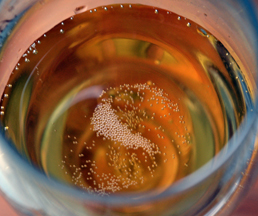
Mousse on the surface of the sparkling Muscat

Mousse on the surface of the sparkling Muscat

It worked! I had a sparkling wine. This was only one bottle so there was not a lot to go around, but it was sparkling. There were multiple beads of bubbles forming a mousse on the surface. The muscat wine was slightly sweet and paired well with cheese and a cake made from blueberry wine. There were not as many bubbles as there were in the cavas I’ve observed. The stream of bubbles would not last as long as they do in some of the cavas we’ve tasted. If you’re thirsty, that doesn’t matter though.

I still would like to make a sparkling wine using the traditional method, but I realize it will take years before it is ready. The carbonizing method does allow you to experiment in case you’ve ever wondered what a still wine would taste like if it was a sparkling.

Cheers,
Terry

Cava: A Delicious Sparkling Wine to Share with Friends and Family

Canals & Munné Cava

Canals & Munné Cava

This weekend we shared a bottle of delicious cava from Canals & Munné. This cava was a Brut Nature Gran Reserva. Ours was bottle #066914. The vintage was 2010 and the cava had 12% alcohol.

This pale yellow cava had many bubbles, multiple beads with a delicate mousse on the surface. The aroma included freshly baked bread and vegetal notes including lettuce. The taste profile reminds one of honeysuckle. The cava was crisp and refreshing.

Consider serving this cava with white fish, strawberries and flavorful hard cheese.

Check out the article we wrote about Canals & Munné online.

Cheers!
Kathy

Free Online Burgundy Wine Class Starts Soon

Clos St-Louis in Burgundy

Clos St. Louis in Burgundy

This morning I came across an article in Decanter by Jane Anson, “University of Burgundy launches free online wine course.” This particular course offered by the University of Burgundy will be available in French and English.

The wine class will be offered through the European MOOC (Massive Open Online Course.) According to the article the class will include: viticulture, terroir, tasting and more.

Wine education involves a lot more than just drinking wine. Unfortunately for too many people, the cost of “official” wine courses and degrees are just too expensive. Taking free online classes is a potential opportunity for people to learn about wine.

For anyone interested in classes that require wine tasting, that can be an additional expense but do-able. One does not need to purchase a bottle of wine to taste it. Other options available for tasting wines includes the use of wine preservation machines found in wine shops and restaurants.

The European MOOC concept reminds me of a traditional library where information/books are available for the general population. For anyone with access to a computer online is a sign of the times.

By the way,  I just signed up to take the class. Will you join the Burgundy wine course? Information is available at

http://platform.europeanmoocs.eu/course_mooc_owu_open_wine_university_

Cheers! Kathy


Sagrantino: What You Need to Know About this Italian Grape

Experimental Sagrantino vineyard at Arnaldo Caprai Winery in Montefalco, Italy

Experimental Sagrantino vineyard at Arnaldo Caprai Winery in Montefalco, Italy

Sagrantino is likely to be indigenous to Montefalco. Some believe the grape variety was introduced to the region by Franciscan Friars perhaps by St. Francis. Today the grape is said to only be grown in Mantefalco. However, we know of a winery in North Carolina and a winery in California that are growing Sagrantino.

Wine lovers who enjoy tannins and those who enjoy Cabernet Sauvignon wines may well enjoy Sagrantino wines. The wines are often dark purple to black in color and exhibit aromas and flavors are dark fruits. Those we had in Umbria had very bold tannins, some with kissing tannins.

According the the Sagrantino website, food pairings include wild boar, fine game, lamb, braised meat, free-range country pigeon and aged cheeses. Other suggestions include pairing it with chocolate and cigars.

Research has shown that Sagrantino wines have a long aging possibility.

History of Sagrantino in Umbria

Prior to 1960’s, not many winemakers grew Sagrantino. However by 1979 Montefalco received DOC for its wines and in n 1980 a D.O.C appellation was given to Montefaclo Sagrantino.  This final designation required that the Sagrantino wine must be 100 percent Sagrantino and aged for 30 months.

With considerable support from  Arnaldo Caprai in Montefalco, Sagrantino received DOCG status from Montefalco Sagrantino.

We were fortunate to visit Arnalda Caprai after the International Wine Tourism Conference. The Wine Trail Traveler article is online.

Cheers,
Terry

Sea Grapes – A Different Kind of Grape

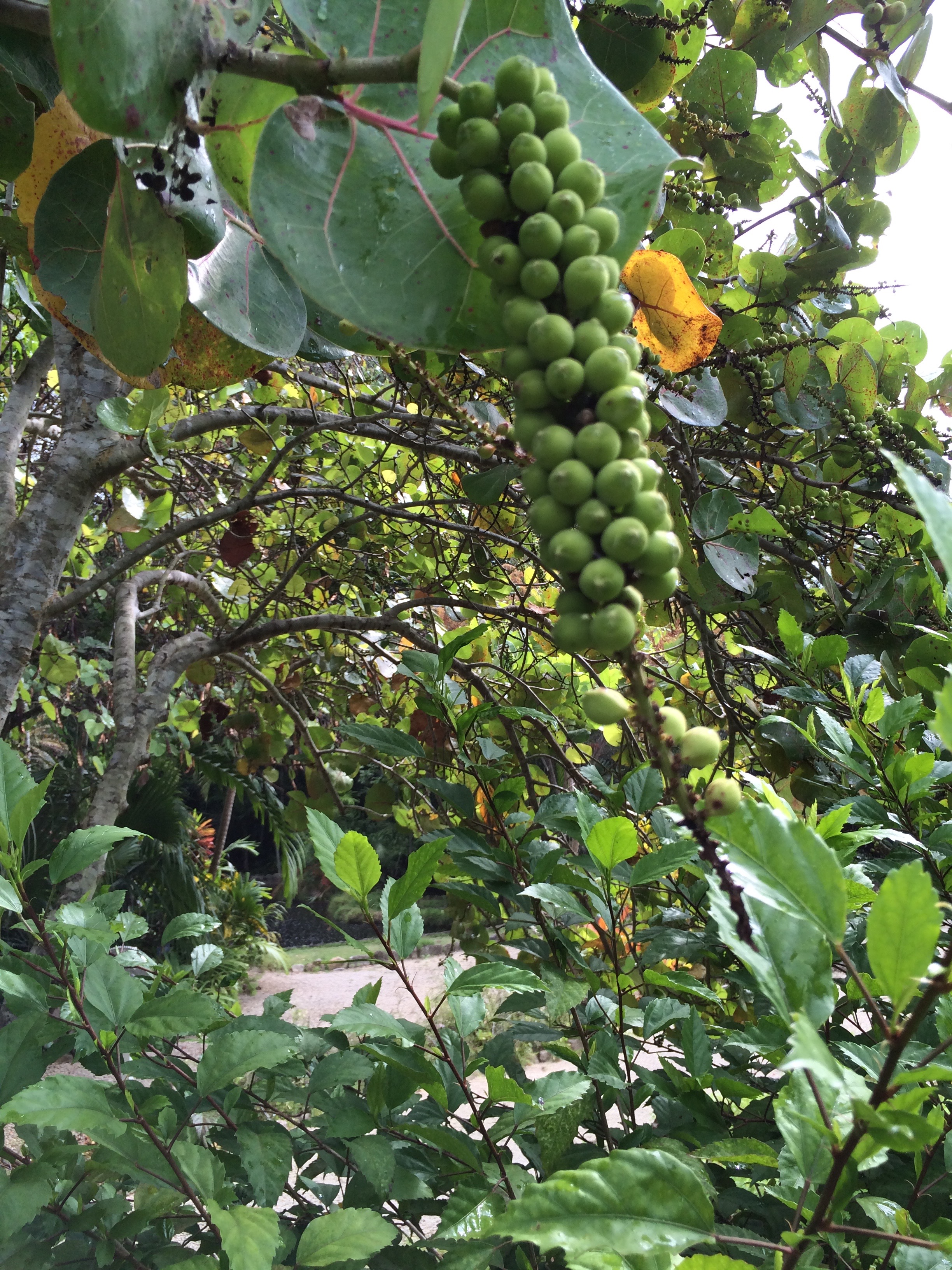
IMG_6107 (1)Have you heard of Sea Grapes? Have you ever tasted a wine made with Sea Grapes? I’d like to what the aroma and taste is like.

During a trip to Grand Bahama Island last week, we visited Freeport. From the pier e enjoyed participating in an excursion to The Garden of the Groves. According to our guide, the Groves garden was built to honor two Americans who had purchased land and then proceeded to add a pier and roads. Years later the land was sold for millions of dollars.

Of particular interest to us was a cluster of round berries that were similar to traditional grapes as they seemed to hang in a cluster. These berries are sea grapes, Coccoloba uvifera, family: Polygonaceae.

The Garden of the Groves sign posted by the plant notes:

This native tree was probably the first land plant seen by Christopher Columbus when he landed on Bahamian shores in 1492. He even stated in his journals that the large rounds leaves of this tree were used by the Lucayans as plates!

The Sea Grape is one of the first woody plants to colonize sandy shores and Lismore salt-tolerant than most hardwood trees. Small white fragrant flowers bored on long racemes occur in late spring and produce abundant nectar to attract swarms of honeybees. The species name uvifera is derived from Latin meaning ‘grape bearing.’ Clusters of recipe purple berries are not only favored by birds but are also eaten by humans. The fruit many be made into a wine-like alcoholic beverage or a slightly tart jelly. Leaves and bark are brewed into a tea to treat asthma as well as diarrhea.

Sea Grape trees may reach heights up to fifty feet and the large, dark-green leathery leaves with red veins that can be ten inches across make them attractive landscape species. They may also be pruned into hedges and are available in more local nurseries.

About the Garden of the Groves

The facility is certified by the Wildlife Habitat by the U.S. Wildlife Federation. Visitors to the Garden of the Groves are likely to see a large fish pond, birds, a Monarch Waystation and numerous plants including hibiscus. The trail through the garden is easy to follow. A tiny, maintained chapel is located on a hill. A large, well-maintained labyrinth can be used for meditation.

Cheers!
Kathy

Sagrantino Is not Sangiovese

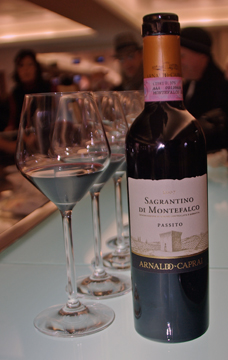
Arnoldo Caprai Winery's Sagrantino

Arnoldo Caprai Winery’s Sagrantino

In our second book, A Wine Tourist Guide Visiting Tasting Rooms, we wrote a chapter about wine misconceptions and myths. Arnoldo Caprai Winery in Montefalco, Italy sent  us two misconceptions that plagues their tasting room. Many visitors believe Montefalco is in Toscana (Tuscany) when it is really in Umbria. The region Umbria does share a border with the region Toscana. The other misconception deals with the grape Sagrantino, perhaps the signature grape of  the Umbria region. It is believed by some visitors that Sagrantino is just another name for Sangiovese, the main red grape of  Toscana. However, the two grapes are completely different with totally different profiles.

Consorzio Montefalco will be present at this year’s Wine Bloggers Conference in Corning, New York. The organization was formed in 1981 to promote the Sagrantino grape. Consorzio Montefalco will be showcasing DOC and DOCG wines from Umbria at the conference. Promoting Sagrantino is a challenge in the United States. It is unknown to many wine enthusiasts. Kathy and I first learned of Sagrantino from the owner of Firelands Winery,

Claudio Salvador. The winery is located in Sandusky, Ohio. Claudio’s wife and brother own wineries in Italy. Claudio is also involved with distributing wine from Italy. One of those wines was a Sagrantino from Umbria.

Claudio poured  a Sagrantino for tasting. I knew after my first taste of Sagrantino that this would be one of my favorite wines. The darker color should have been an indication that Sagrantino is not Sangiovese. I love wines that have outrageous tannins. Sagrantino delivers what I have call “kissing tannins,” a reference to puckering your lips. Sagrantino is food friendly and matches many Italian dishes. Perhaps the Wine Bloggers Conference will give wine bloggers, new to this varietal grape, a voice to inform their readers about this grape from Umbria.

Cheers,
Terry

Johnny Walker Tasting on the Seas

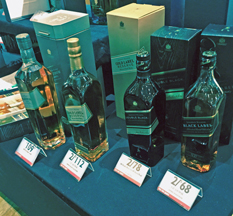
050915aA Johnny Walker promotional event on the Carnival Pride took place on our voyage. Of course after the tasting, there was a special discount for their products. The discount was 10% which amounted to over a $300 saving on the most expensive bottle. When I learned the cost, I moved away from the counter the bottle was on, not wanting to take a chance on tipping the bottle over.

050915bThere were several different bottle of JW including:
Black with 12 years of aging and a cost of $40
Double black $45
Gold $68
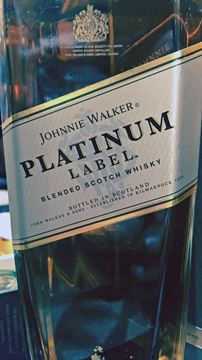
Platinum with 18 years aging, $110
The Royal Route $159
The Gold Route $105
The Spice Shop $45
Blue $177
Blue Cruise $275
King George, made with distilleries that were only opened during the reign of King George, $515

Two of the scotches were tasted. The Platinum with18 years of aging had a gold color. The aroma and taste included sweetness, grain and peat. It was smooth with heat on the finish. The 10% discount brought the cost down to $99. We saw the same Platinum at a duty free wine shop in Freeport, Bahamas for $87. It helps to do your research.

The second scotch was the Spice Shop. This too had a gold color. It had a sweet taste with peat and spice notes.

What I learned from this tasting is that I do not like the influence of peat on the whiskey. My preferred whiskey continues to be bourbon.

Cheers,
Terry


info@winetrailtraveler.com            Sitemap                      Privacy Policy

Copyright: Terry and Kathy Sullivan 2006-2013