-1.5in.jpg)


Yesterday we had a delightful visit to Cakebread Cellars in Napa Valley. The winery emphasizes fine wines and food. Enjoy the recipe below from Cakebread Cellars.
Cheers! Kathy
Duck with White Wine, Garlic and Picholine Olives
Serves 4
Ingredients
4 Peking duck legs
1/2 yellow onion, minced
1 carrot, minced
1 stalk celery, minced
3 cloves garlic, peeled
1/2 c white wine
2 t tomato paste
3 sprigs thyme
1 bay leaf
1 1/2 c brown chicken stock
1 c picholine olives, pitted
Salt and pepper
Directions
- Preheat oven to 350° F.
- Season duck legs with salt and pepper.
- Place duck legs skin side down in a wide bottom skillet over high heat, brown on both sides and remove from the skillet.
- Pour off all but two tablespoons of the duck fat and sauté onion, carrot, celery and garlic to lightly caramelize.
- Deglaze with white wine and scrape the brown bits and glaze off the bottom of the pan with a wooden spoon.
- Reduce wine by half.
- Add tomato paste, thyme and bay leaf.
- Return duck legs skin side up to pan along with chicken stock and olives.
- Stock should cover the duck three quarters of the way. Bring to a simmer, cover and place in the middle of the oven.
- Cook for one hour until duck is starting to pull away from the drumstick.
- Uncover and continue cooking in the oven for 15 – 20 minutes until duck is tender and beginning to brown.
- Place pan under broiler for a minute to crispen the skin.
- Skim the sauce of any rendered fat and spoon over duck.
Serve with olive oil crushed potatoes and/or sautéed escarole.
Enjoy with a glass of Cakebread Cellars Napa Valley Merlot.
Recipe provided by Cakebread Cellars in Napa Valley, California
Customer Service
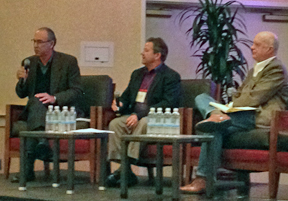
Dixie Huey, of Trellis Wine Consulting and Allan Wright, of Zephyr Adventures, teamed together to present the top ten customer service suggestions. These items were general enough to apply to tasting rooms, touring companies, travel organizations as well as writers. The presenters started with number 10 which was to know your ethos. This includes your brand and logo.In self reflection our brand was rather obtuse the first couple years of Wine Trail Traveler’s articles. We eventually acquired a logo, from a designer, and now there is a feeling of identity. The logo helps define our brand.
The 9th suggestion was to put the ethos into action. For tasting rooms, staff should all be on the same page mentioning a number of significant points that builds up and defines the brand. Tasting room staff should evaluate how they greet customers and how they use a guestbook. The most time consuming suggestion was to follow-up a visit by emailing or calling the visitor and thanking them for coming to the winery. The 8th item was to seek feedback. This would include looking at the items mentioned above and deciding how to quantify them, collect data and act on the data. One can also create surveys and analyze the data from the survey. The tasting room staff along with other winery staff should meet, discuss and seek ways to constantly improve.
The 7th listed item was to learn from mistakes. Allan talked about the need to fix mistakes. Complaints should be taken seriously however action on a complaint may or may not be justified.
The 6th item was to keep a database on your customers. This database can be used to determine the most frequent customers as well as the customers who spend the most. If you have people sign up for a monthly newsletter, send them a monthly newsletter.
Allan’s 5th item was to recognize repeat customers. That’s is why it is important to keep a database. It was suggested that repeat customers receive invitations to special events . They can also be given discounts on future orders.
Dixie’s 4th suggestion was to seek outside best practices. She said, “Look at the competition. What are they doing?” We have traveled to enough tasting rooms to identify some excellent practice that it would be nice for other tasting rooms to adopt. We have also observed spies, however they are usually known. If you pick up information from visiting other tasting rooms, going on other tours, or observing other travel organizations, share that information with your staffs. Ask your staff how you can use that information to provide great service.
Allan’s #3 suggestion certainly addresses one of my annoyances. The suggestion is to answer the phone and return phone calls. In a like manner, answer emails. I’d like to add that one should also check their junk email folder daily to see if legitimate emails were filtered into it. We have not visited hundreds of winery tasting rooms because they don’t return call or answer emails.
Dixie’s #2 item was to engage everyone. She suggested that tasting room staff make phone calls to their best customers and most frequent customers thanking them. This practice should be done by the entire staff including winemaking staff and vineyard staff. As a teacher, we were asked to call parents on a regular basis to tell them how well their child was doing. This was a change over the typical calls from a teacher that usually had something negative to discuss. The parents appreciated the positive phone calls.
The #1 suggestion was opened to the audience. So I’ll give my two cents. If you are producing a quality wine, serve it in quality stemware. We have had a discussion with a few winery owners who want to serve their wines in plastic cups. One even uses nice plastic cups while others use the plastic cups people receive at their doctor’s office for a urine specimen. What does plastic say about your wine? The ISO glass stemware is better than plastic, but not by much. The entire winery staff should have a discussion about the stemware used to present their wine to visitors who come to the tasting room to sample the wines. What message do you want to give a population that is growing in wine knowledge?
These suggestions are valid for tasting room staff, tour operators and travel organizations. You can probably add others and change the order of importance to best suit the needs of your company.
Cheers
Terry