January 26, 2009 – 2:02 pm
As we travel from tasting room to tasting room, we discover many differences between each one. Upon leaving we ask ourselves several questions. Why were we allowed to pour our own tasting (this has only occurred at two wineries and under watchful eyes)? Why didn’t they have crackers at the tasting counter? Wasn’t it wonderful that they offered a cheese and cracker tray? Why don’t more wineries have restaurants? Why did they use an ISO wineglass, plastic cups, hand painted (only at one winery) or Riedel glassware for the tasting?
As we discuss the whys and what if questions, only occasionally do we reflect on whether some obscure law is in effect. In Maryland, counties have different laws regarding wineries and tasting rooms. Richard Seibert from Knob Hall Winery (opening soon) in Maryland would like to see Maryland consider a Class W license. According to Erin Cunningham in The Herald-Mail, “The Class W license would allow the sampling and selling of winery wines at the winery for on- or off-premise consumption, allow the business to hold events and allow the winery to operate seven days a week, among other things.” Each jurisdiction has its own laws. We visited a winery/vineyard in the United Kingdom that if the winery is closed, consumers can pick up their wine in a local post office. I don’t know of any wineries in the United States that can do that.
Cheers, Kathy
January 23, 2009 – 1:50 pm
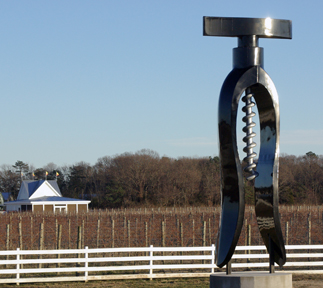 The Northern Neck Wine Trail has been renamed as the Chesapeake Bay Wine Trail. While many people are familiar with the Chesapeake Bay, others question where Virginia’s Northern Neck region is located.
We had the opportunity to visit several of the wineries located in this region last week. Varying in size and style, they all offered a different experience for visitors. If you are looking for a rustic experience with camping, fishing and picnic grounds stop at Belle Mount Winery. Perhaps you would enjoy the elegant style wineries at New Kent Winery or Potomac Point Vineyard & Winery.
Do you want to view a unique piece of sculpture? Check out the entrance at White Fences Vineyard and Winery. The tasting room at Vault Field Vineyards is decorated with lights, flowers and candles. Athena Vineyards & Winery offers a delightful ambience featuring Athena, the goddess of wisdom. All of these wineries have lovely views of vineyards. The Oak Crest Vineyard & Winery tasting room offers artist quality selections created by area artists. Ingleside Plantation Winery is the oldest established winery on the wine trail. The Hague Winery located in Hague, Virginia will open in May of 2009. Each winery offers a unique facility to visit and enjoy conversation and wine.
Cheers!
Kathy
January 22, 2009 – 12:03 pm
Yesterday I commented on racking the mead that finished fermentation. Of course we tasted it. Currently it has a yellow opaque color. The wonderful aroma is honey and floral. The taste is honey. The finish is dry, although there is a slight sweetness that may be perceived. The mead is 12 percent alcohol. There was quite a bit of carbonization in the mead. One taster asked if it was a sparkling mead. For now, it just has to sit and age. I’d like it to become translucent, so I’ll continue to rack it over the next several months. I am surprised at how easy it was to make the mead. The most time consuming part is cleaning and sanitizing the equipment. Perhaps I’m a bit paranoid about sanitizing the equipment, however, I’d rather not come this far and ruin the mead.
Last week I wrote about Paradocx Vineyards Barn Red, a red blend sealed in an air-tight bag and placed in a paint can. Manufacturers of the bag claim that it can keep wine good for up to six weeks. So how is the wine one week after opening it? The Sangiovese and Cabernet Franc blend still had a nice red cherry aroma and taste. It was still crisp and had light tannins. Thus far this is the best opened one-week old wine that I have tasted. Wine stored in an air-tight bag, whether in a box or paint can, may be a great option for a casual wine drinker who doesn’t finish a bottle for a dinner. I’ll report next week on how the wine is after two weeks.
January 21, 2009 – 1:32 pm
My mead has stopped its fermentation so I decided to rack it off the lees. I had to decide what size container to rack it into. The current three-gallon carboy had too much headspace. For aging, the mead should be filled into the neck of the container. Less oxygen will come in contact with the mead. I had this issue with a previous Cabernet Sauvignon that I made. Several winemakers suggested going to the wine store and purchasing a bottle of wine to top off the wine in the carboy. Mead isn’t the easiest thing to find so I took a different approach.
Knowing that I had less than three gallons and that I would not rack off all the mead, I decided to rack into two one-gallon jugs. I filled each into the neck and inserted the air lock. I had less than a gallon left over so I put this in a half-gallon container and inserted an air lock. My plan is to use the mead in the half-gallon container to top off the mead in the gallon jugs. However it occurred to me that if I take mead out of the half-gallon container, then the mead in that container would come in contact with more oxygen. So how do you solve that challenge? Fortunately I have the opportunity to interview many winemakers. Two solutions were presented, one common sense and the other rather unique. The common sense solution is to pour the remaining mead from the half-gallon container into a smaller container. You can always drink anything left over. The more unique solution, which is the one I’ll use, is to place marbles in the half-gallon jug until the level of the mead rises into the neck. I never would have thought of that.
Most winemakers are eager to talk about their craft. They have a wealth of knowledge, some learned from textbooks, some passed down from multiple generations and some learned from trial and error.
Home winemaking is an interesting hobby, one that is filled with trial and error, and much learning as well as the potential enjoyable results to drink. Enjoy a trip into the world of home winemaking.
January 19, 2009 – 2:20 pm
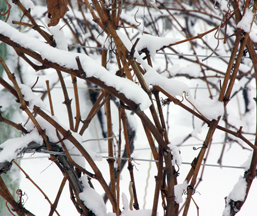 Last week as we visited wineries in the Northern Neck area of Virginia, ice-chilling winds buffeted us as we walked to vineyards. Even with the green foliage long past gone, the architecture of the vines is a statement of hope and a photographic opportunity.
However, the mind numbing temperatures of 5 degrees Fahrenheit brought up a question, “Will the roots survive these cold temperatures?” One winemaker commented, “Oh yes, there shouldn’t be any problem.”
Throughout the United States, there are several techniques used to protect grapevines from the icy cold of winter. First vineyard owners always try to choose grapevines that will be able to withstand temperatures too low or too high. Once the vineyards are in place, some vineyards will heap additional soil around their base. Other vineyards like on the Leelanau and Old Mission Peninsulas in Michigan, expect enough snow to protect their vines. Last year when we visited these two peninsulas in January, there was very little snow and all of the winemakers and vineyardists were hoping for a substantial snowfall.
As much of a concern as cold winter temperatures are, most vineyards will be more affected towards spring hoping that the buds on the vines will not be subjected to a late spring frost. While some vineyards use wind machines to lessen the impact of a frost, many vineyards do not have wind machines.
In the meantime, we wish all vineyards a successful journey through severe ice chilling temperatures.
Cheers! Kathy
January 18, 2009 – 3:05 pm
More vineyards are popping up throughout the United States than ever before. Research is taking place at educational institutions, including New York, Minnesota and Virginia and some states like Colorado are funding vineyard research. More varieties of grapes are available. As a result, some people are beginning to enjoy different styles of wine. Grape varietals have intensely different flavors. Taste a Cabernet Sauvignon grape and you will discover that the grape flavor is much different from a Cabernet Franc. Therefore, it follows that the wines produced from each will be different. Nevertheless, does being different mean it’s a bad wine. Not at all. Some wine drinkers like the same wine repeatedly but others like a change. On the other hand, perhaps you enjoy different wines with different foods.
Terroir adds to the difference that wines can be also. You should not expect every Cabernet Sauvignon to taste the same. If you do, I think you are in for a disappointment when visiting wineries. Based on the grapes, the rootstock and the terroir, wines can vary greatly. The key is to know the difference between a wine that is different and a wine that has a fault.
-1.5in.jpg)


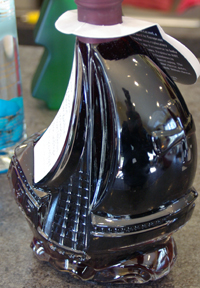 A casual remark made at a winery the other day, made me rethink the concepts of wine in plastic bottles. While most wineries continue to sell wine in glass bottles, many are beginning to look at plastic wine bottles or bags inside cardboard boxes or yes event plastic bags inside a plastic paint bucket as a viable solution. Granted glass is far heavier than plastic so shipping expensive are higher with glass bottles.
Exposure for Wineries
Every wine enthusiast is aware of the big names in the wine industry whether it be wine regions, winemakers or labels. Even the new wine drinker will have heard of the names via news or advertisements. So what about the small, relatively unknown winery that makes quality wine?
Yesterday I heard from a small winery in Virginia that is currently producing 2500 cases of wine each year. In his email, Lew Parker owner and winemaker at Willowcroft Farm Vineyards emphasized that he appreciates any exposure for his winery, writing: “Definitely, would love any exposure we could get.”
This is the plight of the unknown winemaker. No matter how good his wines may be, there is always the difficulty of letting the public know about his wines and how to obtain them.
Wine trail organizations help to get the word out but not all wineries participate in wine trails. A number of states offer information about wineries in their states including Colorado, New York, Pennsylvania, Virginia, Maryland and North Carolina. You may want to do an Internet search for wineries in your state. Consider trying a new wine from a winery that you haven’t tried before.
Cheers, Kathy