About     FAQ     Contact      Advertise With Us      Press   

Lagar da Condesa, A Rias Baixas Winery

An Albariñ wine from Lagar da Condesa

Earlier this year, we attended a Rias Baixas wine tasting just outside of Washington, DC. Numerous wines from this region of Spain were available to taste including one wine from Lagar da Condesa winery which grows only the Albariño grape variety.

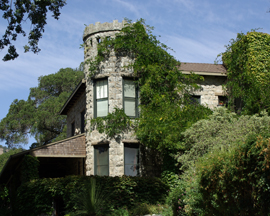
The Lagar da Condesa winery in Pontevedra, Spain is located in the Rias Baixas region. The winery is a member of the Gil Family Estates wineries. The small, relatively new winery, dates back to 2013. It is located in the Arcos da Condesa area. The winery itself is built of granite. The

Rias Baixas wines at a wine tasting earlier this year

structure is considered to be a typical Pazos (manor house) in the Galicia region.

The Lagar Da Condesa 2015 wine was produced with a combination of stainless steel fermentation and French oak fermentation. This wine with 12% alchohol retails for a reasonable $18. The winery’s tasting notes for the wine: “Brilliant pale gold in color, copious apples and pears infused with mouthwatering aromas of lemon, outstanding fruit with a touch of honey beautifully focused and mineral. The attack is rich and broad packed with ripe citrus concentration, dense and fleshy, very good acidity with a long finish.” Suggested food pairings are: a variety of fish, shellfish, white meats, vegetables, rice and salads.

Interview (online) with Winemaker David Landin, Lagar da Condesa

What are your most enjoyable aspects of winemaking? 

It is a whole bunch of emotions but the most satisfying part is observing how the grape transforms and evolves until obtaining a great wine.

How and when did your wine journey begin?

I inherited my passion for wines from my father, with the vineyard we owned at home. Later in 2000, I participated in a tasting contest by chance. When it ended I knew I wanted to make wines when a grown-up. I studied for that and nowadays this is what I do for living with the same passion than the first day.

Why did you decide to start making wine? 

I loved working in the vineyards and when in 2002 I got the opportunity to work in a winery and make wine, that was the achievement of a whole year of hard work in the vineyard.

How many hectares of grapes are you growing? Which varieties are you growing?

We grow around 50 acres, all of them planted with albariño.

What do you wish you knew when you started making wine that you now know? 

How difficult can be making a good wine.

To what do you contribute your success as a winemaker? 

Consistency

Albariño is a very food friendly wine. What types of foods do you like to pair with Albariño wine?

Every food can be paired with albariño wines, even meat. But albariño is outstanding with sea-flavored dishes.


When you have the opportunity, be sure to try the Lagar da Condesa Albariño wine.
Cheers!
Kathy

Champagne Colin: A Premier and Grand Cru Champagne Estate

Champagne Colin is the oldest champagne house that we tasted wines at the APVSA (the Association for the Promotion of Wine and Spirits in America) tasting in Washington DC.  The house was established in 1889; now the seventh generation is leading this champagne house in crafting champagnes made with Grand Cru and Premier Cru grapes. Champagne Colin is located in Vertus, a village in the south of Côte des Blancs.

In the past, the champagne house was a cooperative. That changed under the leadership of Richard and Romain Colin in 1995. They became independent winegrowers. They produced champagnes from their 11 hectares (27 acres) of grapes. Most of the vineyards are planted with Chardonnay grapes, however, they family also has plantings of Pinot Noir and Pinot Meunier. Most of the 11 hectares of vines are classified as Premier Cru and Grand Cru.

Kathy and I tasted four of the champagnes in their extensive portfolio. The Cuvée Alliance was a blend of 65% Chardonnay from a Premier Cru vineyard in Vertus and 35% Pinot Meunier from a vineyard in Sézanne. The dosage was 10g/l and the wine aged for 15 to 24 months prior to disgorgement. The yellow colored champagne had multiple columns of tiny bubbles forming a surface mousse. It offered apple and citrus with a very creamy mouthfeel. This champagne could be served as an aperitif as well as with chicken dishes.

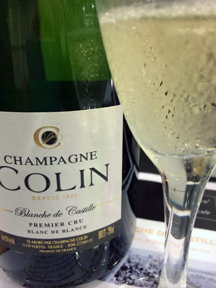
The Cuvée Blanche de Castille, Premier Cru was crafted with 100% Chardonnay from Vertus and Bergères-les-Vertus Premier Cru. The dosage was 7.5g/l and the wine aged 24 months prior to disgorgement and an additional six months after disgorging. The yellow colored champagne had multiple columns of tine bubbles forming a center mousse. Apples and and freshly baked bread were noticed on the aroma and taste. The mouthfeel was creamy. There was a crisp fruity finish. Use this champagne as an aperitif or match with seafood especially shrimp.

The Cuvée Grand Cru Millésime 2008 was crafted with Chardonnay grapes from the Cramant and Oiry Grand Cru vineyards. The dosage was 8g/l and the wine aged for 7 ½ years prior to disgorgement. An additional six months of aging continued after disgorging. This dark yellow colored wine had multiple columns of tiny bubbles forming a mousse around the glass circumference. The champagne aroma and taste was reminiscent of freshly baked bread, apple and citrus. The fruity finish yielded to mineral. Serve this elegant champagne as an aperitif.

Our final tasting was the Cuvée Rosé. The blend is 85% Chardonnay and 15% Pinot Noir that was vilified as a red wine. The grapes were sourced from Premier Cru family vineyards in Vertus and Bergères-les-Vertus. The dosage was 12g/l and the champagne aged for 22 months prior to disgorgement and 6 months after disgorging. The wine had a salmon color with red hue. Strawberries and apples were noticed. The mouthfeel was crisp. Use this champagne as an aperitif or pair with red berry desserts.

We enjoyed these champagnes and hope Champagne Colin finds a distributor in the Washington DC area.

Cheers,
Terry
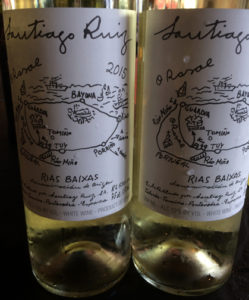
Santiago Ruiz, A Rias Baixas Winery

Santiago Ruiz

Earlier this spring, we attended an Albariño wine tasting, with the focus on Albariño wines from the Rias Baixas region of Spain.

The Santiago Ruiz 2015 was a blend of Albariño, Loureiro, Treinadora, Modelo and Caiño Blanco. The wine was dark yellow color with a gold hue. The aroma was of tropical fruits and blossoms. The taste included notes of peach, blossoms and a hint of pineapple. It was a medium-bodied wine. The finish was very crisp with citrus notes. This 12.5% alcohol wine retails for $20.

An explanation of the Santiago Ruiz’s wine label is written on the label, “Santiago Ruiz daughter´s, Isabel, was celebrating her wedding at the winery- house. She drew a little map to help the guests finding the right way and as soon as Santiago Ruiz saw it, he added his name to the map and decided on that inimitable drawing to be the final label. The text on the label is his own handwriting.”

Santiago Ruiz follows in the historic family footsteps of his grandfather who in 1860 started a winery. According to the Santiago Ruiz website, Santiago’s grandfather “was one of the first to produce and bottle wines in Galacia.” Today Santiago’s daughter, Rosa Ruiz, continues her father’s philosophy at the winery.

The 38 hectares (94 acres) of vineyards are located in the O Rosal region and are influenced by the Miño River and the Atlantic Ocean. At harvest time, grapes are harvested by hand. One of the important grapes in the vineyards is the Albariño. Santiago  Ruiz is acknowledged to have recognized the importance of the Albariño grape and other Spanish grape varieties for winemaking.

In an online interview, Luisa Freire, winemaker at Santiago Ruiz, responded to our numerous questions.

1. What are your most enjoyable aspects of winemaking?

I enjoy all the process. Every step has its delight. From harvesting, which is the last cycle of the vineyard but the first of the wine, to bottling, which is the conclusion of a whole year of work. The magic moment is harvesting, though. Because every year is different. The climate conditions are never the same, the vineyard performance either. Each and every year you hope to have the best harvesting to make a memorable wine.

2. How and when did your wine journey begin?

It started late. After 10 years working on the soft drinks industry, I went back to college to get my PhD. I focused on microbiology and specifically on wine. I got trapped in the magic of the wine world.

3. Why did you decide to start making wine?

The more I studied about wine the more I got attracted to the possibility of “playing” with it. Fortuity or destiny took me to a course where I met someone that owned a small vineyard. In 1994 I made my first wine with his first 1,750 pounds of grapes. At that moment, I decided that was what I wanted to do for living… and here I am!

4. How many hectares of grapes are you growing? Which varieties are you growing?

We own 84 acres and control another 15 acres from external winegrowers. We grow Albariño, Loureiro Blanco (both needed to make Rosal),  Treixadura, Godello and Caiño Blanco.

5. What do you wish you knew when you started making wine that you now know?

If I had known that I was going to enjoy this world that much, I’d have started before. The most important learning is that we work with a living being, so every year is different and the grapes will decide how our work will be during that year.

6. To what do you contribute your success as a winemaker?

My success is the success of the wine. I enjoy my job and making the grape express its full potential. At Santiago Ruiz the team works hard to get a better wine every year.

7. Albariño is a very food friendly wine. What types of foods do you like to pair with Albariño wine?

There are Rias Baixas wines for every moment and food. There are lighter fresher ones that pair perfectly with the fish and seafood from the rías; and there are full-bodied ones, like Santiago Ruiz, that can pair with Asian cuisine, white meats, pates, and a wide range of cheeses, from Galician tetilla cheese to semi-cured cheeses.

Albariño is becoming a go to white wine for us.

Cheers,
Kathy


Champagne Philippe Gamet’s Bubbling Personality

Mother/daughter team at the Washington DC. APVSA wine tasting: Fabienne and Marianne. Image provided by Champagne Philippe Gamet.

One family, two French villages and four generations have molded Fabienne and Philippe Gamet to craft quality champagnes for the Estate Champagne Philippe Gamet. Fabienne and Philippe began the champagne company and now work with the next generation of Gamets: Jean-François and Marianne. Kathy and I met the mother-daughter team at the APVSA (the Association for the Promotion of Wine and Spirits in America) tasting in Washington DC. Fabienne mentioned that they are small producers that emphasis quality and price.

Their vineyards are located in three villages including Mardeuil, Damery and Fleury-la-Rivière. These three villages are close to Épernay in the Vallée de La Marne. The Champagne Philippe Game vineyards are planted with 55% Pinot Meunier, 35% Pinot Noir and 10% Chardonnay. The average age of the vines are 30 years old. Although mechanical plowing is done, harvest is done by hand.

We tasted five of their seven champagnes. All of the champagnes had multiple columns of tine bubbles rising to the surface many forming a central mousse. The first was the Brut Sélection Blanc de Noirs, a blend of 60% Pinot Meunier and 40% Pinot Noir.  The grapes for this champagne were sourced from Mardeuil, Damery and Fleury-la-Rivière. The dosage was 9 g/l and the wine aged for 25 months prior to disgorgement. Red berry fruit was most notable with a bit of citrus on this light yellow colored wine. The champagne had a nice mouthfeel and a crisp finish. It would be a perfect aperitif.

The second champagne was the Brut Cuvée 5000, a blend of 35% Chardonnay, 35% Pinot Noir and 30% Pinot Meunier. Grapes were sourced from family vineyards in the Mardeuil, Damery and Fleury-la-Rivière villages. The dosage was 8 g/l and the wine aged 40 months prior to disgorgement. The light yellow colored champagne was quite crisp with a floral note accompanying citrus. The wine pairs well with seafood. The name 5000 is from the first year of the winery. They produced 5,000 bottles.

The Extra Brut Caractères was a blend of Pinot Noir, Pinot Meunier and Chardonnay with grapes sourced from Mardeuil, Damery and Fleury-la-Rivière. The solar system was used and the base wine aged in oak for 12 months. The dosage was 4g/l and the wine aged 45 months prior to disgorgement. This wine had a yellow/gold color. Citrus and freshly baked bread were noticed on the aroma and taste. The mouthfeel was creamy. The finish was crisp with fruit yielding to mineral. The champagne is a good match for seafood.

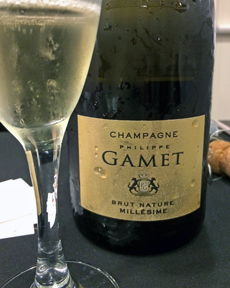
The Brut Nature Millésimé was a blend of 35% Pinot Noir, 35% Chardonnay and 30% Pinot Meunier. Grapes were sourced from family vineyards in the Mardeuil, Damery and Fleury-la-Rivière villages. This wine received no dosage and aged 45 months prior to disgorgement. The light colored wine reminded me of crisp apples citrus and mineral. It was quite dry, years ago I discovered that I prefer Nature champagnes especially paired with food.

Our fifth champagne tasted was the Brut Rosé, a blend of 60% Pinot Meunier and 40% Pinot Noir. Of the Pinot Meunier, 20% was vilified as a red wine. The dosage was 10g/l. The bubbles formed a center mousse on the surface of the wine. This salmon colored champagne offered red berry fruits and had a very creamy mouthfeel. The wine can pair with salmon and desserts. It would also make a wonderful aperitif for National Rosé Day.

During the tasting, Fabienne and Marianne took turns talking about the wines. It was nice to see the mother/daughter team working together and there personalities match the bubbling excitement in the glasses. We met another mother/daughter team on our second trip to Champagne at Champagne Charlier & Fils.

We enjoyed the champagnes and hope that Champagne Philippe Gamet can find a distributor in the Washington DC area.

Cheers,
Terry

Rosato di Sangiovese from V. Sattui Winery

Sangiovese Rosé from V. Sattui Winery in Napa

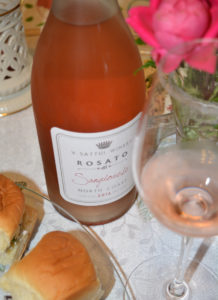
A second rosé we opened for our daughter’s shower was the 2016 Rosato di Sangiovese. This rosé was produced by V. Sattui Winery located in Napa Valley’s St. Helena area.

The delightful Rosato di Sangiovese was a lovely shade of pink with an orange hue. The wine offered an aroma and taste of strawberries and raspberries. Delightful for anytime of the year, the spring/summer weather made it even better. The finish was crisp with fruit notes yielding to some mineral. The wine had 13.4% alcohol and a residual sugar of 3.0 g/L.

The winemaking notes were comprehensive included that the majority of the grapes in this rosé were from V. Sattui’s Hibbard Ranch property, located along the Los Carneros and Mt. Veeder appellations. A portion of the grapes were from the Adobe Creek vineyard below Clear Lake.

The grapes were harvested at night by hand in mid-September 2016. At the time the brix level was 22.3.  The winemaking techniques included whole cluster pressing and 24 hour cold soaking. The chosen yeast was Premiere Cuvée. Some of the grapes were destemmed and macerated for several hours in a bladder press. The two were then blended.

Looking for a rosé for your next summer gathering? Try the 2016 Rosato di Sangiovese which retails for $26.

About V. Sattui Winery

In 1882, Vittorio Sattui and his wife came to the United States from Italy. They began making wine in 1885. They prospered until Prohibition arrived and they were forced to close. In 1975, Dario, a great-grandson, opened V. Sattui Winery.

V. Sattui Winery produces an array of wines including reds, whites, rosés, desserts and sparkling wines. They also make large format wines including: Magnum, Double Magnum, Imperial and Nebuchadnezzer.

The next time you visit Napa Valley you will want to include a visit to V. Sattui Winery.

What rosé are you planning to enjoy today for National Rosé Day?

Cheers!
Kathy

VieVité Extraordinaire a Hit at a Baby Shower

While in college, our daughter Erin spent a study abroad semester in Provence. Upon returning to the US, she taught us what she learned in a wine class that she took while in France. Fast forward to today and Erin is looking forward to the birth of her first child. We helped organize a shower while she was home visiting. For the shower, Erin had several long-time friends visit from New York City. In selecting wines, I wanted to have something stylish that would reflect Erin’s past.

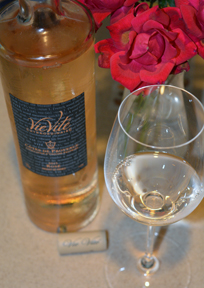
We received a sample of the VieVité Extraordinaire, a rosé wine from the Côtes de Provence region of France. I thought this beautiful rosé would be an elegant starter at the shower. Erin did inform me that she could taste the wine, and her friends certainly would drink it. Gathered around the kitchen peninsula, we opened the bottle and had it as an aperitif.

The wine is crafted by Domaine Sainte Marie near Saint Tropez in the Provence region of Southeastern France. The winery dates back to the 18th century and is known for its 80-year old Grenache vines. This rosé was a blend of 85% Grenache, 10% Cinsault and 5% Rolle. This rosé comes in a beautiful bottle. The grapes macerated with the juice for a short time to capture the color. The light salmon colored wine offered a fruit salad aroma. It had strawberry and mango tastes and a crisp, fruity finish. Although it pairs well with seafood, roasted turkey, duck and rabbit, we discovered that it was a fitting aperitif to celebrate bringing friends together for a special occasion. The VieVité Extraordinaire is distributed through the country in many fine restaurants and wine stores. The MSRP for the VieVité Extraordinaire is $29.99.

Erin (left) and friends

With National Rosé Day (June 10, 2017) quickly approaching, consider the VieVité Extraordinaire with your daily meals or as an aperitif. Kathy and I would consider this a 3P wine. It pairs well with a porch, patio or pool.

Cheers,
Terry

Champagne Bauchet Washington DC Tasting

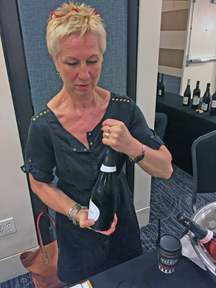
Florence opening the Cuvée Origine

We receive several invitations to travel to Washington DC for a wine tasting. This week we were invited by the APVSA (the Association for the Promotion of Wine and Spirits in America) to taste wine predominately from France. I have a soft spot for champagne, in part because we visited the Champagne region twice and I enjoy the bubbly. Our first stop was Champagne Bauchet where we met Florence Bauchet Labelle who is the director of the champagne estate.

Florence was passionate and as bubbly about her products as the champagne in the glass. She mentioned that her grandmother made champagne as well as her parents. She wanted to follow in the family footsteps and do her part to continue the family business. Smiling, she added, “I also love champagne.”

The champagne estate began in 1920 when Félicien Bauchet harvested his first champagne grapes. Through the decades, the family continued to grow grapes and make the sparkling wine. Today the 1920 one-hectare vineyard has grown to 34 hectares (84 acres) spread out over seven areas. Chardonnay and Pinot Noir are planted in various vineyards located in Côte des Blancs, the Montagne de Reims and in the Côte des Bar. We discovered the meaning of the logo for the champagnes. It is a combination of the B from Bauchet and a heart. The heart represents the love the family has for each other, the love they have for the land and their love of champagne.

Three champagnes were tasted. The Cuvée Origine was crafted from a blend of 70% Pinot Noir and 30% Chardonnay. The grapes were sourced from the family vineyards in Côte des Blancs, the Montagne de Reims and in the Côte des Bar. The champagne had a dosage of 8 g/l of sugar and aged for 24 months prior to disgorgement. The light yellow color wine had multiple streams of tiny bubbles. Apple and pear along with a nutty presence were observed on the aroma and taste. The finish was crisp and refreshing.

The second champagne tasted was the Cuvée Signature – Premier Cru. This champagne was blend of 80% Chardonnay and 20% Pinot Noir. Grapes were sourced from the family’s Premier Cru vineyards in Côte des Blancs and Montagne de Reims. This champagne also had a light yellow color and there were multiple columns of tiny bubbles. The wine had 8 g/l of sugar and aged for 36 months prior to disgorgement. This elegant champagne offered apple notes and had a crisp finish that was pleasant and refreshing.

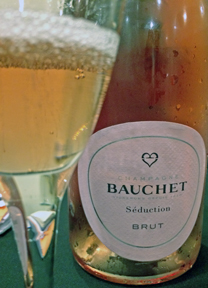
Our third champagne tasted was the Cuvée Séduction, a rosé. The wine was a blend of 75% Chardonnay and 10% Pinot Noir. The salmon color was achieved by adding 15% red wine to the blend. Grapes were sourced from the family vineyards in Côte des Blancs and Montagne de Reims. This wine was just a hint sweeter than the first two with 10 g/l of residual sugar. The wine was aged for 24 months prior to disgorgement. Multiple columns of tiny bubbles rose to the surface. The champagne offered apple notes with strawberry hints. It had a crisp finish.

I asked Florence about collecting placas, the metal caps protecting the cork from the wire. She gave me a set of Champagne Bauchet placas for my collection. Both Kathy and I were delighted in the champagnes from this family and hope they find a distributor in our area.

We were impressed at the number of producers that had the owners or staff from the winery pouring the wines. The APVSA did a nice job placing front line people to relay there passion for their portfolio of wines.

Cheers,
Terry

Recipes for National Fishing & Boating Week

Nearshore Adventures

National Fishing & Boating Week is taking place now! The 2017 Fishing & Boating Week started June 3 and continues thru June 11.

I am fascinated with this idea of a week devoted to celebrating fishing and boating. Terry’s brother recently published a book, Nearshore Adventures, in which Todd and Sheryl write about their journey to fishing in Michigan.

The www.takemefishing.org website suggests seven fishing ideas to try this week.

  1. Find places to fish. The website provides a map for helping you find a fishing location.
  2. Visit a The Best Family-Friendly Places to Fish and Boat
  3. Learn to fish.
  4. Share your #FishCatch photos.
  5. Visit a fishing or boat event
  6. Teach someone to fish.
  7. Spread the news about the National Fishing and Boating event on social media.

It seems it’s never too late to learn to fish.

Of course, if you are lucky and able to come home with fish for dinner, what will you do with it? Check out the fish recipes that use wine as an ingredient on the Wine Trail Traveler website. Several of the recipes are listed below.

Cheers!
Kathy

RoséFest, a Napa Valley Charity Event!

Stags’ Leap Winery will participate in RoséFest!

RoséFest in Napa Valley takes place June 24 at Sterling Vineyards. The RoséFest will benefit the important Susan G. Komen Organization. The Executive Director of Susan G. Komen – Northern and Central California, Kelly MacMillan, will be on hand to provide information about breast health.

RoséFest will feature elegant rosés in Napa Valley. Wineries participating in the RoséFest event include: Adi Rose, Beaulieu Vineyard, Benessere, Black Stallion, Boisset Collection, Ca Momi, Castello di Amarosa, Clos Pegase, Cru, Château Minuty, Cornerstone Cellars, Define Wines, Duckhorn Wine Co., Digression, Etude, Fleury Estate, Luna, Michael Mondavi, Mumm, Paradigm, Peju, Pellet Estate, Provenance Vineyards, Rutherford Hill, Sill Family Vineyards, Stags’ Leap Winery, Starmont, Sterling Vineyards, St. Supery, Swanson Vineyards and Yao Family Wines.

Four restaurants will be providing food bites. Restaurants include: Acacia House, Archer House-Charlie Palmer, Goose & Gander and Brasswood. Food trucks will also be available. Look for Cousins Maine Lobster, Crossroad Chicken, Ca’ Momi and Marks the Spot.

General admission tickets are $65. This ticket includes admission to the main tasting. People with general admission tickets will have the opportunity to taste more than 20 rosés from Napa Valley. Ticket holders will also enjoy food bites from five restaurants and receive a complimentary Riedel wine glass.

VIP ticket holders will receive all of the above plus have access to the VIP Lounge with five special rosés. They will also be entitled to one glass of wine on the lawn. In addition, they will receive one ticket to use at the food truck of their choice. The VIP tickets are $85.  Tickets for the RoséFest are available online.

Cheers!
Kathy

A Special Lemonade for Grown-Ups!

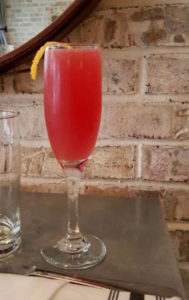
Lemonade for Grown-ups with Prosecco!

Be sure to gather up the ingredients for this super cocktail soon. This sparkling cocktail is the answer to a delightful day relaxing on the patio!

While out shopping this weekend, pick up strawberry vodka (or make your own), hibiscus syrup, lemon and Prosecco.

Pink Prosecco Lemonade 

Ingredients

•1.5 oz Homemade Infused Strawberry Vodka
•1 oz Hibiscus Syrup
•.5 oz Lemon Juice
•Prosecco
•Lemon twist, for garnish

Directions

  1. Combine vodka, lemon juice and hibiscus syrup in a cocktail shaker with ice.
  2. Shake.
  3. Pour into a flute and top off with a splash of prosecco.
  4. Garnish with lemon twist.

The recipe is from August restaurant in Manhattan. According to the email from Diaz-Schloss Communications,  “Relocated to Manhattan’s Upper East Side from its longtime West Village location, August serves casual, refined, expertly prepared American Bistro cuisine in a convivial setting that evokes the warm, relaxing vacation days of late summer. Open daily for lunch + dinner; weekday drinks specials and weekend brunch.”

Cheers,
Kathy


info@winetrailtraveler.com            Sitemap                      Privacy Policy

Copyright: Terry and Kathy Sullivan 2006-2013