About     FAQ     Contact      Advertise With Us      Press   

Finger Lakes: Glenora Wine Cellars’ Restaurant

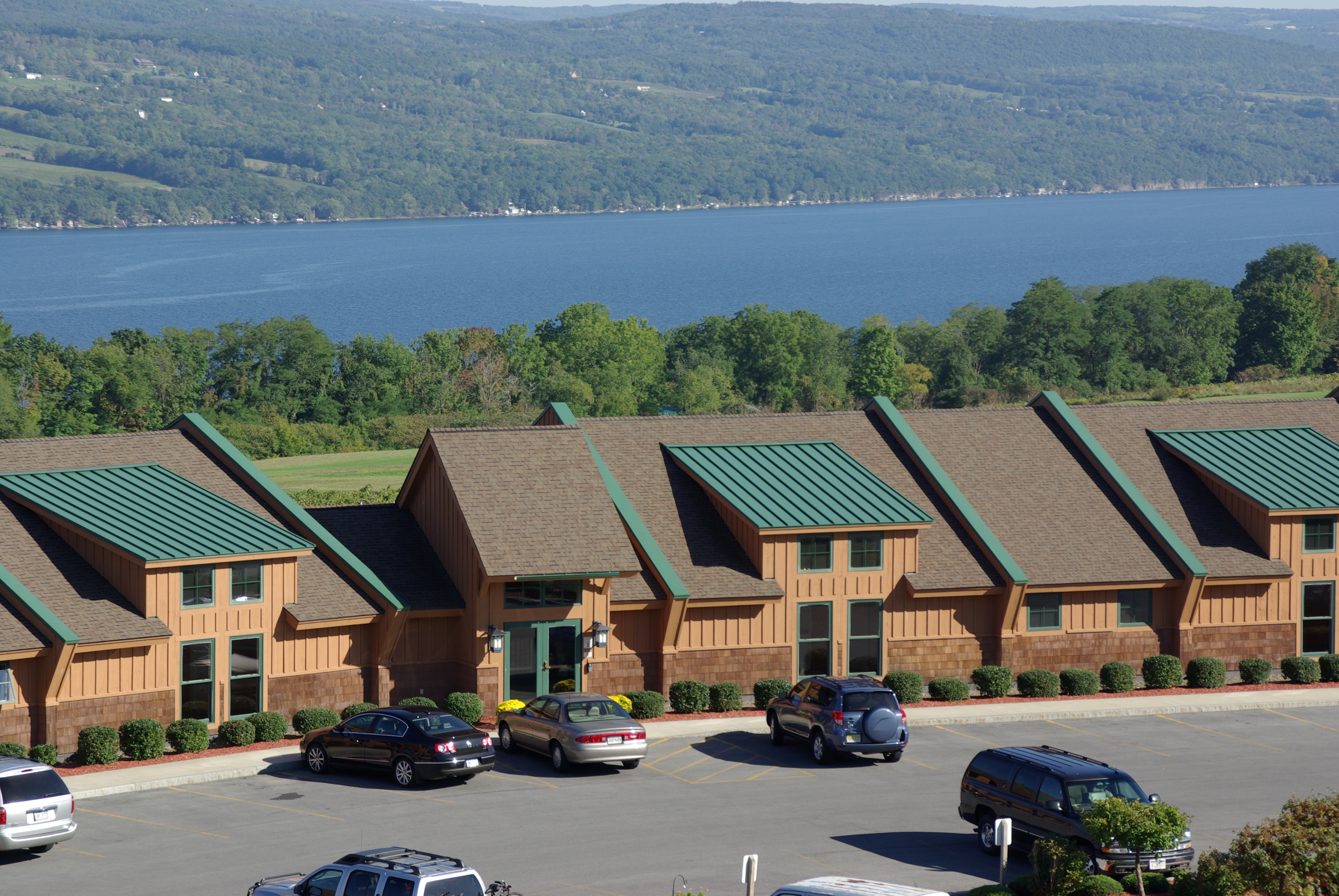
Glenora Wine Cellars' Inn, Finger Lakes

Glenora Wine Cellars’ Inn, Finger Lakes

Yesterday after a busy day visiting four wineries in the Finger Lakes region of New York, we had reservations for dinner at Glenora Wine Cellars’ Veraisons Restaurant. The experience was delightful with indoor and outdoor seating overlooking the beautiful and enticing Seneca Lake.

Veraisons Restaurant is situated in the same complex where Glenora’s inn is located. The executive chef is Orlando Rodriguez.

The summer dinner menu included salads and soups for starters, boards of cheese samplers and a charcuterie board, small plates for those with smaller appetites and dinner entrees. The menu is labeled with foods marked as vegan, vegetarian, gluten free and dairy free.

As we had been tasting wines all day, we decided not to order a glass of wine although it would have been very nice to have enjoyed a Glenora wine with our dinner.

Terry ordered the soup special of the day, a fish stew and a large Veraisons Green Salad. The description of the salad included greens, feta, Riesling soaked watermelon, candied pistachios, and Riesling vinaigrette.

I ordered a traditional crispy fried chicken entree accompanied by a large biscuit, gin pickled cucumbers and corn butter.

Prior to our dinners arriving, a bread basket was brought to the table. The

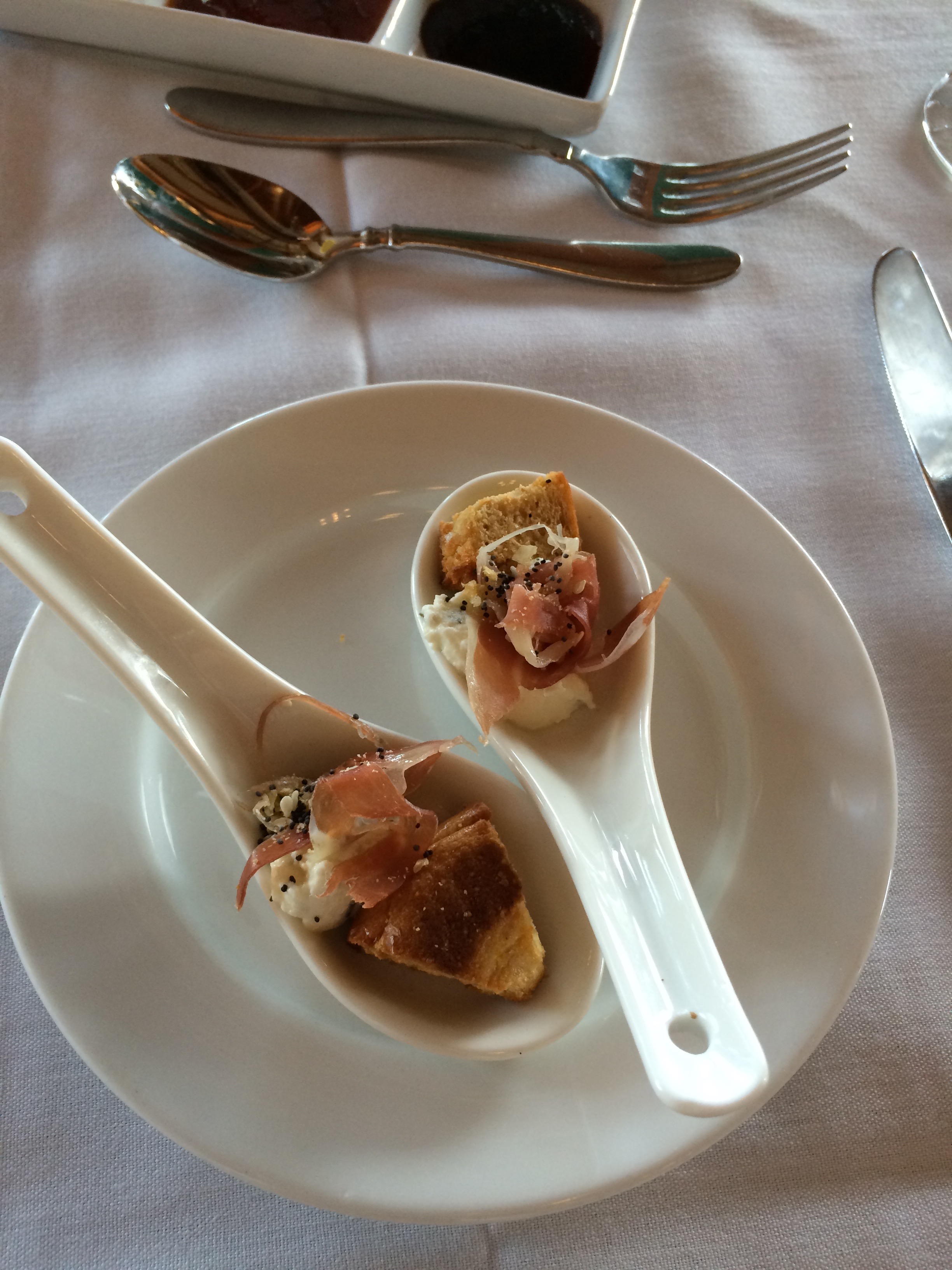
Appetizer at Veraison Restaurant

Appetizer at Veraison Restaurant

bread was tasty and looked and tasted home baked. A choice of three sauces came with the bread. Then a small appetizer consisting of a bite of bagel with charcuterie arrived at our table with the compliments of the chef.

As we enjoyed our dinner we continued watching Seneca Lake changing with the approach of evening. The Veraisons Restaurant offers a relaxing evening dinner for travelers along the Seneca wine trail.

For those traveling at other times of the day Veraisons offers breakfast and lunch menus. Check it out when traveling in the area.

FYI.  Our dinner was comped by Glenora Wine Cellars.

Cheers, Kathy

Someone Is Negative About Your Writing

071315aThe last day of the Wine Bloggers Conference in Corning, New York offered spirited panel discussions with audience input. The first session was titled, The Secrets to Wine Blogging Success and starred Madeline Puckette from Wine Folly, Jana Seitzer from Merlot Mommy, and Frank Morgan from Drink What You Like. One question raised was how to deal with negativity about your writing.

Kathy and I experience this a few weeks ago. After doing nothing immediately, we let it rest for awhile and then composed a positive response. However, taking our particular tact did nothing to soften the blow. Years ago I copied a response by an author to a friend that was on the receiving end of negativity. Unfortunately, I have forgotten the source of this piece, but thought it may prove helpful to those attending the session and wondering about dealing with negativity.

I have an acquaintance with a New York Times best selling author originally from Bisbee and we’ve met more than once.  Not long before one of our meetings, I had someone slam me and my writing, actually telling me I should go back to college and start over.  When I shared this with this author, she said the following to me and I’ll never forget it:

Nancy, every writer worth their salt is told they can’t write.  I was told this, Stephen King was told this, Dick Francis was told this, even Hemingway was told he should stop writing.  Can you imagine a world without Hemingway?  As much as it stings to hear you can’t write, understand from whom it’s coming and where it’s coming from.  First, for a person to go out of their way to say something that mean to you tells me they’re mean like that in real life and not a happy person. The kind of anger expressed towards writers, when it comes from a fellow writer, comes from an extremely ugly place inside a person and that’s not someone I want to know.  Second, and this is the most important, for someone like that to go out of their way to even say the things they say, well, they’re also incredibly jealous.  My thoughts on this guy saying this to you?  Enjoy the fact he has just put you in some incredible company and has assured your success.

I hope this helps you when you deal with negativity. The first half of the response was appropriate for us.

Cheers,
Terry

Red and Rosé Wines Live Blogging Haikus

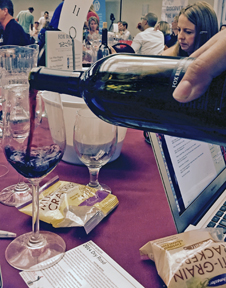
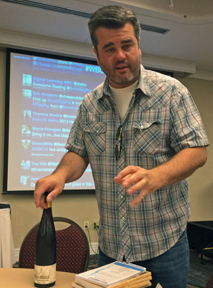
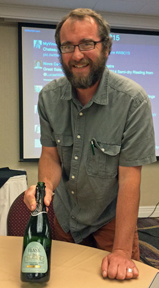
081615aOn our second day of the Wine Bloggers Conference, it was time for the winemakers to speed taste their red or rosé wines. The winemakers had five minutes to pour and talk about their wines to the bloggers that were typing away tweeting, trying in ernest to type less than 140 characters as they listened to the winemakers and tasted the wine. It does take some practice for the winemakers. They are trying to talk about their wines and at times it looks like their captive audience is not paying attention. In reality, the bloggers are multi-tasking. Paying attention is one of their tasks and although they may be typing, they are still listening. As with the white wines, I wrote a haiku for each of the red or rosé wines tasted.

Lakewood Vineyards 2013 Cabernet Franc

Dark ruby Cab Franc
Dark fruits, plum, leather, yummy
Lakewood Vineyards rose

Heron Hill – 2013 Eclipse

Cab, Cab, Merlot blend
Translucent ruby color
Bottled for six weeks

Sheldrake Point  – 2014 Rosé

Light pink with orange hue
Floral and red berry fruit
Nice Cabernet Franc

081615bDr. Konstantin Frank – 2012 Cabernet Sauvignon

Cassis, black berries
Smooth, fruity, tannins, leather
Doctor Frank’s C. S.  

Knapp – 2014 Cabernet Franc Rosé

Light orange skin contact
Berry fruits, smooth, refreshing
Rocking chair and porch


Chateau Lafayette Reneau – 2013 Meritage Cab, Cab, PV and Merlot

Dark ruby black fruits
Cabs, Petit Verdot, Merlot
Fruit forward leather touch

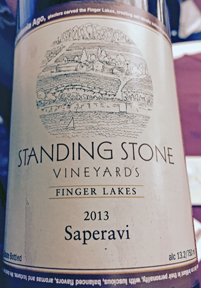
081615cStanding Stone – 2013 Saperavi

Georgian black grapevine
Saperavi black, fruits, yum
Delicious black grape

081615dFox Run – 2012 Lemberger

Translucent ruby
Dark fruits, black berries, leather
Fox Run Lemberger

J. R. Dill – 2013 Cabernet Sauvignon

Fruity dark, cassis
With kissing tannins, leather
J. R. Dill Cab S


Ventosa Vineyards – 2011 Cabernet Franc

Three plus years French oak
Opaque dark ruby, fruity
Leather Cabernet

Cheers,
Terry

White Wines Live Blogging Haikus

081515cOne of the sessions at the annual Wine Bloggers Conference is a blogging session of white wines. Winemakers from the Finger Lakes wineries were on hand to pour a wine and talk about it in just five minutes. The bloggers multi-task. Listening to the winemaker, tasting the wine and blogging, all within the five-minute time frame. Once over, the winemaker takes his wine to another table and the process is repeated. For this session, I have resorted to writing Haikus. The poetry fits nicely in a tweet and once starting I usually can get on a roll.

Haikus

Bellangelo – 2013 Semi dry Riesling

Bellangelo white ?
Riesling mineral, fruity ?
Complex delicious

081515dDr. Konstantin Frank Wine Cellars – “Celebre”

Dr. Frank’s sparkling ?
Riesling citrus, mineral
?Fizzy, agressive

Red Newt Cellars – Dry Riesling

Red Newt Dry Riesling ?
Mineral, smooth, yellow stone
?Crisp, dry where’s the food??


081515eGlenora Wine Cellars – 2014 Gewürztraminer

Gewürztraminer ?
Spicy, mineral, floral ?
Dry, smooth, Glenora ?

Hunt Country Vineyards – Vidal Blanc Ice Wine

Honeysuckle ice
?Vidal Blanc, velvet, fruity ?
Hunt Country dessert

Standing Stone Vineyards – Gewürztraminer

Standing Stone yellow ?
Spicy, floral, stone fruit, dry
Gewürztraminer

Fox Run Vineyards – 2011 Reserve Riesling

Yellow, petrol wine ?
Fruity, mineral Riesling
?Fox Run pair with food?

Fulkerson Winery – 2014 Grüner Veltliner

Grüner Veltliner ?
Floral, mineral, fruity ?
Fulkerson winery?

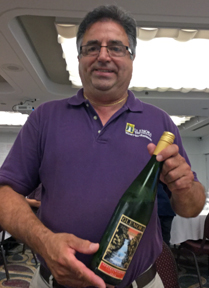
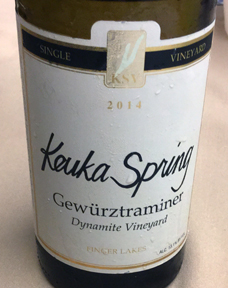
081515fKeuka Spring – 2014 Gewürztraminer

Dynamite Vineyard ?
Floral, spicy, velvety
?Gewürztraminer

3 Brothers – 2014 Grüner Veltliner

Grüner Veltliner ?
Floral, mineral, fruity ?
Three Brothers sweet touch?

Cheers,
Terry

“Know Wine Well”

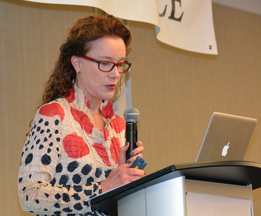
081515aKaren MacNeil delivered the keynote address at the 2015 Wine Bloggers Conference in the charming town of Corning, New York. Karen gave the wine writers, bloggers and authors several things to think about that will help us improve our writing. One of her suggestions is that we should “know wine well.” This led me to reflect on how Kathy’s and my wine journey led us to “know wine well.”

Experiencing the intermediate level of WSET, I decided to change course on acquiring wine knowledge. By 2008, the next year, focus shifted to making wine. Kathy and I reasoned that if we were going to write about wine, we should make it. We have made wine at home since 2008, as well as making wine at a winery in Virginia, a teaching winery in Maryland and a winery in the country Georgia. While making wine in Virginia and Maryland, we took an online winemaking course through Washington State University. As we learned more about winemaking, we realized that we were ignorant of many things related to viticulture and oenology. However, we also believe that in making wine, we have a better understanding of wines.

When we first started making wine, we learned as much of what not to do as we did of what to do. Starting with a wine kit, our first wine was not quaffable. At that time we spoke with many winemakers who offered suggestions. The wine had a geranium taint. Later I learned what I did to cause this. One of the suggestions was to put a bit of port in a glass then pour the wine. Another winemaker argued, “Why ruin the port.” We decided to break away from wine kits. By 2009, we were making wine at wineries, what a difference! We learned that making wine in small containers was a challenge, a challenge that rings true today when trying to make wine in our 23 liter qvevri. At wineries, we made our wine in barrels. That was actually easier than making wine in vessels that were only a few gallons.

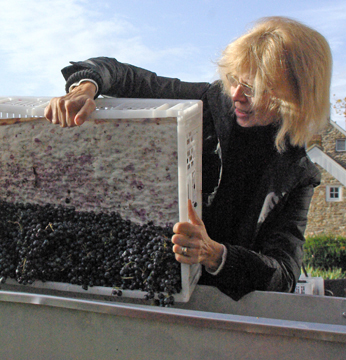
Kathy adding Cabernet Sauvignon to destemmer at Tin Lizzie Wineworks in Clarksville, Maryland

Kathy adding Cabernet Sauvignon to destemmer at Tin Lizzie Wineworks in Clarksville, Maryland

Our winemaking experiences include making wine in glass carboys, oak barrels and qvevri that are buried underground. We brought a small qvevri back with us from the country Georgia and have it buried in our yard at home. After preparing the qvevri for burying, we made our fist vintage of wine in it in 2104. This year we hope to make a Georgian grape variety Rkatsiteli in our qvevri. Qvevri winemaking is an unusual winemaking process that is ancient. There are few wineries in the United States making qvevri wine, although it is beginning to gain popularity in Italy and some other European countries.

We take cleanliness seriously and probably over sanitize and clean. I learned that I react to potassium metabisulfite very quickly, while Kathy can tolerate it. Kathy now does the most of the sanitizing. Equipment does need to be clean. A winemaker told me if there is crud in a container and you sanitize it, you just have sanitized crud. You do not want that in your wine.

We did revisit a kit wine in 2011. But we purchased a high-end expensive kit, and the wine turned out fine. When it comes to kit wines, you get what you pay for. We made other wines at home from scratch including peach wine, mead and two white Cabernet Sauvignons, one with Virginia juice and the other with Maryland juice. We also made a decent second run wine. After pressing our must at a winery, we collected the pomace and added sugar water to it. The grapes were sourced from Stagecoach Vineyards in the Atlas Peak AVA of Napa Valley. The table wine turned out fine with surprisingly dark ruby opaque color and good fruit notes.

We believe our winemaking experiences have given us a different understanding of wine, one that is more scientific and mathematical along with a dose of creativity. There are many avenues that lead to wine knowledge. I am not suggesting that wine writers start making wine to know wine well, but for us, making wine was a road to further our wine knowledge.

Cheers,
Terry

Virginia Wines at Pre-WBC15

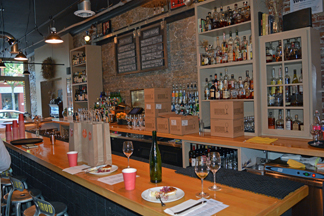
Hand & Foot in Corning, New York

Hand & Foot in Corning, New York

Kathy and I had a delightful evening last night starting with a special, by invitation only, dinner at Hand & Foot in Corning, New York. The two-hour event took place right before the start of the 2015 Wine Bloggers Conference, just a few blocks away. The dinner showcased several Virginia wines and the fabulous foods created by Hand & Foot. The dinner and wine pairing was coordinated by Frank Morgan and was sponsored by Early Mountain Vineyards. The dinner brought back memories of the 2011 Wine Bloggers Conference that was held in Charlottesville, Virginia.

The first half hour was meet and greet. During that time we had a  Early Mountain Vineyards Rosé that was a blend of Merlot and Malbec. The rosé was a pink with salmon hue color. The refreshing wine was a perfect greeting wine as well as a good choice for a rocking chair on a porch during a summer day. Frank Morgan welcomed the group and introduced Early Mountain Vineyard. The tasting of wines was led by Neal Wavra, a sommelier from Virginia.

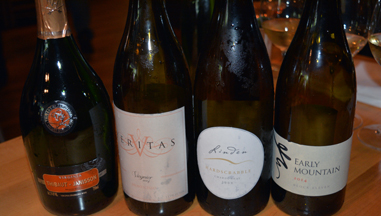
White wine flight

White wine flight

First Course

The meal was served in three courses and a wine flight to accompany each course. The first course consisted of four white wines accompanied by:

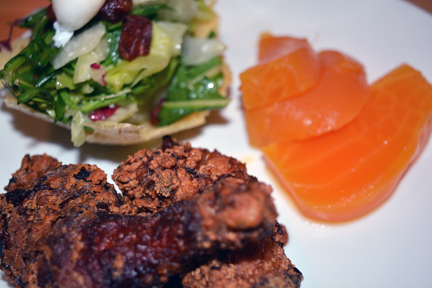
yard!bird (fried buttermilk, brined!poussin)
country caesar (bitter greens, anchovy vinaigrette, bacon lardon and a poached quail egg)

Four white wines accompanied this course. The  Thibaut-Janisson Blanc de Chardonnay was a non-vintage brut that offered some apple and pear. The fizz was perfectly matched with the food. Next was a 2014 Viognier from Veritas Vineyards. This light yellow colored wine offered mineral and tropical fruits. The minerality enhanced the country caesar salad. A 2009 Linden Vineyards Chardonnay from their Hardscrapple Vineyards was the third selection. This wine also had an apple and pear profile. The fourth wine in the flight was a 2014 Block Eleven by Early Mountain Vineyards. This blend of Petit Manning and Muscat offered floral and tropical fruit notes with a crisp finish that paired well with the food.

yard!bird (fried buttermilk, brined!poussin) country caesar (bitter greens, anchovy vinaigrette, bacon lardon and a poached quail egg)

yard!bird (fried buttermilk, brined!poussin)
country caesar (bitter greens, anchovy vinaigrette, bacon lardon and a poached quail egg)

Second Course

Continueing the theme of Southern cooking, the second course offer a red wine flight and the following:

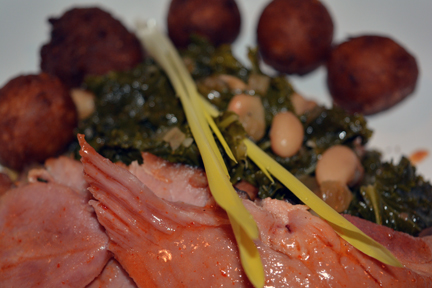
ham (cholula/honey glaze)
greens & beans (smoke kale, bacon and white beans)
hush!puppies (masa, sweet corn and onion)
boiled peanuts (raw peanuts, chipotle and old bay)

The pairing started with a 210 Reserve Cabernet Franc by Barboursville Vineyards. The dark ruby colored wine reminded me of dark fruits. The wine had tannins with a fruity finish and a trace of chalk. It paired well withe the course. The next wine was my favorite. Fabbioli Cellars 2012 Tannat was an opaque dark ruby color. This wine also offered dark fruits and had very bold “kissing” tannins. A 100% Petit Verdot 2012 by King Family Vineyards was the next wine in the flight. This wine also offered dark fruits, tannins and a crisp finish. The flight ended with a 2009 RDV Vineyards Rendezvous. This blend of Merlot, Cabernet Sauvignon, Cabernet Franc and Petit Verdot was a dark ruby color, offered dark fruits and tannins with a crisp finish. All the wines in this flight complemented the food in the course.

ham (cholula/honey glaze) greens & beans (smoke kale, bacon and white beans) hush!puppies (masa, sweet corn and onion) boiled peanuts (raw peanuts, chipotle and old bay)

ham (cholula/honey glaze)
greens & beans (smoke kale, bacon and white beans)
hush!puppies (masa, sweet corn and onion)
boiled peanuts (raw peanuts, chipotle and old bay)

Third Course

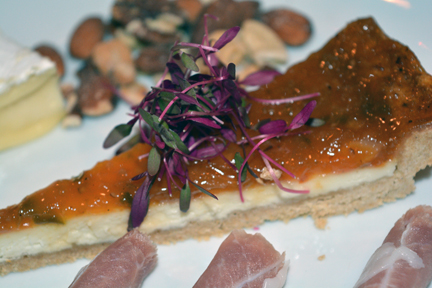
Next up was the dessert course. The plate included:

tart (lively run chevre and mango/jalepeno chutney)
prosciutto, chaseholm farm’s camembert

The course was paired with two dessert wines. The Glen Manor Vineyards 2012 Petit Manseng was a late harvest wine. The gold colored wine offered floral notes of honey suckle and jammy tropical fruits. The second offering was a Michael Shaps Raisin d’être Rouge. The late harvest cabernet Franc had dark jammy fruits with a hint of earthiness. Once again, the wines in this flight matched well with the food.

tart (lively run chevre and mango/jalepeno chutney) prosciutto, chaseholm farm’s camembert

tart (lively run chevre and mango/jalepeno chutney)
prosciutto, chaseholm farm’s camembert

Frank Morgan, Neal Wavra, Early Mountain Vineyards and the chef and staff Hand & Foot did an excellent job of preparing the meal and matching with Virginia wines. Perhaps this dinner will foreshadow the 2015 Wine Bloggers Conference.

Cheers,
Terry

Saperavi Finds a Home in Central Pennsylvania

Fero Vineyards and Winery in Lewisburg specialize in European grape varieties. One that has found a home is Saperavi, the most common black grape from the country Georgia. Chuck and Daneen Zaleski, owners, sourced Saperavi vines from the descendants of Dr. Konstantin Frank. Years prior to coming to the United States, Dr. Frank was a vineyard manager in Georgia. He settled down along Keuka Lake in New York’s Finger Lakes wine region.  Several wineries in Eastern United States have acquired grapevines of Saperavi and the white grape Rkatsiteli from Dr. Franks vineyard.

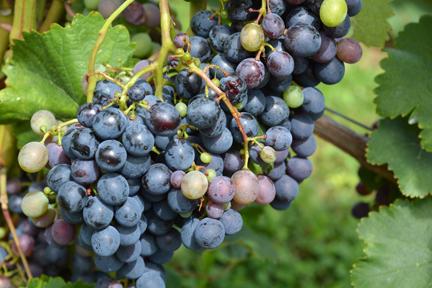
While visiting Fero Vineyards and Winery, we ambled with the vineyard staff to the top of a hill where the nine rows of Saperavi form a vanguard of the 12.5 acre vineyard that includes several other European varietal grapes. The Saperavi grapes began veraison two weeks ago. Tasting a riper looking berry, we noticed the seeds were still green as would be expected. The grape was flavorful and starting to develop the sugar content. The vines looked healthy and we were told that even though the winters are cold in Lewisburg, the Saperavi vines have thrived.

Saperavi grapes at Fero Vineyards and Winery two weeks after the start of veraison

Saperavi grapes at Fero Vineyards and Winery two weeks after the start of veraison

Back at the tasting room, adjacent to the vineyards, we tasted the only Saperavi vintage to date. The 2013 Saperavi was a translucent dark ruby color with a pink hue. We learned that many wine tasters comment about the darkness of color of the wine. The aroma had dark fruit notes. The taste reminded me of blackberries, black cherry and leather. This wine offered bold tannins and a long fruity aftertaste.

Are American wine enthusiasts ready for Saperavi? In an email interview, Chuck wrote, “We have released only one vintage so far. It is our most expensive wine and it sold out in a few months. It went over exceptionally well with full bodied red wine drinkers. I knew we were on to something when we served it on tap at a Bucknell University Board of Directors meeting. This was a sophisticated group of wine drinkers and it was universally loved. We have one bottle in the tasting room displaying the gold medal from the Finger Lakes International Wine Competition and someone offered to buy it for $60.”

Wine enthusiasts that like bold red wines will have no problem embracing wines made with Saperavi grapes. I have tasted many Saperavi wines made in European style and in the traditional qvevri style. Several of these can rival Cabernet Sauvignon. Cab drinkers should search out wines made with Saperavi and see if they enjoy this variety from Georgia.

Cheers,
Terry

In Search of Ancient Georgian Winemaking in America

The country Georgia has the longest, continuous winemaking tradition on the globe. They have 8,000 vintages. Yet, much about the viticulture and enology from this country is unknown by wine enthusiasts. There are those in the United States who are exceptions. We are constantly in search for native Georgian varietal grapes grown in the United States and ancient Georgian winemaking technique with qvevri buried in the ground. Qvevri winemaking is the only winemaking process that is on the UNESCO list of Intangible Cultural Heritage.
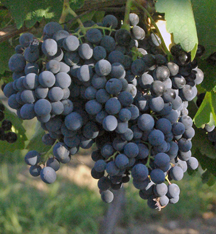
Saperavi grapes

Saperavi grapes

Sitting in the lobby of the Hotel Giò in Perugia, Italy, I joined a group from the country Georgia. Ia Tabagari was pouring wines from Georgia. Earlier that day I attended a session where Ia talked about qvevri winemaking. I found it extremely fascinating. The first wine Ia poured was an Rkatsiteli. I mentioned that I had wines made with this grape in the United States. The Georgians were surprised. Next they poured a Saperavi that I also had in the United States. The two main Georgian grapes, a white and a red, I have previously tasted at wineries in the Finger Lakes region of New York. In addition I had the white Rkatsiteli at wineries in Virginia.

Conducting a bit of research reveals the road these two varietal grapes have taken from Georgia to America. The six thousand mile journey was trekked by Dr. Konstantin Frank who managed a vineyard in the Kakheti region of eastern Georgia. Dr Frank eventually settled along Keuka Lake in the Finger Lakes region of New York. His research on cool and cold climate viticulture, while at the University of Odessa, led him to plant vitis vinifera grapes on his New York property. Dr. Frank is largely responsible for championing the planting of European grapes in the Finger Lakes region, where at the time native American grapes thrived.
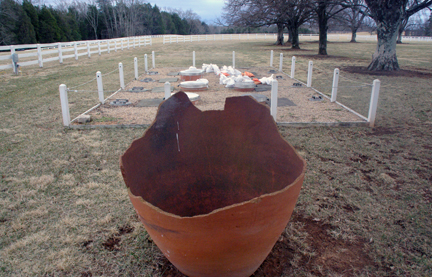
Buried qvevri and one broken qvevri at Castle Hill Cider in Keswick, Virginia

Buried qvevri and one broken qvevri at Castle Hill Cider in Keswick, Virginia

Dennis Horton of Horton Cellars in Gordonsville, Virginia acquired Rkatsiteli cuttings from Dr. Frank and now has several acres of Rkatsiteli growing in Virginia. Other Virginia wineries source some of the Rkatsiteli grapes and produce Rkatsiteli wines. A few wineries in the Finger Lakes are growing Saperavi that has also made its way to a winery in central Pennsylvania. Fero Vineyards and Winery in Lewisburg, Pennsylvania acquired Saperavi grapes from Dr. Frank’s descendants and has produced their first vintage. Georgian grape varieties are slowly beginning to spread throughout the United States. What about ancient Georgia qvevri winemaking?
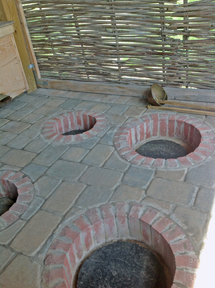
Marani at St. David Agmashenebeli, a Georgian Orthodox Monastery in Ashley, Pennsylvania

Marani at St. David Agmashenebeli, a Georgian Orthodox Monastery in Ashley, Pennsylvania

Our first view of qvevri in the United States was at Castle Hill Cider in Keswick, Virginia. Stuart Madany, production manager purchased several qvevris from craftsmen in Georgia and is fermenting cider in them. The qvevris were buried outside near the winery production area. Also buried outside, we observed a marani of qvevris at St. David Agmashenebeli, a Georgian Orthodox Monastery in Ashley just outside of Wilkes-Barre, Pennsylvania. Then there is the buried qvevri that Kathy and I brought back from Georgia and buried outside our house in central Maryland. We made our first wine in that small qvevri in 2014.

As American winemakers become aware of qvevri winemaking, some will want to experiment. The biggest challenge is acquiring qvevris to bury. Fortunately, America has a qvevri maker in Texas. The Qvevri Project is a group that is supporting qvevri winemaking with Georgian grape varieties in the United States. Billy Ray Mangham of Sleeping Dog Pottery in San Marcos, Texas is making and selling qvevris. He traveled to Georgia and learned qvevri making from craftsmen. Joining Billy Ray on the Qvevri Project are winemakers Dr. Brent Trela and Tom Vincent. The Qvevri Project also conducts research investigating wine production in qvevri.
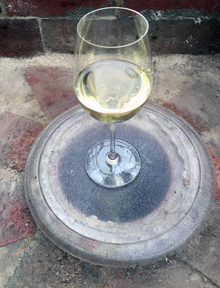
Our 1st qvevri wine made in Maryland

Our 1st qvevri wine made in Maryland

We have also heard of others in the United States who are growing Georgian grape varieties and making wine in qvevris, but we have not had an opportunity to visit them. Although qvevri winemaking may not be embraced by all American winemakers, there are enough who are creative and have a spark of interest in experimenting with wines made in buried qvevri. This interest is growing as more awareness of ancient winemaking techniques are learned.

Qvevri winemaking is fascinating due to its long history and the wines this technique produces. When you have an opportunity be sure to indulge in a tasting of qvevri-made wine.

For more information about wineries and winemaking in the country Georgia, visit our Georgia articles. For information about qvevri winemaking, check out our winemaking site.

Cheers,
Terry

The Palate Food + Wine Bar in Colorado

Food and Wine! Yum!

Food and Wine! Yum!

I just finished reading an article in the Denver Business Journal,  “150 wines by the glass? Inside the new south-metro bar with more to pour”  by Caitlin Hendee. The article is about The Palate Food + Wine Bar in Denver. This unique restaurant offers 150 wines by the glass.  The Palate is able to make so many wines available because they are using a wine-preservation system using argon gas. The restaurant was developed by the Vivek and Sanju Beri who are knowledgeable about wine. The Palate Food + Wine Bar is open for lunch and dinner.

The Palate Food + Wine Bar website offers detailed menus to browse before you go. In addition to wines from the US, the wine menu includes wines from France, Italy, Germany, Austria, Hungary, Chile, Portugal, and Spain.

The lunch and dinner menus include some great selections including salads, lunch/dinner plates, small plates and desserts. The wine bar also offers cocktails, aperitifs, spirits and beer.

The next time you head to Denver be sure to check out the restaurant. The address is: 5375 Landmark Place, Suite F-105, Greenwood, CO.

When planning a visit to The Palate Food + Wine Bar remember to keep track of the grape varieties you taste for your Wine Century Club tracking.

When you visit the wine bar, let me know how you like it.

Cheers!
Kathy

STOMP Out Cancer at Harvest Ridge Winery

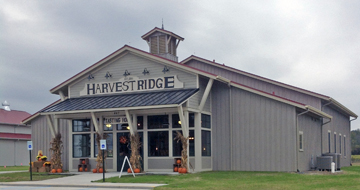
Harvest Ridge Winery, Delaware

Harvest Ridge Winery, Delaware

Harvest Ridge Winery is a recently opened winery hugging the Delaware and Maryland border. While vineyards are located in Maryland and Delaware, the tasting room and winery are just across the line in Delaware. This fall Harvest Ridge is hosting a charity focused on “STOMP.” According to a blog post “STOMP” is short for STOMP Out Childhood Cancer.

The STOMP event takes place September 19.

The event includes food trucks, wine, music, and stomping grapes. Food trucks attending the STOMP include:

  • WiLDWiCH
  • Wandering Chef Cart
  • I Don’t Give a FORK
  • Jerk King Caribbean Cuisine
  • Backyard Louie’s BBQ
  • The Frozen Farmer
  • Vitale’s Italian Ice

Participants in stomping grapes will be in teams of three and will have opportunity to win STOMP titles. People are encouraged to enter the Lucille Ball look-alike and best dressed contests.

Team registrations are$125 and include admittance for the three team members, three logo glasses, three glasses of wine or tasting flights and the grape stomp.

General admission will be $10 and includes a logo glass and a glass of wine or a tasting flight.

A raffle will be held for a handmade cooler made by a local resident. Raffles tickets are $1.

Proceeds from STOMP will benefit the A.I. duPont Hospital for Children’s Oncology Department.

Cheers!
Kathy


info@winetrailtraveler.com            Sitemap                      Privacy Policy

Copyright: Terry and Kathy Sullivan 2006-2013