About     FAQ     Contact      Advertise With Us      Press   

Our First Day in Tbilisi, Georgia (Sakartvelo): Birthplace of Wine

Bagrationi 1882, Georgia (Sakartvelo)

On Monday, we arrived in Tbilisi, Georgia at 4am. A driver met us at the airport and transported us to the Radisson Hotel. Quickly falling asleep we awoke for breakfast at 9am. Our first winery in Georgia was Tbilivino followed by Bagrationi 1882.

The breakfast at the Radisson was great. The buffet and had a large choice of fruits, meats, fish, cereals and breads.

Later on the way to the wineries, I noticed that while the traffic was lighter than in some major world cities, they seemed to have a mind of their own in terms of merging with traffic and lane changing.  At times it seemed like an intricate dance of cars. I was glad we had a great driver who knew the local traffic customs.

Our first winery we visited was Tbilivino where we needed to go through strong security to gain entrance to the parking area. We were met at the door of the facility where we began our tour just inside in large room with marble floors. We viewed the modern winemaking technology used to produce the wines followed by the tank room and barrel rooms. We went to a room on the second floor where we enjoyed tasting five wines including two that were made using the traditional qvevri. After we left Tbilivino it was not long before we arrived at our next winery Bagrationi 1882.

Bagrationi 1882 is wonderful especially for anyone who enjoys sparkling wines and Champagne. This winery produces mostly sparkling wines. Again the security at Bagrationi 1882 was strong. After securing permission, a large solid gate rolled back to allow entrance to the parking area. We were quickly greeted and entered the large facility. The entry way is large with stairways on both sides carpeted in red that curve up to the second floor. We visited the bottling line, sparkling winemaking room and the tank room.  We then tasted six sparkling wines in a smaller room lined with cubes filled with different sparkling wine bottles.

Soon our driver escorted us to the old area of Tbilisi where buildings are closer together and there are an array of shops, restaurants and cafes. Lunch was sumptuous as a variety of Georgian foods began to quickly arrive and filled the table to over flowing. Tourists will enjoy wandering through this area.

After sitting for an hour-long lunch, we were beginning to drag and we decided it was best to return to our hotel before a long dinner at 8pm.

Cheers,
Kathy

Our First Georgian Supra

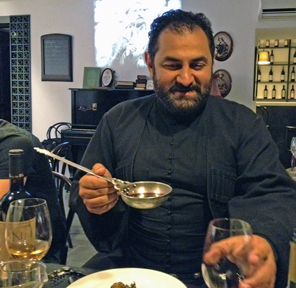
Laursab toasting wine at the supra

We managed to sleep off a rather large lunch and prepare for dinner at Azarpesha in Tbilisi, Georgia. Azarpesha is a wine restaurant and the wines for the evening were made in qvevri. When we arrived we were warmly greeted by Laursab Togonidze who spoke about efforts to increase awareness of qvevri wines and qvevri making. Laursab also spoke of his role as tamada for the evening’s supra.

As the guests arrived we moved to the long table set up for our group. Laursab directed the evening making several toasts. The toasts were short and heart-felt. We toasted God, Georgia, the guests, love, wine, the future, our children and others throughout the four-hour meal. After the toasts Laursab and two other singers sang traditional songs. Their singing was polyphonic. Kathy and I didn’t understand the words. We didn’t have to though. We felt the emotion of the songs and the harmonies were wonderful. I keep wondering if our music ministry group could arrange a polyphonic hymn for the mass I sing at.

The supra was the most welcoming meal that we ever attended. We felt like part of the family. The evening was moving and I, not knowing Georgian customs, asked privately if anyone would be offended if I offered a bottle of the wine that Kathy and I made. Laursab was very pleased that the guests would share a bottle of wine. He liked our name Illuminatus and the fact that the name was chosen because the experience of making the wine at a Virginia winery was very enlightening. I spoke a little about how we made the wine. Laursab picked up on my statement that the wine was like a child. While bottle aging, we had to open a bottle to see how our child was doing. This provided material for another toast and song.
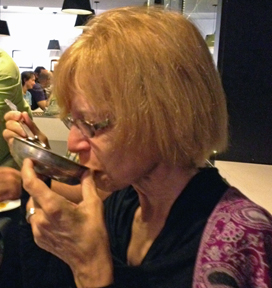
Kathy made a toast and then drank from a silver vessel.

We spoke about the qvevri wines we had with the meals. There are only a few qvevri makers left in Georgia. We toasted the future with the hope that the younger generation will take up the ancient craft of qvevri making. I mentioned a qvevri wine that we had at Kobola Winery in Croatia. I also spoke of a qvevri cider that is made at a cidery in Virginia. Our host was quite interested in a hard cider made in qvevri. We made a note to bring a bottle of qvevri cider on our next visit to Georgia in the spring.

The evening flew by. It had that magical component of wine, food and friends. However, that magic transcended onto another level. The Tamada’s toasts and polyphonic singing added a spiritual awareness. We are beginning to understand the spirituality associated with wine by Georgians.

Upon reflection, the custom of a Georgian Supra is something that should be taught to the world. I may try to do this with family and friends this Thanksgiving while visiting family in Portland, Oregon. Will we have polyphonic singing? I think that I and my two sons could manage a song or two.

Cheers,
Terry
Writing a Book about Georgian Wine History

There are certain events in one’s life that have a lifelong impact. One happened while I was in high school. I attended a lecture by Dr. Willard Bascom about the Moho Discontinuity. After high school, I couldn’t recall anything about the lecture other than a comment that Dr. Bascom just happened to mention. It has remained with me for life. Dr. Bascom said, “If you really want to understand something, write a book about it.” This singular statement has driven me for decades. Although not books, I have been a writer of different things from lesson plans, curricula and program evaluations. Wine Trail Traveler provided a vehicle to move from educational writing to travel and wine writing.

In the early years Kathy and I wrote articles and blogs. We differentiate all of our writing. Our first book was published in 2012 and our second book was recently published in 2013. Writing these books about wine did not happen overnight. They were years in the making.

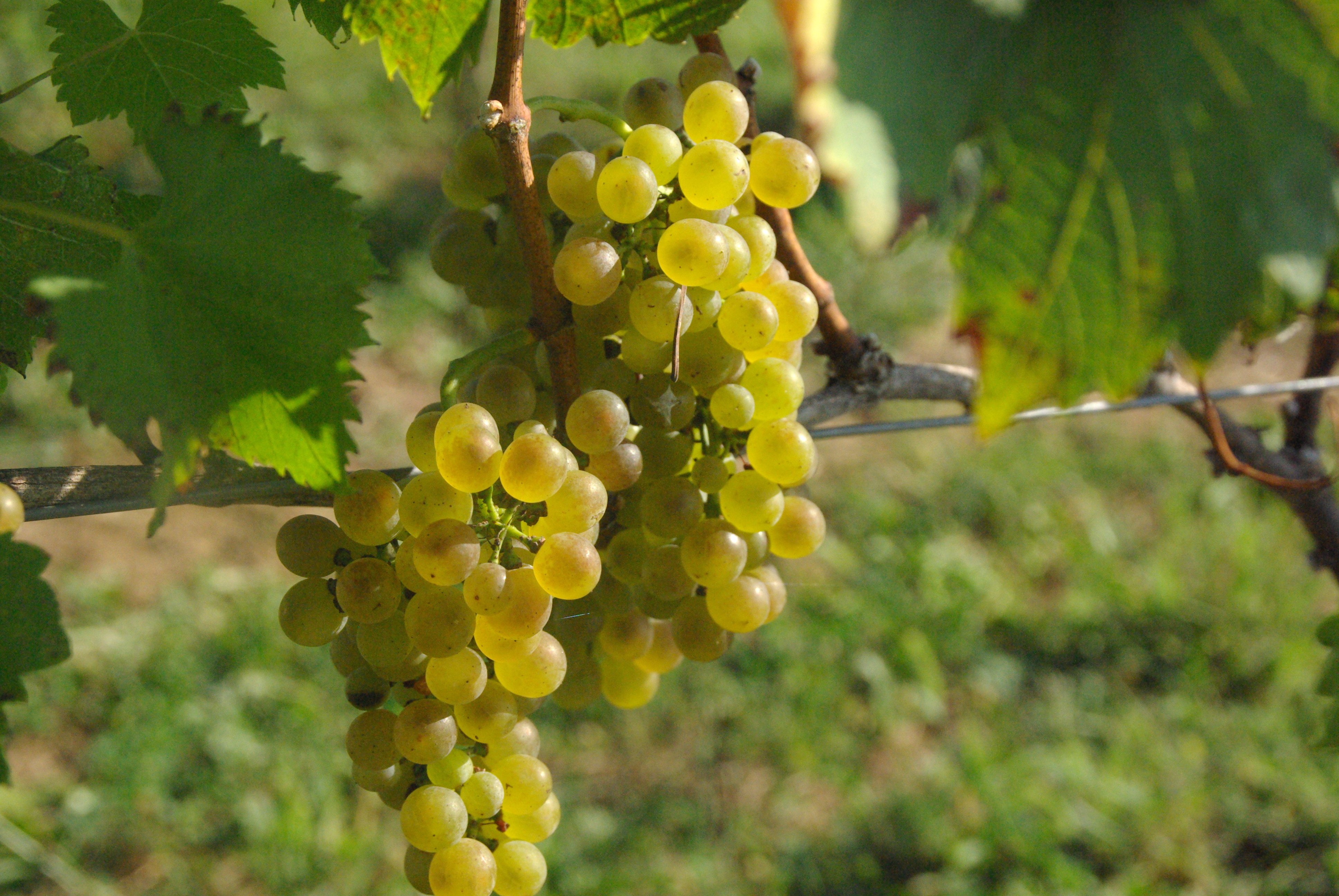
It makes sense to write a book about Georgia and its wine history. Georgia has a wine history that is traced back some 8,000 years ago. This fascinates me. I want to learn more about Georgia as the cradle of wine. As a winemaker, I find it interesting that Georgia has a winemaking practice that is thousands of years old. The practice of fermenting and aging in qvevri buried underground is also fascinating. So many people that Kathy and I have interviewed like to claim that they let the grapes express themselves. Then they add yeast for fermentation and then add bacteria and then put the wine in oak. The grapes are not expressing themselves. The Georgian winemakers, following the old techniques, just put the grapes, juice, skins, seeds and stems in a qvevri and let the wine be made naturally. If anyone has a claim of letting the grapes express themselves, it is the Georgians.

I believe that writing a book about Georgia and its wine history will help me become more knowledgeable about Georgia and a history that everyone should hear. Wine enthusiast should take a moment while looking at the color of the wine in their glass, and ponder how people thousands of years ago made wine without stainless steel tanks and oak barrels.

Cheers,
terry

Struggling to Understand 8,000 Years Ago

Understanding time has much to do with our own experiences. I have no problem understanding two and three hundred years ago. While teaching fifth grade in the Prince George’s County Public School System, I would help take over 100 students on an overnight field trip to Jamestown and Colonial Williamsburg in Virginia. Both of those sites are living histories and one can walk on a ship, stroll in a fort and its buildings or amble through the streets and buildings in a colonial town. You get a pretty good sense of two to three hundred years ago.

My concept of old was shattered on our first trip to Italy. I commented that a cantina that was built three hundred years ago was old. I was corrected on the spot. The cantina is new not old we were told. Kathy and I were then taken to the vineyards where the ruins of a house stood amidst the vines. The house dated bace to the 1100’s. Further trips to Italy, United Kingdom, Croatia and France helped me gain the concept of a few thousand years ago. In France, this summer, we visited several caves. At Tattinger Champagne House, the cave were hewn out by the Romans who were quarrying the limestone. In Wales a vineyard had the remains of a Roman built water system. It was believed that there was a vineyard on the site thousands of years ago. In Italy and Croatia we discovered more wine related artifacts dating to the time of the Romans and Greeks. While in Orvieto, we walked through caves dug out by the Etruscans. A concept of three thousand years ago was developing as I gained experiences walking the land and seeing artifacts.

Our wine journey now leads us to the country Georgia, the birthplace of wine. My concept of how old is old will be challenged as I struggle to understand 8,000 years ago. The inhabitants of what is now Georgia were cultivating grapes and making wine for thousands of years before Western Europe. Also as old is the use of fermenting and aging wine in clay vessels called qvevri. Some of the millennial old practices are still used today.

Our trip to Georgia is not just to learn about present-day wine and grape varieties. It is also to learn wine’s history and a people’s culture that kept wine in the forefront for eight thousand years. We hope to harvest grapes and help make a qvevri wine. Many decades ago, while a high school student, I attended a lecture. The presenter commented, “If you truly want to learn a subject, write a book about it.” Heeding his advice, Kathy and I are researching Georgia as the birthplace for wine, and writing a book about it.

We will make a return trip to Georgia in late March of 2014 for the International Wine Tourism Conference. After the conference, we will join the media FAM group touring Georgian wineries. Perhaps we will open a qvevri of wine whose grapes we helped harvest and make the wine. We are fascinated with Georgia and gaining an understanding of 8,000 years ago.

Cheers,
Terry

Beginning a Journey to Georgia, the Cradle of Wine

We are at the airport awaiting our plane for the first leg of our trip to JFK. If all goes well we should leave around 2 pm. After reaching New York we’ll wait for a couple of hours for our flight to Rome where we have a 16-hour layover waiting for a flight to Tbilisi, Georgia. It’s a long trip but we are so looking forward to learning about Georgia, sometimes referred to as the “Cradle of Wine.”

During the past few weeks, we have been reading whatever information we can find about the country of Georgia and its winemaking history. Unfortunately some of the information in the US seems to be limited, so we hope to increase awareness of Georgia regarding its long history, winemaking and culture. As the days progress we will be writing daily blogs as well as articles about the wineries we visit, the Georgian wines and Qvevri.

We are also researching and beginning our third book with a working title of “Georgia: Birthplace of Wine.”

Hope you will follow along as we share our experiences with you.

Cheers! Kathy

Viognier Harvest at Catoctin Breeze Vineyard

Catoctin Breeze Vineyard, MD

Thursday morning we had a delightful time at Catoctin Breeze Vineyard where we helped harvest several rows of Viognier grapes. We were a group of five volunteers who enjoy vineyards and wineries from the vineyard to making the wine disappear. The day was hot but the almost continuous breeze was great.

The Viognier grapevines are planted on a long gentle slope. White buckets were placed every few feet. Once we reached the next bucket we began filling the new bucket. This not only allowed the bucket to be lighter and easier to lift but also prevented the grapes on the bottom from being crushed before reaching the winery.

The owner of Catoctin Breeze Vineyard Wojciech Fizyta asked us to presort the grapes as we cut the clusters. This was easy enough to do as there was very little that needed to be removed – just a few raisined grapes and a few grape leaves.

A few of the grapevines showed some signs of Japanese beetles. This was easy to spot as the leaves were mottled where the beetles have eaten through the leaves.

After the Viognier grapes were harvested we walked to the tasting room and were offered a glass of wine or a beer. We then sat out on the lawn where we relaxed and enjoyed our time. Soon a wonderful lunch prepared by Alicja Fizyta was arranged for us under the awning of the tasting room. Catoctin Breeze Vineyard knows how to treat visitors and volunteers. When you have the opportunity you will want to visit the winery. Check the Catoctin Breeze Vineyard website for hours.

Cheers!

Kathy

Make Your Own Wine at Tin Lizzie Wineworks in 2013

Photo from Tin Lizzie Wineworks, MD

Want to make a barrel of wine in Maryland. You will want to check out Tin Lizzie Wineworks in Clarksville, Maryland not far from Baltimore and Washington, DC.

Tin Lizzie Wineworks is a hands-on teaching winemaking facility. Tin Lizzie Wineworks is the brainstorm of Dave Zuchero, owner and winemaker. Zuchero’s business has been teaching winemaking for several years. Would-be winemakers will appreciate the low-key approach that Dave has while working with participants to create the type of wine they will enjoy.

Is 2013 the year you want to make a barrel of wine? Tin Lizzie in Maryland is the place to consider doing it at. Zuchero has established a routine that makes it easy for participants to schedule time; of course, grapes and winemaking have their own schedule too. Many of the grapes are sourced from California and they are about a month ahead of schedule.

Several pricing options are available. However they all include instruction, grapes/juice, equipment, bottles, corks and labels. If a full barrel of wine is too much for your needs, consider making a half or quarter of a barrel.

Three years ago we worked with a group to make a barrel of wine at Tin Lizzie Wineworks and really enjoyed the experience. In 2012 we made a barrel of Cabernet Sauvignon that is going through extended aging now. We tasted it the other day and were impressed with the results. Currently we plan to allow it to continue to age.

Much more information is available on the Tin Lizzie Wineworks website.

Since the grape harvest in California is early, participants should email or call Dave now so he will know how many tons of grapes to source.

Contact: Dave Zuchero,
Email: info@tinlizziewineworks.com
Phone: 301-318-9954

Cheers!
Kathy

What Could Be Better than Local Cheese and Wine Pairing in Pennsylvania?

Save the weekend October 5th and 6th for the Artisan Cheese & Wine Pairing Event on the Berks County Wine Trail in Pennsylvania. Participants will travel the self-guided trail to eight wineries to taste local wines paired with local cheeses. This year a local grower will provide samples of several varieties of Asian pears.

The eight wineries participating in the Berks County Wine Trail include:

Bashore & Stoudt Country Winery (Shartlesville)
Blair Vineyards (Kutztown)
Calvaresi Winery (Bernville)
Clover Hill Winery (Robesonia)
Kog Hill Winery (Morgantown)
Long Trout Winery (Auburn)
Manatawny Creek Winery (Douglassville)
Pinnacle Ridge Winery (Kutztown)

Tickets are available at the participating wineries and online. Purchase tickets early at $12 each or on the weekend of the event for $18. This event benefits  the wine trail which provides information to travelers and tourists with a website, brochures and maps.

Cheers!
Kathy


Planning a Labor Day Picnic? Remember the Sangria!

Why not add a Sangria to your beverages for this Labor Day weekend?

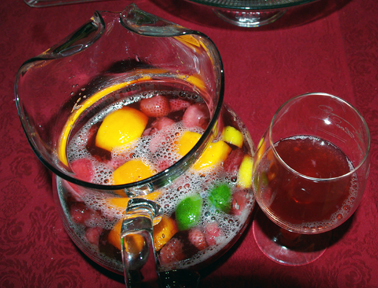
Savoy-Lee Winery Sangria

Sangria can be purchased by the bottle at some wineries; other wineries produce wines that can be used for making your own Sangria. Sangria already bottled is quick and easy for a picnic (make sure you have a corkscrew handy.) Several wineries offer recipes for making Sangria. If you have time you may want to create your own special Sangria.

Below are four easy recipes from wineries in Colorado, Pennsylvania and Virginia. Enjoy!

Hope everyone has a wonderful Labor Day weekend!

Cheers!

Kathy


Narmada’s Midnight Sangria

Ingredients

2 bottles of Midnight Wine (This Narmada Winery wine is produced with Chambourcin and is off-dry.)
1 c of frozen orange juice
4 cans of Sprite soda
¼ c of sugar
Fruit – oranges, lemons, strawberries
Mint leaves

Directions

1. Mix and Enjoy!

Recipe provided by Narmada Winery, Amissville, Virginia.

Pickering Winery Sangria

Ingredients

1/2 bottle of Marchael Foch
1/2 lemon sliced
1/2 orange sliced
1/2 apple sliced
1/4 c sugar
2 shots Gin
16 oz Ginger Ale

Directions

1. Mix wine, sugar, gin and ginger ale until sugar is dissolved
2. Add fruit
3. Chill

Recipe provided by Pickering Winery, Pennsylvania.

Sangria (Carlson Vineyards)

Ingredients

1 bottle Carlson Vineyards Laughing Cat Sweet Baby Red Note: this is a sweet wine blend made from mostly Merlot.
1 c orange juice
1/4 c juice from one lime
1/4 c juice from one lemon

Directions

1. Pour all ingredients into a picture.
2. Add ice and slices of lemon, lime and orange.

Recipe provided by Carlson Vineyards, Palisade, Colorado.

Savoy-Lee Sangria

Ingredients

1 bottle of Savoy-Lee Johnson Mountain Picnic Blush Wine or dry fruity rosé
1 lemon, cut into wedges
1 orange, cut into wedges
1 lime, cut into wedges
2 T sugar
1 small can of diced pineapple (with juice)
1 small container of sliced, sweetened frozen strawberries (thawed)
2-4 c of ginger ale (preference)

Notes

1. Pour Savoy-Lee Johnson Mountain Picnic Blush Wine in a pitcher and squeeze the juice wedges from the lemon, orange and lime into the wine.
2. Toss in the fruit wedges (leaving out seeds) and pineapple then add sugar.
3. Mix well.
4. Chill overnight.
5. Add strawberries and ginger ale just before serving.
6. Use fruit wedge or fresh strawberry for garnish..enjoy!

Makes approximately 10 – 12 glasses of Sangria.
NOTE: Do not double recipe – make individual batches.

Recipe provided by Savoy-Lee Winery, Virginia.


Wine Intimidation Tackled by Wine Trail Traveler Authors

Wine Intimidation Tackled by Wine Trail Traveler Authors

A Wine Tourist's Guide: Visiting Tasting Rooms

PRE-ORDER BOOK ANNOUNCEMENT

August 30, 2013 – A Wine Tourist’s Guide: Visiting Tasting Rooms by Terry and Kathy Sullivan is a unique book and is available for pre-ordering now.

A Wine Tourist’s Guide: Visiting Tasting Rooms cuts the intimidation factor from the world of wine. After arriving at a winery tasting room, what will visitors see and experience? This quick guide will help newcomers to the world of wine and those more experienced wine enthusiasts by presenting themes associated with the winery/vineyard tasting room experience. Topics cover tasting room expectations, etiquette, wine tasting, and wine aroma charts. Also included are some common wine myths and misconceptions. Readers will find a suggested wine tasting form, a discussion of common grape varieties, and suggestions on how to plan a trip to wineries.

A Wine Tourist’s Guide: Visiting Tasting Rooms by Terry and Kathy Sullivan, Paperback ISBN: 978-0-7414-9801-4 $10.95; 90 pp.

Limited Time Offer: Pre-orders – only $9.00 per copy plus shipping

Reviews:

“Terry and Kathy’s book is an invaluable contribution to a segment of the wine industry that is increasingly popular in the states as well as abroad. Utilizing their extensive background in education and sheer volume of tasting room experiences, there are few as qualified to lead newcomers and veterans alike through the ins and outs of this highly enjoyable past time. The book is an enjoyable and educational read for all.” Geoff Howell, Gilbert Cellars

About the Authors:

Terry and Kathy Sullivan have discovered a passion for the wine culture, including wine history, winemaking and visiting wineries. A Wine Tourist’s Guide: Visiting Tasting Rooms is their second book, having published A Wine Journey in November 2012.

Terry and Kathy have visited and written about 1,000 wineries on three continents. In 2008, they decided that since they were writing about wine, they should make wine. At home, they experiment making wine. At a Maryland and a Virginia winery, they make wine following a traditional process.

Want to interview the authors or schedule an appearance?

Authors:

Terry and Kathy Sullivan
410-402-0217
kathy@winetrailtraveler.com

All written correspondence can be directed to:

Terry Sullivan
Wine Trail Traveler, LLC
6578 Dovecote Drive
Columbia, MD 21044

###


info@winetrailtraveler.com            Sitemap                      Privacy Policy

Copyright: Terry and Kathy Sullivan 2006-2013