October 14, 2009 – 8:34 am
Linden Vineyards in Linden, Virginia is the result of Jim Law’s intense interest in producing great wine in Virginia’s countryside. Jim is the owner, viticulturist and winemaker. The vineyards include three areas. Jim is well acquainted with every vine in every vineyard. He believes, “It’s one thing to grow grapes but another to grow grapes well. The grower needs to have a passion for the wine.”
Wines available include Sauvignon Blanc, Vidal Riesling, Seyval, Chardonnay and a late harvest Vidal. Reds include Petite Verdot, Claret and a Rosé. Recently we had the opportunity to enjoy a bottle of Linden Vineyards wine. The wine was a Claret 2004 produced with 48 percent Cabernet Sauvignon, 35 percent Petit Verdot, 13 percent Merlot and 4 percent Cabernet Franc. This wine is unfiltered with 13.3 percent alcohol.
Suggested pairings with this wine are grilled steak, hamburgers and coq au vin. Claret 2004 offered an earthy with red fruit aromas. The taste was of smooth red fruit and the finish offered mild tannins.
Enjoy a quiet, peaceful visit to Linden Vineyards. Stay awhile with a glass of wine in the sunroom or on the deck.
Linden Vineyards wines are available only in Virginia. This is another great reason to visit local wineries.
(Check out Regional Wine Week hosted by the Drink Local Wine website.)
October 13, 2009 – 12:25 pm
Deciding what wineries to visit and planning an itinerary can be time consuming. Two-day itineraries that feature wineries, maps and lodging options are available on the Wine Trail Traveler website. In celebration of Drink Local Wine week, we are focusing our attention on Maryland and Virginia. These itineraries focus on several interstates. In Maryland the itineraries are based on wineries along Interstate 70, Interstate 83 and Interstate 95. Four itineraries are available for Virginia. Three are based on areas of Interstate 66 and Charlottesville South. Interstate 66 was divided into East, Central and West.
These itineraries are suggestions and flexible. Maryland and Virginia wineries are great places to explore the world of wine including the terroir that each region offers.
As you explore the wineries in Maryland and Virginia, take notes on what differences you discover with the same varietal. Try to determine what influenced the different styles. Was it the winemaker or the terroir?
Most of all enjoy your visit to these friendly wineries.
Cheers, Kathy
October 12, 2009 – 4:04 pm
An easy and fun way to celebrate Regional Wine Week and discover Maryland wines is at the Autumn Wine Festival next weekend in Salisbury, Maryland. Now with more wineries established in Maryland, it’s important that residents and travelers recognize the contribution that Maryland wineries make to agriculture and the economy (restaurants, lodging) as well as providing good wines from grapes growing in Maryland’s terroir.
On October 17 and 18, the Autumn Wine Festival will be at Pemberton Historical Park. This is an opportunity to taste local wines and local cuisines. Twenty-one Maryland wineries will be participating. Some of these wineries have been producing wines for years and others are new on the scene. Whether you enjoy dry, sweet, red, white or fruit wines you will most likely discover wines you enjoy. Check the wineries out at the festival, you’ll be glad you did. Live music and local craft vendors will also be available to enjoy. To learn more, visit the Autumn Wine Festival website.
(For more information about Regional Wine Week, visit the DrinkLocalWine website.)
Cheers, Kathy
October 12, 2009 – 7:57 am
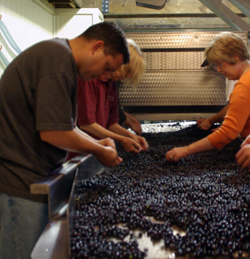
On the first sorting table, large MOG, materials other than grapes, were removed. The grapes then went to a destemmer. The stems were sent to a bin while the grapes went to another sorting table. I worked on the second sorting table. At first it was easy. There were a few stems, an occasional leaf, and a lot of jacks to remove. I noticed the Merlot berries were small and most were not split or crushed. The easy removing of MOG didn’t last long. The people on the first sorting table began to speed up and before we knew it the second sorting table had to more from leisure to a much quicker pace.
While working the line, owner, Chris Pearmund brought us fresh Merlot juice. Juice made from wine grapes is much better than grape juice bought in grocery stores.
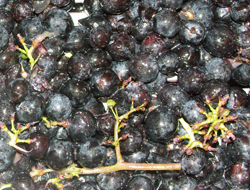 After sorting two tons of Merlot, I could feel my lower back start to complain. Then bin after bin of local Cabernet Franc was brought in to sort. Cab Franc is one of my least favorite red wine grapes. After sampling a few of the berries, my opinion didn’t change. The berries were larger than the Merlot berries. By the time they were on the second sorting table, they were broken. This made the sorting a bit harder and stickier.
The experience was fun. It certainly gives an appreciation for the hard work that growers and winemakers go through to produce a bottle of wine. This is a great time of year to visit local wineries. There is a lot of activity that can be observed. At Vint Hill Craft Winery, a second floor gallery allows visitors to watch the proceeding below. While sorting, I noticed that at times we had a captive audience.
(For more information about Regional Wine Week, visit the DrinkLocalWine website.)
October 9, 2009 – 8:40 am
Congratulations to northern Maryland wineries who have just started a new wine trail in September. The Piedmont Wine Trail was launched at Fiore Winery and includes wineries in Harford County and Baltimore County. This wine trail encompasses eight wineries including Basignani Winery, Boordy Vineyards, Dejon Vineyards, Fiore Winery & Distillery, Harford Vineyard & Winery, Legends Vineyard, Mt. Felix Estate Vineyard & Winery and Woodhall Wine Cellars.
Piedmont Wine Trail now joins three other Maryland wine trails. A nice feature of the Piedmont Wine Trail website is the addition of local restaurants and lodging sites. Be sure to check out their website at http://www.piedmontwinetrail.com/contact.shtml
Cheers, Kathy
October 8, 2009 – 12:45 pm
An opportunity to visit the United Kingdom and participate in the Falmouth Oyster Festival would be a special activity. Activities include cooking demonstrations and children’s shell painting, live music and an oyster shucking contest and more. Foods will include oysters, seafood, wine and ale. Check out the website about the event.
Cheers! Kathy
October 7, 2009 – 10:58 am
Have you had a Petite Sirah lately? Petite Sirah is on the rise especially in California. Petite Sirah is also known as the French variety – Durif. The “parents” of Petite Sirah are Syrah and Peloursin. The result is a grape that grows well in California with more than 6,000 acres of the vine. We tasted several Petite Sirahs while visiting California wineries.
Petite Sirah wines are a deep purple/black color. Even a drop on your hand will be obvious. The wines are robust with big flavor and full-bodied. Look for nuances of black cherries, blackberries, spices and more. Other word descriptors used to describe a Petite Sirah include inky in color and chewy. Enjoy a wine that pairs well with beef, cheese and chocolate. According to the website, P.S. I Love You, this grape produces wines that age well. If you haven’t tried Petite Sirah, give it a try, it may become one of your favorite wines.
Cheers! Kathy
October 6, 2009 – 12:53 am
I am paying particular attention to tasting Sauvignon Blancs while in California. I recently offered to make the wine for my son’s wedding in 2011. It will be an August east coast wedding, probably temperatures and humidity in the 90’s. A Sauvignon Blanc may prove to be quite a cooling, crisp and refreshing wine for a wedding. I was hoping to avoid the green vegetables and cut grass or hay that some Sauvignon Blancs offer. After tasting many Sauvignon Blancs in Suisun Valley, Lake County and Napa, I was pleased to find good citrus aroma and taste with crisp fruity finishes.
Today I tasted a Sauvignon Blanc that really caught my attention. There was pineapple on the aroma and taste followed by citrus. The crisp finish had a good lemon aftertaste. This would make a wonderful wedding wine. What was more amazing to me is that this wine was at Caymus. I didn’t expect this. To me Caymus had been synonymous to Special Selection Cabernet Sauvignon. The Caymus Sauvignon Blanc is only available at the winery in Rutherford, California.
I’ll continue to search for Sauvignon Blancs that may make a good wedding wine. Of course Kevin and Brittany need to do their own searching for a taste profile that they like. Then I’ll need to figure out where to find the grapes. I certainly wouldn’t mind making a Sauvignon Blanc similar to Caymus’.
-1.5in.jpg)


How to Participate in Regional Wine Week: Visit a Local Winery
There are several ways to participate in Regional Wine Week. The most obvious is to drink local wine. Acquiring local wine may take some work though. You can visit your local winery, taste from their portfolio of wines and choose the one you like. A drive in the country is a great Sunday afternoon activity. Discover what your local wineries are producing. Match the wine with locally grown foods to create a total “eat and drink local meal” for Sunday evening.
When visiting local wineries, ask a few questions. Not all wineries source grapes from the local growers. It is a common practice to source grapes out of the state or even out of the country. Consider asking at the winery where the grapes came from for the wines you are interested in purchasing. On the other hand, don’t assume that if the winery doesn’t have grapes on the property, that they source all their grapes outside the state. There is a difference between a winery and a vineyard. Many wineries that do not have vineyards source their grapes locally.
The primary idea for this week is to taste wines made from the grapes grown in your region. Local wineries are a good place to discover the “taste of the place.”