-1.5in.jpg)


Pilot inflating the balloon for a flight over Temecula, California.
Decades ago I worked for a hot air balloon pilot. A group of us would awake early on a Sunday morning, gather equipment, load a van and proceed to a launch site in Central Maryland. About every five times crewing, the pilot would take me up in the balloon. One of the flights I went on was flawless. We flew over the Maryland countryside and would change altitudes to catch air currents that occasionally changed our direction. Our pilot was a captain in the Army Reserve. His last name was Kirk and he named his hot air balloon fittingly, Enterprise. Captain Kirk hovered the balloon basket only inches above the ground at a residence where we hoped to land. He asked me to get out of the basket and take a bottle of champagne to the house of the property owner.
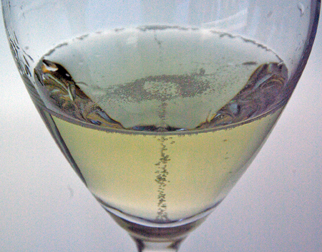
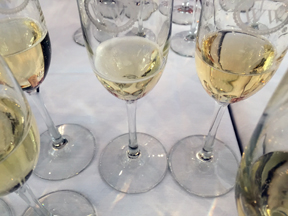
A glass of champagne helped to prove the inhabitants of a hot air balloon were not monsters.
It was early Sunday morning and after banging on the door, a sleepy gentleman answered. I pointed to the hot air balloon hovering over his yard and asked if we could have his permission to land. I then offered the bottle of champagne. His answer was yes and minutes later his whole family was outside to see us land and deflate the balloon. Why the bottle of champagne?
Hot air ballooning is a form of flight that some like to keep traditions. The beginnings of hot air ballooning is traced to France. Early flights filled the balloon with smoke. As the legend goes, upon landing it was not unusual to be attacked by peasants with rocks and pitch forks. After all the balloon did look like a fire breathing monster. To overcome the citizens’ fear, glasses of champagne were offered to the assembly of greeters. Monsters do not give you a glass of champagne. At our landing, we gave the entire bottle to the homeowner, not just a glass.
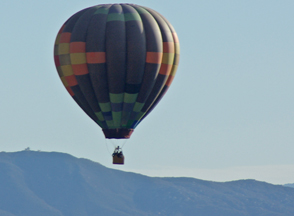
Another balloon spotted over vineyards in Temecula, California.
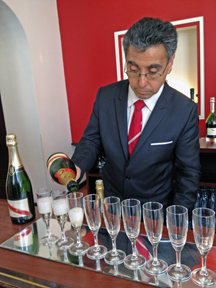
Captain Kirk also had a bottle of champagne to share with the crew. The crew chases the balloon on the ground. One member drives a van, another reads a map and gives directions and other members look out the windows. The balloon always traversed land where the roads did not go. So our navigator, often me, had to do the best we could with the roads we had. We were thanked after deflating and packing the balloon with a glass of champagne.
I like traditions. While crewing and flying with Captain Kirk, I always enjoyed offering the landowner a bottle of champagne. It always brought a smile to his face even though it was early on a Sunday morning.
In many wine regions, hot air balloon rides take you over vineyards. We flew over vineyards in the Temecula region of Southern California. There are hot air balloon rides over Champagne in Reims, France site of the sixth International Wine Tourism Conference on April 8th and 9th, 2015.
Cheers,
Terry

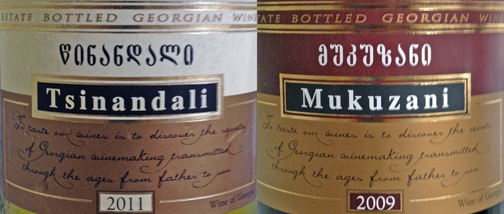
Georgia Wine Tasting: a Warm Break for the Snow Weary
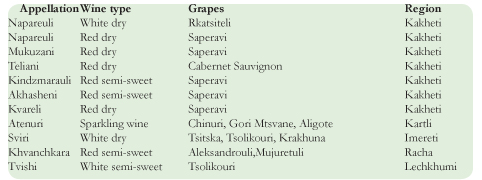
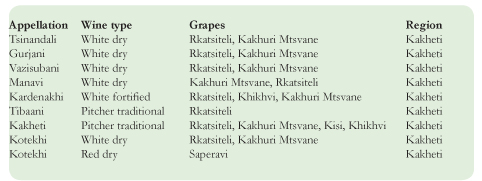
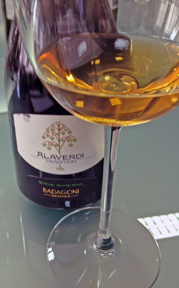
For the snow weary residents of Boston and its suburbs, this weekend provides opportunities to escape the frigid temperatures and piles of snow. On February 14th and 15th the Boston Wine Expo takes place at the Seaport World Trade Center. Wine producers and distributors from around the world will offer 2,000 wines for tasting. A day earlier, on February 13th, Marani wines from the country Georgia will have a tasting from 5:00 – 7:00 at the Wine Gallery in Brookline. Marani and other Georgian producers will have ten tables at the Boston Wine Expo. What is so unique about wines from this country south of the Greater Caucasus Mountains?
Georgia, Sakartvelo: the Birthplace of Wine
Kathy and I have traveled to wineries and vineyards around the world. If asked what was the most unique and different wine region to visit, we would quickly say Georgia. Although they have very small plantings of the international grape varieties, most of the varietal grapes are ancient grape varieties that are new to many people. You will have an opportunity to taste varieties that are new to you at the Wine Gallery and the Expo. Grape varieties is not the only uniqueness this wine country has to offer. It is widely believed that Georgia is the birthplace of wine. There have been over 8,000 continuous vintages making Georgia the oldest wine region in the world, older than western Europe by thousands of years.
There are many winemaking techniques that have been tried over the millennia. One that has survived for thousands of years is wine made in earthen vessels called qvevris that are buried under ground. Qvevri winemaking is the only winemaking technique that is on the UNESCO list of Intangible Cultural Heritage. You will have an opportunity to taste qvevri wines at both the Wine Gallery and the Expo. Our first trip to Georgia was so mind opening that we wrote a book Georgia, Sakartvelo: the Birthplace of Wine. We will have copies of our book with us and be happy to inscribe books. The book discusses the location of the country Georgia, it appellations and appellation wines, qvevri making, qvevri winemaking, its history, culture and monastery wines.
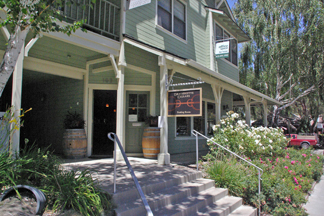
Kathy and I will be at the Wine Gallery on Friday from 5:00 to 7:00. Visit and taste the wonderful wines from this country that is at the crossroads of Europe and Asia.
The Wine Gallery
400 Washington St.
Brookline, MA 02445
Cheers,
Terry