About     FAQ     Contact      Advertise With Us      Press   

Birthday Celebration Continues 10,461 km Away

040214gSometimes it’s hard to celebrate a birthday away from friends and family. That may even be sadder if you are 10,461 km (6,500 miles) away from home. That is unless you are in Sakartvelo, the country Georgia. Here, visitors are treated as guests. This is our second visit and we are treated like family.

Unexpectedly on our bus ride of the International Wine Tourism Conference media group from Signaghi to Tbilisi, a chorus of Happy Birthday broke out. Then Kathy was greeted at the Tbilissi Marriott with a “happy birthday” from the receptionist. An unexpected knock on the door revealed a birthday cake from the hotel. This is Georgia!

We usually spend over 30 days a year in hotels. The Tbilisi Marriott deserves special praise. Their staff make this an incredible hotel. This includes all their staff: reception, cafeteria, bellboys; everyone will go the extra mile to make your stay something special. This was a wonderful venue for the International Wine Tourism Conference. Kathy is pleased with the unexpected attention she received on her birthday so far away from home.

Happy Birthday Kathy,
Terry

Opening Our Qvevri Wine

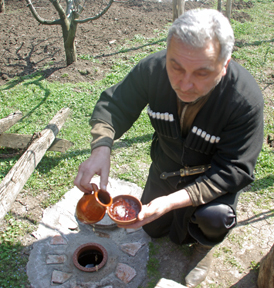
Terry and Gela remove sand covering qvevri lid.

Terry and Gela remove sand covering qvevri lid.

We returned to Twins Wine Cellar in Napareuli six months after starting a qvevri wine. The Rkatsiteli grapes fermented and remained on its chacha (grape skins and seeds) until April 1, 2014. During the six months the wine aged and natural filtration took place in the qvevri.

When we arrived the surface of the qvevri was covered. There was a layer of black sand over the covering. Gela Gamtkitsulashvilis, one of the twins that owns the winery, helped me clear away the black sand. It was a bit dry, so water was added to moisten it. That cut down dust particles that were airborne. A brush was used to brush the sand into a corner to make it easier to remove.

040214bTerry then grabbed the slate covering and lifted it. There was suction between the lid and the qvevri so it took a bit of force to lift the cover. On the reverse side of the qvevri a ring of clay could be seen. This clay formed a seal between the slate cover and the top of the qvevri.

After the qvevri was opened, clear wine was noticed at the surface. Several inched below the surface, you could see the chacha. With a wine glass, I stirred the surface and then put wine into the glass. The first taste of our qvevri wine, well I forgot. Caught up in the moment, I did not reach for pen and paper to take notes. I do recall that it had a light gold color, flora aroma and taste with some fruit character and mild tannins. It was a lighter body than other qvevri wines and the tannins were milder. Many people in the media group seemed to like this. We did not put any stems in the qvevri when we made this wine so we did not get the darker color, more body and harsher tannins that other white qvevri wines have. There is a wide spectrum of white qvevri wines and our was extremely palatable.

040214dKathy and I posed for photos with both owners Gela and Gia Gamtkitsulashvilis. I then proceeded to take glasses, give the surface of the wine a gentle stir and fill with a tasting for each of the media group and Twins Wine Cellar staff. Then we started bottling the wine. I went straight to the corker, a device I have had plenty of experience using. Labels were placed on the bottles and signed by the Gia and Gela and myself. The qvevri only produced 13 bottles of wine. Kathy and I took six and Tamta took three. Tamta helped us harvest the grapes and make the wine last September. The owners and a staff person took three bottles and one bottle mysteriously disappeared. I expect an over exuberant member of the media decided to help herself. Kathy and I plan to use our bottles when we have classes that teach about Georgia, the Birthplace of Wine and qvevri wines.

Gia, Kathy, Terry and Gela celebrate opening of qvevri.

Gia, Kathy, Terry and Gela celebrate opening of qvevri.

Terry collects a tasting of the qvevri wine for members of the International Wine Tourism Conference media and Twins Wine Cellar staff.

Terry collects a tasting of the qvevri wine for members of the International Wine Tourism Conference media and Twins Wine Cellar staff.

The experience of harvesting Rkatsiteli grapes, cleaning the qvevri, sanitizing the qvevri, putting the grapes in the qvevri and finally opening it was extremely valuable. We will share this experience over and over with our readers and during our classes.

Cheers,
Terry

What We Missed at Kindzmarauli Marani

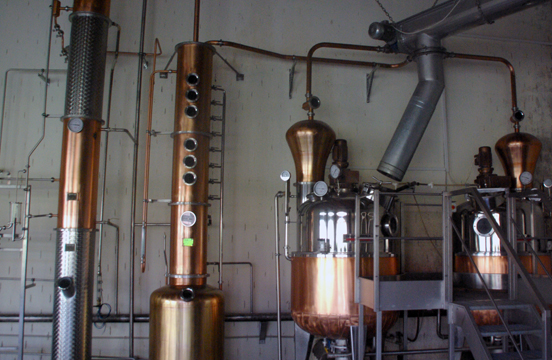
There are a few of us in the International Wine Tourism Conference media group that enjoy Georgian Chacha. Most of the wineries have stills of various shapes and sizes. We were running late on our Kakheti tour yesterday and did not have a chance to see the distillery at Kindzmarauli Marani. This is the largest still that we have seen at a winery. Enjoy!

Cheers,
Terry

Still at Kindzmarauli Marani

Still at Kindzmarauli Marani

Alaverdi Monastery Has Heart

Cordons tied in a heart shape

Cordons tied in a heart shape

We visited Alaverdi Monastery and noticed the small vineyard on the way to the marani. The vines were pruned and tied in a heart shape. This pruning method was new to us and we speculated as to why it was shaped and tied. Two cordons were tied to the post about eight inches above the trunk. They were then looped around and tied again about 20 inches towards the bottom. This creates a heart shape.
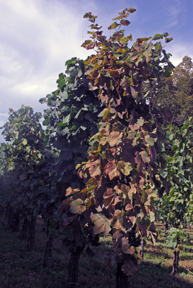
Vineyard, September 2013

Vineyard, September 2013

I thought back to last September, when Kathy and I previously visited. I did not recall the vines in a heart-shaped pattern. The vines appeared to be in a column. Others in our group seemed to recall seeing vines tied in this heart-shape.

Winter and early spring are times to discover the architecture of the vine. Once covered in green, it is difficult to see the structure. A vineyard is wonderful to visit during all seasons as it changes. Perhaps I should try this heart-shaped tiring on a couple of my vines.

Cheers,
Terry
Georgian Wine Grand Tasting

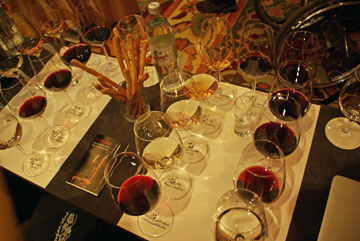
The grand tasting of Georgian wines took place in the ballroom at the Marriott Hotel in Tbilisi, Georgia. Sarah Abbot introduced the wine tasting session. The selected wines were prepared by Shalva Khetusuriani, President of Georgian Sommelier Association. Shalva and Sarah commented about the wines during the tasting.

What is now becoming traditional, my tasting notes for conference tastings are written as haikus.

033013aTsinandali by Shumi
Crisp Tsinandali
Appellation controlled white
Bright, floral, drink now

Krakhuna by Winery Khareba
Krakhuna bright white
Crisp, refreshing, nice in mouth
First appetizers

Chkhaveri by KTW
Chkhaveri light gold
Ticklish tropical fruit notes
Guria’s white wine

Rkatsiteli by Alaverdi Monastery
Rkatsiteli
Qvevri made monks labor
God’s gift to cherish

Kakhuri Mtsvane by Mandili
White kissing tannins
Mtsvane Kakhuri gold
Legs, body, beauty

Otskhanuri Sapere by Winery Khareba
Imereti red
Otskhanuri Sapere
Qvevri juicy

Saperavi by Vitavinea
Saperavi black
Spice meets fruit, kissing tannins
Qvevri refined

Mukuzani by Tbilvino
Kissing tannins too
Mukuzani oak quality
Appellation wine

Saperavi-Satrapezo by Telavi Wine Cellar
Black Saperavi
Satrapezo food friendly
Almost kissing wine

Shavkapito by Chateau Mukhrani
Shavkapito fruit
Everyday dinner friendly
Drink without at date

Kindzmarauli Original by Kindzmarauli Marani
Kindzmarauli
Saperavi for Russians
Sweetness expresses

Chacha by Chateau Mukhrani
No devil counting
Chacha strengthens energy
Long fruit aftertaste

Cheers,
Terry

The Dangers of Being a Wine Writer

032814cLet me say from the beginning, wine or spirits did not cause an accident. Rather, a photographic opportunity, an errant step and a fall were the contributing factors. Because of the accident, Kathy did not make the brandy tasting at Sarajishvili. Instead she waited patiently as the IWINETC Media Group processed brandy making and degustation. I joined Kathy and waited with her for help to arrive. After the media group left, we were visited by several very kind individuals.

A call to the National Wine Agency was made and they were sending Geo who we spent several day with touring wineries in Georgia. A worker at Sarajishvili spoke excellent English. He brought Kathy a chair to sit on and another chair to elevate her foot. Several women passing by stopped to look at her ankle, already showing signs of swelling. A doctor stopped by and examined the foot. She said it did not seem broken, but strongly encouraged us to go to the hospital. Then an ambulance arrived.

Ignoring Kathy’s protests, the medics placed a temporary splint on her foot and took her vitals. Geo arrived and gently coaxed Kathy into going to the hospital for an X-ray. Travel by ambulance is fast. The power of flashing lights, siren and a menacing horn caused most traffic to scoot out of the way.

Once in the emergency area of the hospital, an X-ray was ordered. Four X-rays were made. The good news, no broken bones. The bad news, the doctors wanted to put Kathy’s foot into a cast. Now she will have something for the media group to sign. We proceeded from the hospital to a medical supply facility to purchase crutches. The total cost of the ride, x-rays, cast and crutches was around $100.

Accidents do happen. It is easier to deal with if you have been tasting wines all day. An accident, prior to tasting, is just not fair.

Cheers,
Terry

Virginia Cider Made in Georgian Qvevri Served at Supra in Tbilisi

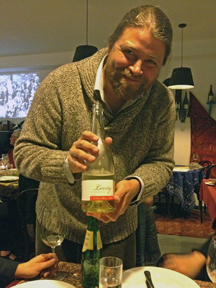
John Wurdeman, tamada at a supra, pours Castle Hill Cider.

John Wurdeman, tamada at a supra, pours Castle Hill Cider.

Buried under the ground not far from a shade tree are several qvevris that were made in the country Georgia. These earthen vessels, for making wine, traveled 6,500 miles for their resting place at Castle Hill Cidery in Keswick, Virginia. Stuart Madany, production manager, was interested in making cider in qvevris. He had first become interested in qvevris because of his architectural interest in healing and how shape and material affects people. In studying these ideas he was introduced to Viktor Schauberger’s intriguing concepts.

Viktor recognized that nature uses egg shapes. The ancients knew about storing food in amphorae that is somewhat egg shaped. Amphorae are similar to qvevris but not the same. Amphorae are earthen vessels used for transport. Stuart read about how wineries were producing wine in egg-shaped earthen vessels buried in the ground, and this reminded him of Viktor’s egg theory.

We brought a couple bottles of the qvevri made cider, Levity, to Georgia and opened them during a Supra at Azarpesha, a restaurant in Tbilisi. The cider was made with Pippin apples. Only the juice was put in qvevris for fermentation and aging. There was no skin contact. The cider was refreshing and had a strong apple taste. Several members of the media really enjoyed the cider and complimented it. Some said it was different than other ciders they had. The Virginia cider was a hit in Georgia.

During the supra, a toast was made to Georgia. That toast was passed to other who also made a toast to Georgia. A part of Georgia, the birthplace of wine, came to America. The Georgians appreciated the gift of cider made in an ancient style and friendships thousands of miles away.

Cheers,
Terry
Monks at Dadiani Old Cellar Produce the Rolls Royce of Georgian Wines

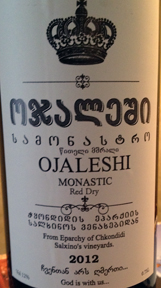
A bottle of Monastic Ojaleshi

A bottle of Monastic Ojaleshi

We were surprised at a comparison of Ojaleshi as the Rolls Royce of Georgian wines where Saperavi is just a Volkswagon. Were the monks from Dadiani Old Cellars poking fun at the monks producing Saparevi from Alveredi Monastery? Actually after some reflection the analogy has validity from a purely financial point of view.

There are very few bottles of Ojaleshi produced just like there are very few Rolls Royces produced. Saparevi is the most widely produced red wine in Georgia, making it like a Volkswagon. The scarcity of Ojaleshi makes it more costly to grow, make wine, market and sell. A bottle sold in the United States would cost over $100. Qvevri-made Separavi is a fraction of the price of Ojaleshi. The analogy works from the financial supply and demand point of view.

However, if you take other factors into account such as, aroma, taste, alcohol, tannins etc. the analogy breaks down. There are people that will prefer one over the other. One who likes Saperavi could argue that they can purchase several bottles of Saperavi for the same price as one bottle of Ojaleshi. The analogy becomes one of personal likes and dislikes. But I still wonder if the analogy was meant to be gentle teasing. There was a sparkle in the eyes of the monk that said. “Ojaleshi is a Rolls Royce and Saperavi is a Volkswagon.”

Cheers,
Terry

No Hail Terroir

Vineyards that get trounced with hail often are ruined for the year. Hail can happen in most wine regions around the world. A hail storm in the spring can ruin the buds of grape vines. Hail in the late summer or fall can puncture and damage the fruit. In some cases a hailstorm can become so strong that entire clusters of grapes are knocked off the vine. Hail is a menace that wine growers fear. Several French wine regions suffered damage caused by several hail storms in 2013. Hail is an unfortunate part of the concept of terroir.

A place to plant grapevines and not worry about hail

A place to plant grapevines and not worry about hail

We were quite surprised yesterday to visit Danieli a vineyard in Kakheti. The name of the village is Argoichki and means no hail. The views from the vineyard were amazing. In this region of no hail, winegrowers can plant with confidence of successful crops, at least not have the issues caused by hail. We learned of the passion that Olaf and Eka Malver for the Kisi grape, as well as their passion for planting vineyards on the surrounding gentle slopes. This is a beautiful place where one could spend countless days just admiring the vistas and enjoying the gift of liquifying your assets.

Cheers,
Terry

A Kakhetian Supra

Simon Ruadze fills drinking vessel with qvevri-made wine.

Simon Ruadze fills drinking vessel with qvevri-made wine.

Tradition, bounty and hospitality are the hallmarks of Simon Ruadze and his family. We had lunch in his distillery room just a short stroll from his house. Simon met us at our van, dressed in traditional Georgian dress. He spoke of providing visitors with an experience of a traditional Kakhetian supra. On the stroll to the distillery, Simon pointed out his grapevines and his 80 year-old mother who was working in the garden. We stopped a moment to taste a Rkatsiteli from a qvevri buried in the ground. Simon than pointed to his daughter who was barbecuing pork called suki. Grapevine cuttings are dried and used to flavor whatever is barbecued.

Inside the distillery we observed his still, larger than many we have seen in homes. A long table in the room is used for supras. At the end of the table a fire was crackling in the fireplace. Simon poured some Chacha for us to taste. But first, he took a shot and threw it on the flames in the fire place. It ignited. We were going to during that? An empty bottle later, no one seemed to care.

We sat at the table and Simon served the pork kabobs. He then raised his glass and started the first of many toasts. Wine glasses were filled for each toast. For one toast, the woman were asked to remain seated. The men were asked to stand on our seats and toast the women. Between toasts, Simon and his daughter would sing traditional Georgian songs in two parts. Several instruments e made by Simon’s father. Simon or his daughter would play the pander that Simon’s father crafted.
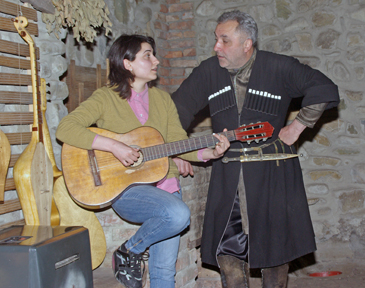
Simon and his daughter sing a song Simon wrote at the supra.

Simon and his daughter sing a song Simon wrote at the supra.

Our supra had several toasts that bordered on the poetic and philosophical. There was also an abundance of Georgian foods. I settled in on drinking the Saperavi that matched the foods. A Georgian supra is a life event that everyone needs to experience.

Cheers,
Terry


info@winetrailtraveler.com            Sitemap                      Privacy Policy

Copyright: Terry and Kathy Sullivan 2006-2013