About     FAQ     Contact      Advertise With Us      Press   

Two Western Georgian Wine Tastings Turn into Supras

A supra is an important event in Georgia. It combines food, wine and people. The leader of a supra is a tamada. The tamada makes toasts, then everyone drinks. A tamada is not resigned to just one toast, but may make several toasts. Our last two wine tastings in Western Georgia turned into supras.

Our tasting at Dadiani Old Cellar in Salkhino consisted on two wines and Chacha. The wines were a 2012 and 2013 Ojaleshi. This winery is run by Orthodox monks. During the tasting there were several toasts made. As soon as your clay vessel ran low on wine, it was filled. There was a small  qvevri in the center of the table, so an abundance of wine was available to drink. Different foods were set on the table. We toasted God, the visitors, love among others. Conversation flowed even though Georgian had to be translated. Wine, food and friends is a magical combination.

First toast at Dadiani Old Cellar in Salkhino was to God.

First toast at Dadiani Old Cellar in Salkhino was to God.

Our next day we visited Lado Shavishili’s Wine Cellar in Keda. Lado conducted our tasting in the tasting room. Afterwards he asked which wines we enjoyed the most. He took those wines and Chacha and proceeded to an outdoor table area that was set up for a Supra. Lado’s wife brought several plates of food for us to sample while he kept our wine glasses full. Lado started the supra with a toast to God. We then drank Chacha and Lado confirmed that the men werte drinking Chacha correctly while the women needed to work on there Chacha drinking skills.

Lado made several toasts including God, visitors, the beautiful weather we had, our friends and relatives that have passed away and our children and grandchildren. Even though we were on a schedule, we did not want to leave. Again wine, food and friends was magical. When we finally left, we were two hours late and off-schedule. This defined perfectly the time zone we are in GMT (Georgia maybe time).

Table setting for supra at Lado Shavishili’s Wine Cellar in Keda

Table setting for supra at Lado Shavishili’s Wine Cellar in Keda

Of the thousands of wine tastings we have participated in, our favorites are degustations. Supras are a high form of degustations. They provide a time for reflection, poetry and to cherish the things that are most important to you.

Cheers,
Terry

Turkish Airlines lunch menu from Brussels to Istanbul

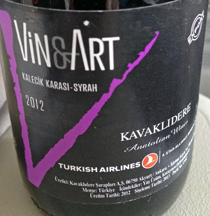
A Syrah from Turkey

A Syrah from Turkey

We were flying in business class on a Turkish Airlines flight from Brussels to Istanbul. Upon entering the aircraft we first saw an apprentice chef wit white jacket and white chef’s hat. This was a different experience than on other carriers. After reaching cruising elevation, the chef passed out menus and took our drink order. I said I never had a Turkish wine and he suggested a 2012 Kalecik Karasi Syrah. The first course had an assortment of Turkish appetizers. The tray was quite versatile. There were an assortment of bite-sized cheeses, olives, green beans marinated in olive oil, slices of turkey and eggplant served with pine nuts, tomato and lettuce and a small chocolate covered cream puff.
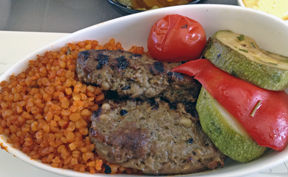
Turkish style grilled minced beef served with sautéed zucchini, red peppers and bulgur

Turkish style grilled minced beef served with sautéed zucchini, red peppers and bulgur

For the main course, I choose a Turkish style grilled minced beef served with sautéed zucchini, red peppers and bulgur. The Syrah matched well with many of the foods including the hard cheeses, bulgur and Turkish style grilled minced beef. The wine was a dark ruby color and offered black fruit notes on the aroma. The taste included plum and blackberries. The tannins were noticeable but just a tad short of bold. The finish was fruit forward until the aftertaste. Then the spices kicked in especially pepper. The Turkish Syrah was 14.5% alcohol.

This was a very nice lunch and since it has been awhile since I have had a Syrah, I enjoyed the pairing of wine with different foods. I will fly Turkish Airlines again and see if they offer the same as on this flight or have different wines and foods.

Cheers,
Terry
Brussels Airlines Dinner Service from Washington Dulles to Brussels

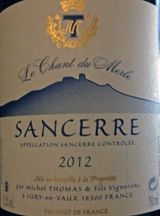
A Sauvignon Blanc on a Brussels flight

A Sauvignon Blanc on a Brussels flight

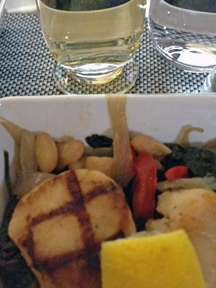
The flight from Washington’s Dulles airport to Brussels was a late flight leaving at 22:35. Dinner was served around 23:30. That is quite late for Kathy and I to have dinner, but I wanted to sample the wine selection and food offerings. There were several wines offered. Since I decided to have scallops for the dinner entree, I went with white wines. The first served quite well as an aparetif. The 2012 Domaine Thomas Le Chant du Merle Sancerre was a straw colored Sauvignon Blanc from the Loire Valley. The aroma was both floral and tropical fruits. The taste was complex offering different fruits at different times. I noticed pineapple, lime, lemon grass and melon. The finish was crisp. The fruit yielded to lime and mineral on the aftertaste. The Sauvignon Blanc was served during the starter course. The wine was paired with beef caponata with micro greens and balsamic glaze. There was a side dish of different cheeses that over powered the wine. I should have ordered a red wine to go with the starter food items, but that white looked interesting.

Grilled scallops accompanied by creamy polenta and sautéed spinach

Grilled scallops accompanied by creamy polenta and sautéed spinach

The main course that I selected was grilled scallops accompanied by creamy polenta and sautéed spinach. I chose the 2012 Glenelly Grand Vin Chardonnay. This wine from Stellenbosch, South Africa was a light yellow color. The aroma and taste reminded me of pears, apples and caramel. The finish was crisp with a hint of citrus and minerality. The wine paired nicely with the scallops.

Although very late at night, the food was on the lighter side as were the wines. When I fly Brussels Airlines again, I’ll see if the change the wines they are offering as well as the starter and main courses.


Cheers,
Terry

How Do You Like Your Pinot Noirs? Bold or Delicate

Oregon is home to many producers of Pinot Noirs. One of the newest wineries is Elizabeth Chambers Cellar in the Willamette Valley.

We’ve been fortunate to enjoy several different Pinot Noirs from Oregon, which has ideal growing conditions for this grape variety. Should all Pinot Noir taste the same as in bold with intense fruits?

When a bottle of Pinot Noir produced by Elizabeth Chambers Cellar arrived, we were happy to taste the wine and pair it with a home cooked meal.

This 2011 Winemaker’s Cuvée Pinot Noir was produced with 100 percent Pinot Noir grapes from the Willamette Valley Appellation. It was a light bodied, delicate wine. The wine was a ruby color with a sienna tint and a clear rim. The aroma and taste offered an earthiness with hints of leather, cherry, raspberry and spice. The finish had soft tannins.

A little search for Elizabeth Chambers yielded some interesting information. This new, boutique winery is located in an old power station in McMinnville, Oregon. Elizabeth Chambers notes, “It may be because I am a woman, but I am not interested in seeing who can make the wine with the biggest muscles. I want to drink wines that have table manners, wines that can dance. I want elegance and style in my wines.”

If you are tired of bold, intense wines you may want to consider Elizabeth Chambers Cellar Pinot Noir. Try it and see if it is a wine that can dance.

Cheers! Kathy

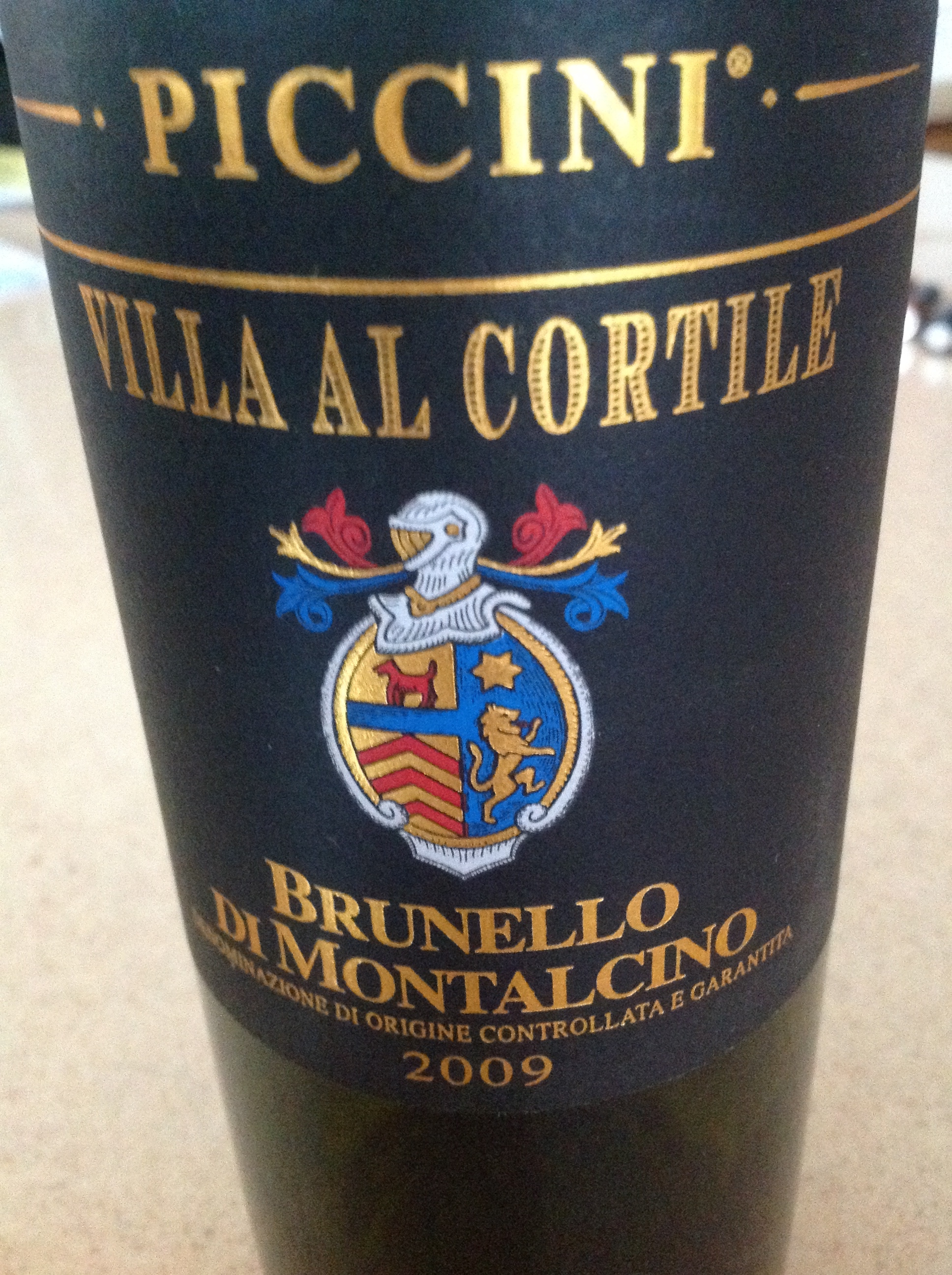
Brunello di Montalcino 2009 DOCG from Piccini

Brunello di Montalcino 2009 DOCG from Piccini

Brunello di Montalcino 2009 DOCG from Piccini

Earlier this month we received a bottle of Italian wine produced with 100 percent Sangiovese grapes.

Last week we opened and enjoyed this wine produced by Piccini located in the Chianti region of Italy. The Brunello di Montalcino 2009 DOCG was a dark ruby color produced from the Sangiovese grape variety. The aroma and taste offered hints of black cherry, licorice and baking spices. This 14 percent alcohol wine was aged in oak for 26 months. This is a good red wine for red wine lovers and Sangiovese enthusiasts.

Pairing suggestions include red meat, game or perhaps after dinner with an array of aged cheeses.

Piccini produces four wine labels according to the location of the vineyards. These labels include: Valiano, Tenuta Moraia, Villa Al Cortile and Piccini.  The most recently added vineyard is Regio Cantina. Today Piccini manages 400 hectares (1,000 acres) of vines.

The 4th generation family currently operates Piccini winery, located in the Chianti region of Italy. They have been producing wine since 1882 when Angiolo Piccini and his wife Maria Teresa Totti began growing 17 hectares (7 acres) of vineyards and making wine.

Visit the Piccini website to discover the three recipes from Mama Piccini. The recipes are Tomato Jelly, Tuscan Meat Sauce and Peposo (Peppery Stew.) Each recipe has a suggested Piccini wine.

Looking to try a Piccini wine? The United States importer is Aveniu Brands. This importer also imports Piccini’s Piccini Chianti DOCG, Piccini Sasso Al Poggio, Piccini Chianti Classico and Piccini Brunello Riserva.

Have you tried a wine from Piccini yet?

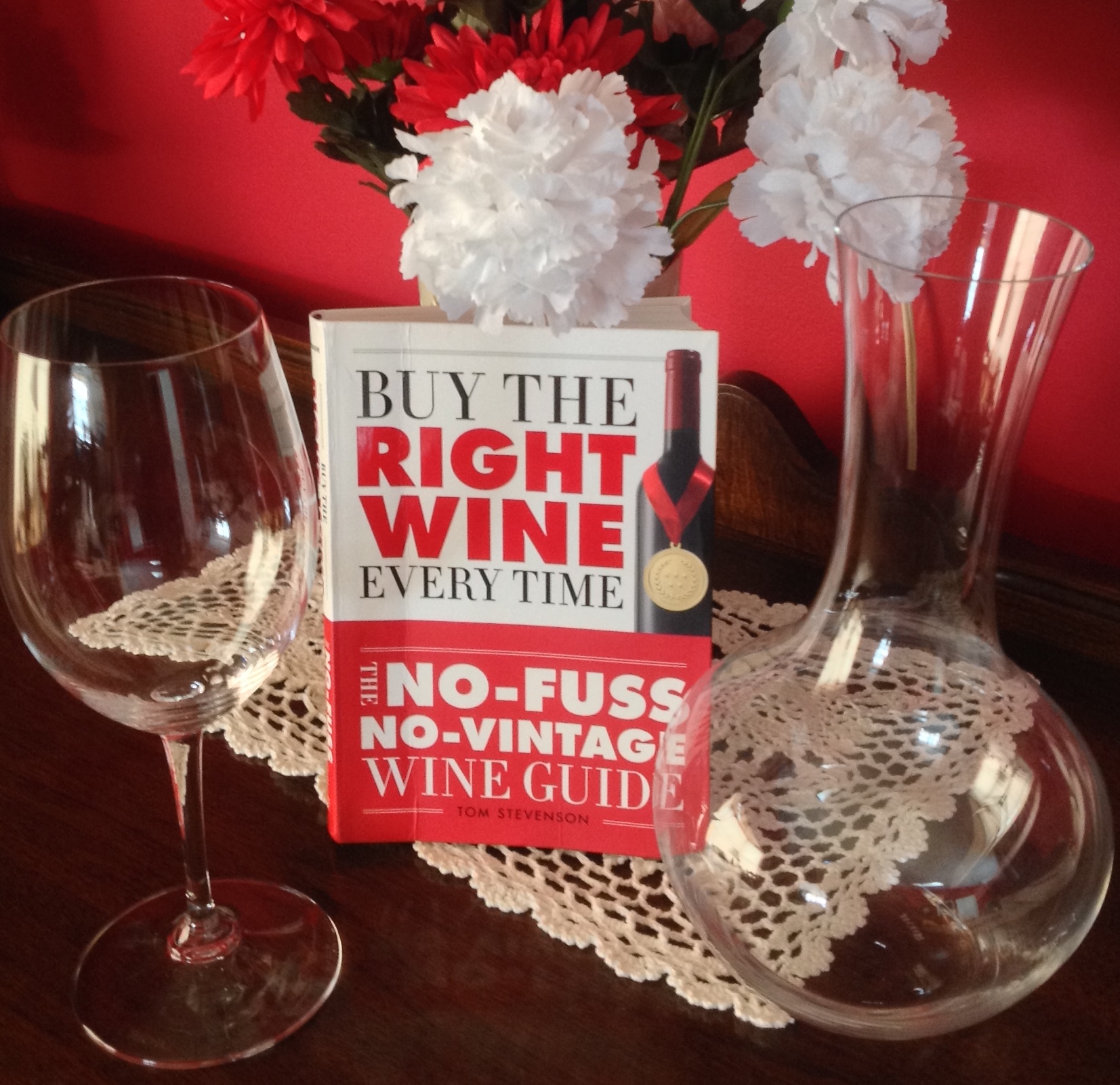
Buy the Right Wine Every Time: The No-Fuss No-Vintage Wine Guide

IMG_7018Buy the Right Wine Every Time: The No-Fuss No-Vintage Wine Guide by Tom Stevenson is now available for purchase. The retail price is $14.95.

Tom Stevenson has been writing about wine for many years. As a renowned author he has written the popular The Sotheby’s Wine Encyclopedia that he has updated several times.

The back cover of Buy the Right Wine Every Time: The No-Fuss No-Vintage Wine Guide notes “This book is for you…

  • jf you drink wine, but don’t think wine.
  • prefer to stick to the types of wines you know.
  • can’t be bothered with pretentious “winespeak.”
  • want instant professional guidance so you’ll buy the right wine every time.”

I have a review copy of Buy the Right Wine Every Time: The NO-Fuss No-Vintage Wine Guide and have added a review of the book to the Wine Trail Traveler website. You can read the review at http://winetrailtraveler.com/reviews/generalbooks.php#buyright.

When you read the book, I’d love to know your reaction to this recently published book. How would you rate it?

Cheers! Kathy

Are there Qvevri Makers in the United States?

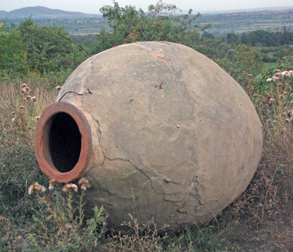
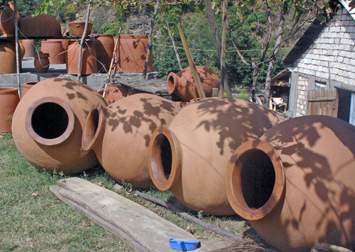
Qvevri resting on its side. This qvevri will be buried at a new marani.

Qvevri resting on its side. This qvevri will be buried at a new marani.

Qvevris are clay vessels used for fermenting and aging wine. Unlike amphorae, qvevris are not used to transport wine, rather qvevris are buried underground and can remain in use for centuries. Qvevri production is mostly taking place in the country Georgia, where there are a handful of artisans left to create these vessels. We met two qvevri makers while in Georgia during September 2013. Remi Kbilashvili is a qvevri maker in Vardisubani, Kakheti in the eastern part of Georgia and Zaliko Bodjadze crafts qvevri in Makatubani in Western Georgia. Are there qvevri makers in the United States?

While researching for our book: Georgia, Sakartvelo: the Birthplace of Wine we discovered that there is a group in Texas crafting qvevris and making qvevri wines. Their website Qvevri Project encourages people to learn about qvevris and make wine in qvevris. Billy Ray Mangham, of Sleeping Dog Pottery, San Marcos Texas, is a master potter who is now crafting small qvevris up to 220 liters. That is a perfect size for winemakers to use in experiments. Along with Billy Ray two other partners are involved in the Qvevri Project. Dr. Brent Trela works in the enology program at Texas A&M and Texas Tech University. He previously studied wine production in Georgia. Now he is studying the wine made in Billy Ray’s qvevris. Tom Vincent, a winemaker, spent three years in Georgia and obtained his winemaking certificate from UC Davis.

Qvevris at Zaliko Bodjadze's workshop in Western Georgia.

Qvevris at Zaliko Bodjadze’s workshop in Western Georgia.

Wine Trail Traveler conducted an email interview with the Qvevri Project group. One of our interests was the use of beeswax to coat the inside of a qvevri. Remi Kbilashvili told us it has always been done. The beeswax seals the qvevri and offers some antibacterial benefits. Other interests include sealing the qvevri and if Americans are ready for qvevri-made wines.


Wine Trail Traveler: Will the beeswax lining on the inside of the qvevri interact with the wine? If so, how will it interact with the wine? 

Tom Vincent: One of the most important things to understand is that many aspects of qvevri  production have never been studied in the lab. We do believe that the Russians carried out some studies, but it is not clear whether they would be available, reliable or applicable to Western standards. We have done preliminary trials with beeswax from hives in Central Texas and believe that some interaction is likely.

Brent Trela: We noticed some chemistry going on from our one time trial in wine and model wine. Qvevri that we used were permeable even with beeswax coating the interior of the vessels resulting in some liquid volume loss, somewhat similar to oak barrels. This can have a concentrating effect on some of the compounds in the wine, such as pyrazines that can contribute vegetable type flavors. Beeswax glaze absorbed some compounds such as terpenes and esters that can contribute to floral and fruity flavors, but these were not significantly reduced in the wines.

Author’s Comment: I noticed that there can be some honey on the aroma and taste of wines that have been made in qvevri that are new or recently had beeswax applied. This was evident in some of the wines we had in Georgia and a cider made in qvevri at Castle Hill Cider in Keswick, Virginia. The honey influence was not as apparent on qvevri wines that were produced in qvevris that had not been recently recoated in beeswax. It is important to note that the honey influence was not a negative on the wines or the cider tasted. It added another decision to the wine.

Wine Trail Traveler: Why seal the inside of the qvevri with beeswax as opposed to other things such as epoxy that some wineries use to seal cement vats? 

Tom Vincent: Qvevri production is thousands of years old. Tom Vincent has visited present day Vani, in Georgia, the site of the story of Jason and the Golden Fleece and there  are locations that have been in continuous use since that time. Wine production evolved in times pre-dating industrial techniques of almost any kind.

Brent Trela: Looking at qvevri as made from natural materials using traditional handmade techniques, beeswax lends itself as an effective natural sealer, not unlike wine barrel manufacture – most of which are handmade and toasted over traditional  fires.

Author’s Comment: In Georgia, through the millennia other items were tried to seal the inside of the qvevri. Nothing worked as well as beeswax. In July of 2013 while in Bordeaux, France a producer studied the wines made in cement vats that were sealed with epoxy and those made in cement vats not sealed with epoxy. His conclusions stated that there are traces from the epoxy in the wines from those vats sealed with epoxy. This was only one study and the topic needs to be further researched. It would be interesting to see if beeswax would have a potential use in other winemaking vessels.

Perhaps the largest qvevri in the world, people can walk inside this qvevri at Twins Wine Cellar in Napareuli, Kakheti, Georgia.

Perhaps the largest qvevri in the world, people can walk inside this qvevri at Twins Wine Cellar in Napareuli, Kakheti, Georgia.

Wine Trail Traveler: Are the qvevris coated with beeswax only once or after X number of uses? 

Tom Vincent: Qvevri are recoated as needed, but it is a difficult process once the qvevri are  buried in the ground. As a result, it is not uncommon to “retire” qvevri and bury new ones rather than continually rewax them. In fact, we do not really know how producers make that decision.

Brent Trela: However, older, buried qvevris can also be heated and waxed and commonly are resealed if necessary.

Author’s Comment: I asked this question to every qvevri winemaker we met in Georgia. Each had a different answer. The answers ranged from every year to “I have not done it yet and the qvevri has been buried for over a century.” For those who do reapply the beeswax, they have a container in which they build a fire and lower the container into the qvevri to heat it. Once the qvevri reaches 170º the inside can be recoated with beeswax.

Wine Trail Traveler: How do you seal the top of the qvevri once fermentation is completed?

Brent Trela: It used to be customary to pour vegetable oil onto the wine’s surface to ensure airtight storage of the wine but this can be problematic if the oil becomes rancid. Melted beeswax has also been poured onto the wine’s surface to seal the wine, but the most common method to ensure the airtight storage is to properly seal the vessels with lids which are the right size. Lids can be made of wood, generally found in West Georgia, or stone, which is more popular in East Georgia, especially in Kakheti. In West Georgia, lids are placed directly on the  opening of the buried qvevri then covered with earth. In Kakheti, clay is applied first to the dry qvevri opening where it sticks. Then the clay is covered with a stone lid which is strongly pressed into the clay before covering with earth.

Billy Ray Mangham: We are making lids using the same clay as the Qvevri and plan to seal them with beeswax.

Author’s Comment: While in Georgia, Kathy and I observed qvevris covered in slate, glass and wood. Slate and glass were used in Eastern Georgia and wood was used in Western Georgia. Some wineries place a layer of clay on the qvevri opening, then cover with slate. Through the clay they place a small tube and run a gas through the tube to replace the oxygen at the surface of the wine.

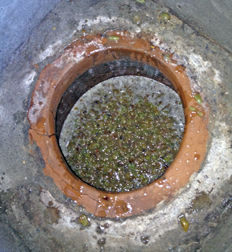
We poured Rkatsiteli grapes that we harvested into a sixty liter qvevri at Twine Wine Cellar in Napareuli.

We poured Rkatsiteli grapes that we harvested into a sixty liter qvevri at Twine Wine Cellar in Napareuli.

Wine Trail Traveler: Are Americans ready for qvevri wines? 

Tom Vincent: Yes! There are already some popular wines which take on aspects of qvevri produced wines, such as the now passé “orange wines”. In addition, we expect  that even common grape varieties may take on new life when fermented in qvevri.

Billy Ray Mangham: I attended the Qvevri Symposium in Georgia several years back and this was a major concern of the producers. Among other questions they wondered if America/Europe wine drinkers were ready for the color of Qvevri produced wine.

Author’s Comment: The most striking color difference is with white wines. They take on a gold to amber color. Also the white wines can have very bold tannins because of the prolonged skin contact. I personally enjoy very bold tannins in a red wine. When I tasted some qvevri-made white wines in Georgia they also had very bold tannins, I consider tannins a gift to wine. Red wine drinkers may enjoy qvevri-made white wines. As far as qvevri-made red wines are concerned, one can also experience wines that are full bodied and have bold tannins. What is not noticeable is the influence of oak. As a result, in my opinion, qvevri-made wines have more of the grape expressing itself than wines aged in barrel.

Kathy and I have visited some wineries in America that ferment one of their white wines on the skins and seeds for one to two weeks then press. These wines are a dark yellow to gold color and have noticeable tannins. Fermenting and aging in a qvevri is a logical next step for these winemakers.

I recently spoke to a person from Pennsylvania who purchased some property near the Pennsylvania/New York border. He plans to plant a vineyard and bury qvevri. He wants to make qvevri wine. In his travels through Pennsylvania, he met two other people who are making wines in qvevris. There may be more qvevris buried in the United States. It would make sense to create a database of those making wine in qvevris and a database of qvevri makers with contact information.

Wine Trail Traveler: Do you believe that qvevri wine producers in the United States will embrace the word qvevri, or are they likely to use the word amphora as some qvevri wine producers in Western Europe are doing?

Tom Vincent: That’s up to the marketers. However, amphorae are not the same as qvevris, and it  seems possible that Europeans have an association with the word “amphorae” that Americans may not. Therefore, it may be easier to introduce the word. More  importantly, the Georgian wine culture is accompanied by great food, song, dance and heritage. Using the word qvevri would allow producers to go beyond a simple production technique and talk about an entirely different aspect of enjoying wine.

Billy Ray Mangham: We are marketing the qvevris we are making as “Texas Qvevri”. I believe the  winemakers should go with qvevri. As I post pictures of the vessels we have made I find my audience takes the time to look up the word and thus gain more knowledge and more interest in the wine.

Author’s Comment: This is an opportunity to educate people as to the difference in the words amphora and qvevri. When Kathy and I talk about our book Georgia, Sakartvelo: the Birthplace of Wine and qvevri-made wines, people are fascinated. We constantly hear, “I didn’t know that.” We have also noticed that people want to learn more about traditional/historical ways of making wine.

We hope to join those Americans making wines in qvevri with grapes from the 2014 harvest. Our plans include making a 2014 Viognier in a small qvevri.

Cheers,
Terry

Book: Georgia, Sakartvelo: the Birthplace of Wine Arrives

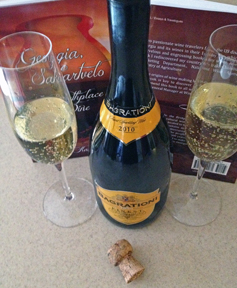
Our book "Georgia, Sakartvelo: the Birthplace of Wine" and a bottle of sparkling wine from the country Georgia.

Our book “Georgia, Sakartvelo: the Birthplace of Wine” and a bottle of sparkling wine from the country Georgia.

We just received copies of our book Georgia, Sakartvelo: the Birthplace of Wine. Kathy and I began to research winemaking and qvevri making in Georgia last summer. In September we traveled to the country and experienced visiting over 30 wineries, monasteries and churches, harvested grapes, pressed grapes, cleaned and sanitized a qvevri, put our grapes into the qvevri, punched down the cap in different qvevris and visited two qvevri makers. Since we had a driver, we were able to observe the landscape, both in cities and in the country. The outline of our book formed while we were in Georgia. Returning in late September, we began writing. A draft was completed in early December and we spent several weeks editing. By mid-January, we sent our manuscript to our publisher.

This is our third book and the first that we used colored photos rather than black and white photos. The color photos look great. In future books, we will also use color photographs. How do you celebrate the culmination of nine months of work?

We decided to open a sparkling wine from Georgia. The 2010 Bagrationi Finest Brut is a great choice for a celebration. The sparkling wine was made in the traditional method with Chinuri grapes. The light yellow colored sparkling wine had a floral aroma with hints of apple. Tiny bubbles were persistent. The taste reminded me of almonds and apple. It was a perfect celebratory sparkling wine from the country Georgia.

Book’s website.

Copies of the book will be available for sale at the International Wine Tourism Conference, IWINETC, in Tbilisi, Georgia March 29-30.

In the United States books can be ordered from the Wine Trail Traveler bookstore.

Cheers,
Terry

Upcoming Winery Events

Wineries around the country are gearing up for spring with special events. With St. Patrick’s Day quickly approaching, why not visit your favorite winery or do something adventurous such as discovering a winery you haven’t been to before.

If you find a winery with something unusual to offer wine enthusiasts let me know, I’d like to hear about it!

Reid's Orchard Winery in Pennsylvania

Reid’s Orchard Winery in Pennsylvania

Cheers!
Kathy

Wednesday, March 12

The Winery at Perennial Vineyards
Location: Navarre, OH
Music: Major Lee
Website Information

Thursday, March 13

Grand River Cellars
Location: Madison, OH
Event: Brushes & Lushes
Website Information

Friday, March 14

Grand River Cellars
Location: Madison, OH
Event: Winter Glow – An Exclusive Progressive Dinner

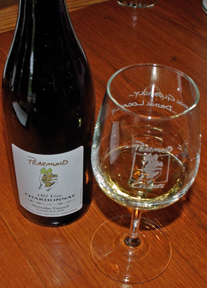
Pearmund Cellars in Virginia

Pearmund Cellars in VirginiaWebsite Information

The Winery at Perennial Vineyards
Location: Navarre, OH
Music: Ren
Website Information

Saturday, March 15

Grand River Cellars
Location: Madison, Ohio
Event: St. Patrick’s Day Celebration
Event: Ice Wine Festival
Website Information

Pearmund Cellars
Broad Run, VA
Event: Barrel Tastings
Website Information

Reid’s Orchard & Winery
Location: Orrtanna,Pennsylvania
Event: Mason Dixon Tour de Tanks
Website Information

Sunday, March 16

Lorimar Vineyards and Winery
Location: Temecula, California
Event: St. Patrick’s Day
Website Information

Pearmund Cellars
Location: Broad Run, Virginia
Event: Barrel Tastings
Website Information

Reid’s Orchard & Winery
Location: Orrtanna, Pennsylvania
Event: Mason Dixon Tour de Tanks
Website Information

Monday, March 17

Lorimar Vineyards and Winery
Temecula, California
Event: St. Patrick’s Day
Website Information

International Wine Tourism Conference (IWINETC) Offers Advertising Options

For the past 6 years the International Wine Tourism Conference has provided the opportunity for winemakers and travel agent providers to gather together for extensive presentations highlighting various regions of the world to visit for wine tourism. Until March 14, advertising opportunities are available. To date the conferences have been held in Portugal, Spain, Italy, and Croatia.

This year at the end of March, the International Wine Tourism Conference takes place in Tbilisi, Georgia – a country that is often referred to as the “cradle of wine.” Each year those attending the conference receive a program that details the numerous presentations that are scheduled.

The program/catalogue offers ample space for businesses related to the wine and tourism industries to advertise. There is still time to advertise in the IWINETC program/catalogue. If you are in the tourism industry or wine industry this may be just the place you want to advertise. The deadline for advertisements is March 14.

Below are the benefits of advertising and the cost specific information from the IWINETC website. If you need advertising check the description out.

Maximum Impact

  • Each attendee at the event receives a copy of the Conference Catalogue
  • IWINETC  communicates the IWINETC catalogue via all their official channels (website, social media, mailings..that’s in excess of 100,000 right people each time we speak)
  • Available in print and digital format
  • Available online prior to, during and after the event

Advertisement options include:

1. 1/2 page (190×130mm), black & white – 290 Euros

2. Full page (190×270mm), black & white  – 500 Euros

3. Inside front or back cover (190×270mm), full color – 750 Euros

4. Outside back cover (190×270mm), full color – 1,100 Euros –  RESERVED

Please note all advertisements must be booked by 14 March 2014.

For more information about advertising in the IWINETC program/catalogue, contact Anthony at info@winepleasures.com.

Want to know more about International Wine Tourism Conference? Visit the IWINETC website.

Cheers, Kathy


info@winetrailtraveler.com            Sitemap                      Privacy Policy

Copyright: Terry and Kathy Sullivan 2006-2013