November 18, 2008 – 12:50 pm
By yesterday morning, the must for the mead was letting off CO2 through the air lock every second. According to the directions we used, it was time to add a nutrient and energizer. As soon as Superferment was added, foaming began and ran down the sides of the carboy. It looked like the opening scene from Shakespeare’s Macbeth. After four to five minutes, the foaming slowed down so that it could be stirred. Replacing the air lock, we waited to see what would happen. In the evening, the CO2 was bubbling in the air lock once every second.
This morning every two seconds there are two bubbles. We decided that on Saturday we will check the alcohol level with the hydrometer. In the meantime, the room where the carboy is located smells delightfully of honey, almost like an apiary facility.
If you are interested in home winemaking, you may want to check out a winery and home winemaking supply facility we visited recently. Presque Isle is located in North East, Pennsylvania.
November 17, 2008 – 1:10 pm
We had a great time yesterday morning beginning the process of making mead. We began with sterilizing everything. This being a necessary process is anything but fun but as soon as that was done, we were on our way. The directions we followed indicated that the water needed to be 109 degrees. While heating the water, we sprinkled the yeast (Lalvin K1-V1116) over warm water. When everything was ready, we poured the wonderful wildflower honey from my brother’s apiary into the water. We used Deer Park water to avoid chemicals in the tap water. The water and honey mixture needed to be stirred well until the honey and water were thoroughly mixed. At this point, we put the honey/water into the three-gallon carboy and added the softened yeast. We mixed the must briskly for five minutes. The hydrometer readings were a specific gravity of 1.090 and potential alcohol of 12 percent. After adding the air lock, we were prepared to wait for quite a while as other winemakers had told us that fermentation with honey could take a long time. However, by evening the air lock was emitting CO2 every two seconds. Here’s to hoping that when fermentation is finished and the mead is bottled, we have some good mead. Cheers!
November 15, 2008 – 1:07 pm
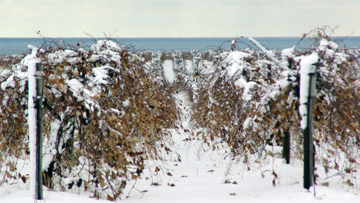 Now that most grapes have been harvested and many but a few remaining leaves clinging to the vines have fallen, vineyards look cold an uninviting. Just in time, nature takes over and paints an early November picture. A sudden lake effect snow swept through the Lake Erie region of Ohio, Pennsylvania and New York on Monday. In it’s wake, vineyards once again captured an elegance showing white against the background of the blue waters from Lake Erie.
An interesting sign in North East, Pennsylvania asked drivers to “drive as though it is winter.” Although streets were snow covered, the wineries in North East were open and waiting for visitors.
November 14, 2008 – 1:06 pm
Whether or not you have planned your Thanksgiving menu, consider serving a sparkling wine or a cranberry wine, maybe even a late harvest or ice wine. A sparkling wine is light and cleanses the palate, and easily complements the traditional heavy Thanksgiving dinner. Of course, a cranberry wine carries through on the Thanksgiving theme. A late harvest wine or an ice wine would be a perfect ending for the meal.
When choosing a sparkling wine, remember there is a full range from dry to sweet. Sparkling wines can be as good or better than Champagne. Take the opportunity to visit wineries that offer tastings of sparkling wines before deciding on your purchase.
Cranberry wines can also be delightful and again there is a range of cranberry wines. This past week I tasted a cranberry wine that reminded me of cranberry juice. It was light and fruity. When looking for a cranberry wine, I prefer a wine produced with 100 percent fruit. While cranberry wines may be produced with additives and cherry extracts, the 100 percent cranberry fruit just sounds healthier.
If you visit someone for Thanksgiving, any of the above types of wine would be a perfect gift to the host.
November 13, 2008 – 5:02 pm
As we visited wineries along Lake Erie in Ohio and Pennsylvania we had the opportunity to taste several ice wines. Being wary of other wineries in the United States who claim to make an ice wine, I always ask at what temperature the grapes were harvested. I’m suspicious of wineries that harvest grapes and then freeze them and sell their product as ice wine. Some who follow this method call their product an “iced wine.” I wonder if the addition of the “d” to the word “ice” confuses consumers.
At several wineries along Lake Erie that were visited, they all stated that they are not allowed to harvest grapes for an ice wine until the temperature drops to 17 degrees Fahrenheit. This is equivalent to Canadian law that does not permit the harvest of grapes for an Icewine until the temperature reaches -8 degrees Celsius. One partner at a winery mentioned that the temperature was 9 degrees Fahrenheit when she helped to harvest the grapes.
Does it get that cold along the southern shores of Lake Erie? Apparently so! We visited the area in early November and one evening the temperatures dipped to 30 degrees and we were awakened to snow and plenty of it. A sign on the road posted “Drive as though it were winter.” Most heeded the advice. So it’s easy to understand that the temperatures can get low enough to harvest grapes for ice wine in the areas close to the Lake where many of the vineyards are located.
Many of the ice wines tasted were made from Vidal grapes. One however was made from Concord grapes. That ice wine would pair nicely with Swedish meatballs.
November 12, 2008 – 2:43 pm
On our recent travels through the south shore of Lake Erie in Ohio and Pennsylvania we made several observations. There are many vineyards, some small and some stretching as far as the eye can see. Many of these vineyards grow Niagara and Concord grapes. Many of these grapes go to Welch’s. This is not surprising if one takes a moment to think of all the Welch’s products made from grapes available in grocery stores throughout the country. These products, juice and jelly for example, require massive tons of grapes. One can observe a large number of acres of Concord and Niagara grapes.
Another observation is that the many wineries throughout the area make more than Niagara and Concord wines. True they also make Catawba, but there is a large planting of vinifera grapes especially the cooler climate varieties. Many wineries indicated that their best selling wines tend to be sweet. Ranging from 50 to 75 percent of sales are wines from the sweeter part of their portfolio. But don’t be led into thinking that these are all Concord, Niagara and Catawba. At many wineries the best selling wine is an off-dry or sweet Riesling.
With the massive plantings of vineyards destined for Welch’s, it is easy to overlook the many vinifera vineyards. Chardonnay and Riesling are commonly planted along with Pinot Grigio. For the reds, there are plantings of Cabernet Franc and Cabernet Sauvignon. Merlot will grow in some areas, but frequently is bought from growers in other wine regions. There are also many plantings of other vinifera as well as hybrids.
Several winemakers told us that even though the sweeter wines are the best selling, they’ve noticed a change in drinking habits over the past few years. Customers who always buy sweet wines are beginning to also buy the dryer wines. The winemakers also noted that the younger purchasers tend to buy dry.
One pleasant scene was a drive through North East, Pennsylvania where we saw acres upon acres of vineyards. If you haven’t visited the South Shore Lake Erie area, consider taking time to become familiar with it.
November 10, 2008 – 2:03 pm
There continue to be numerous winery events this fall leading into the holidays. For instance, some of the Grand River Valley wineries in Ohio are featuring a Turkey Trot on November 15. This features wine paired with a variety of foods for Thanksgiving. Debonné wines and Ferrante wines will be paired with turkey. Grand River Cellars will pair wines with stuffing. Laurello Wines will be paired with cranberries. St. Joseph Wines will be paired with desserts.
I just received an email from Pearmund Cellars in Virginia that will be featuring a dinner at The Palm Restaurant in Washington, DC. The date is November 21, 2008. Reservations are required. If you can join the group the menu promises to be mouthwatering.
I’ll continue to make suggestions of special events especially from those wineries who support Wine Trail Traveler. Many wineries have special events at this time of year. Check to see what winery events are in your local area.
November 8, 2008 – 12:42 pm
On an April 20th post I commented on the Front Royal, Virginia Applebee’s display of local wineries’ wines and stock of different local wines. On a recent trip to the North East Ohio wine country we discovered an Applebee’s in Ashtabula. It had a local wine list in addition to the chain wine list. Six wines were offered from five Ohio wineries. These wines could be purchased: by the bottle, by the glass or as a tasting of three. The wine list was titled, “Wines from the Neighborhood.” We believe that Applebee’s is on the right track. If they want their image to be your neighborhood grill and bar they should offer local wines.
Wines included a Meier’s Walleye White and a Firelands Pinot Grigio. Both of these wineries are not exactly local but still in Ohio. Local wines included Debonné’s Riesling Reserve, Ferrante’s Golden Bunches Riesling and two wines from Grand River Cellars: a Chardonnay and Austin’s Red a blend of Merlot, Cabernet Sauvignon and Syrah.
The “eat and drink local movement” is certainly gaining momentum. One challenge is to define “local”. How many miles is considered “local”? Applebee’s wine list mentions 100 miles. Visiting a Maryland restaurant we were told that a winery 3000 miles away was local. What do you think?
-1.5in.jpg)


Wine in Cans?
Wine containers have changed throughout the history of wine. In Georgia, amphora was used to transport wine. Kvevri was used to ferment wines. Clay vessels were used for centuries. Oak barrels eventually replaced amphora and kvevri. Oak barrels were easier to ship. With the advent of identical sized glass bottles, the wine world perceived that this would be the container of choice. Include a glass bottle with a cork and a label and one has the modern concept of what wine is to look like in a vessel. Just as in the past, change is in the air.
When the packaging of wine turned to boxes, I eventually came to believe that under certain circumstance it was fine. Boxes and plastic bottles would be fine for wines designed to be used within a year or two. But a sip box with a straw, I don’t think so. Now the wine industry is selling cans of wine.
Somehow, for me it takes wine down a notch. While beer is fine for many consumers, trying to equate wine with beer just doesn’t work. Wine is a very different beverage and should be treated as such. With wines delicate aromas and flavors, it should be treated as a delicious beverage best served from appropriate containers and in “real wineglasses.”
Have you tried a can of wine? Does the wine taste the same as one in glass? I believe wine is influenced by the experience and drinking a wine from a can lowers the experience. What is your opinion? Will you buy wine in a can?