April 17, 2019 – 12:09 pm
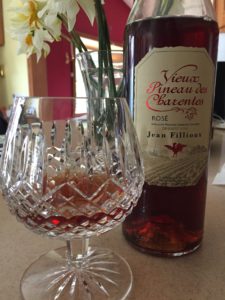
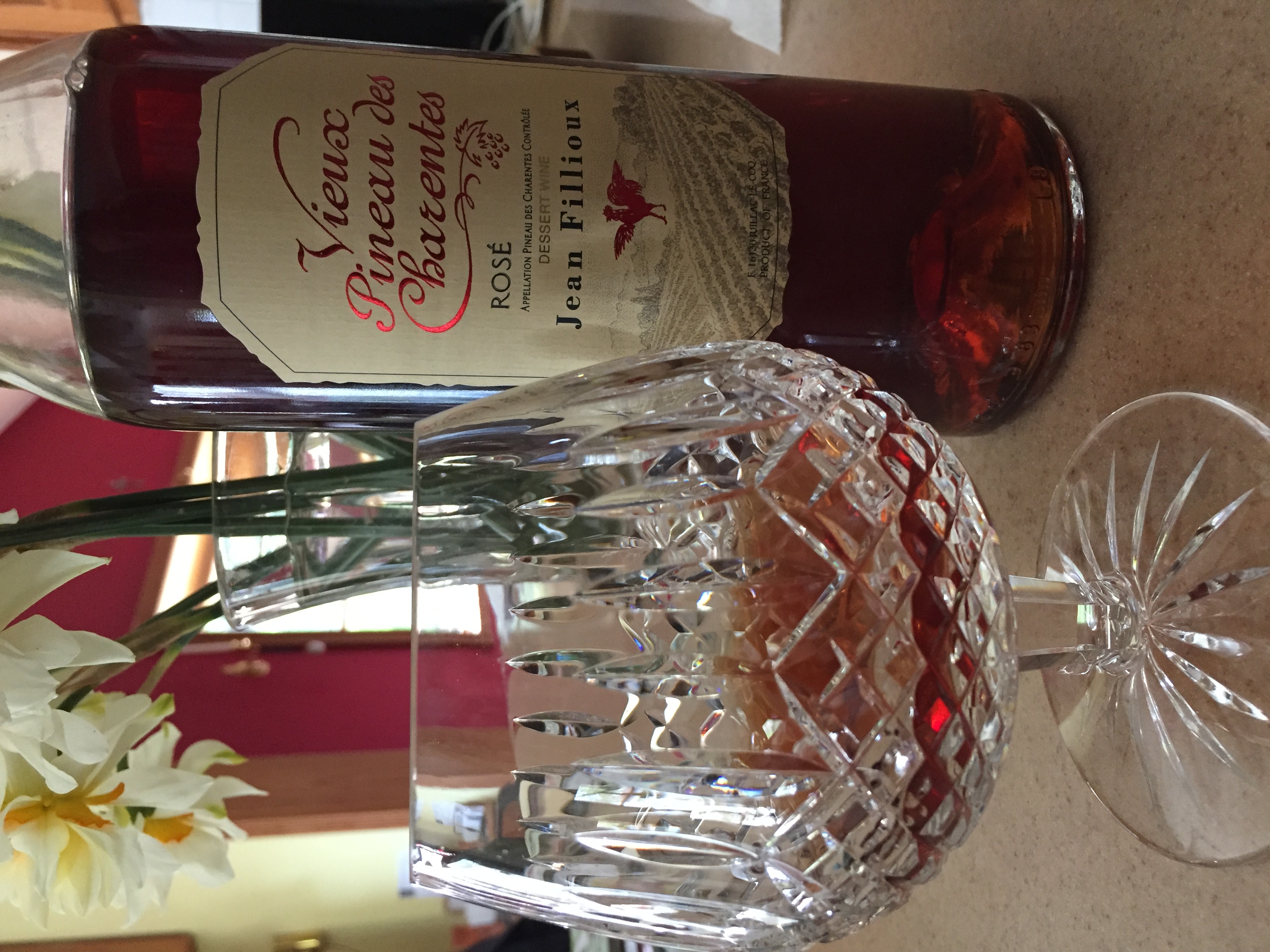
Vieux Pineau des Charentes
The Pineau was a burnt Sienna color with an orange hue. The aroma included notes of jammy dried fruit and a brown sugar sweetness. The mouthfeel was velvety. The taste included baked apples with brown sugar and baked figs. The Pineau was full-bodied. The finish was long and lingered with brown sugar notes. Use this wine as an aperitif or pair with foie gras, chocolate or blue cheese.
The Vieux Pineau des Charentes was produced primarily from the Ugni Blanc. The Vieux Pineau des Charentes was produced by adding the eau-de-vie to red grape must. This drink was produced with five years of aging noted by the use of the word Vieux.
The above described wine is from Cognac Jean Fillioux in France’s famed Cognac region. The cognac house was founded in 1894 when the founder purchased Domaine de La Pouyade. Five generations have continued producing cognac at Jean Fillioux and now includes the delightful Pineau des Charentes, a delectable dessert wine.
A year ago while in Porto, several of the port lodges were making a simple refreshing cocktail with white and rosé port. We decided to try this cocktail with the Vieux Pineau des Charentes Rosé. We added equal amounts of Vieux Pineau des Charentes Rosé and tonic water. Terry added some ice to his, while Kathy did not add ice. The resulting cocktail was refreshing and retained all the aromas and taste of the Pineau. It was delightful on a warm spring day.
Cheers!
Kathy and Terry
April 15, 2019 – 12:06 pm
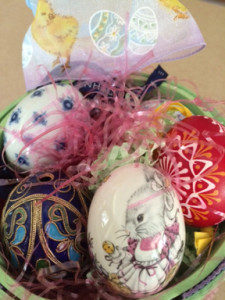 With Easter Sunday approaching so quickly, deciding what to serve for dinner can be daunting for those who are experiencing hosting Easter dinner at their home for the first time. Others experienced in hosting Easter dinner may want to offer a different entrée or side dish for everyone to enjoy.
If you are looking for a unique recipe for the day, consider one of the recipes from the Wine Trail Traveler website’s recipe section and/or look at some of our suggestions for Easter.
If you are planning on serving lamb for Easter, check out this recipe from Schug Carneros Estate Winery in California.
Sirloin Lamb Roast with a Cabernet-Olive-Roasted Pepper Jus
Ingredients
- 1 nicely trimmed boneless sirloin lamb roast approx. 2 lbs., tied with string (your butcher can do this for you)
- 2 cups dry red wine
- 1 tsp. dried thyme
- 2 large cloves garlic minced
- 1/3 cup shallots finely chopped
- 1 cup Cabernet Sauvignon
- 1/2 cup beef stock
- 1/4 cup chopped Kalamata olives
- 1/3 cup chopped roasted red bell peppers
- 2 tsp. fresh thyme chopped
- 2 tsp. fresh rosemary chopped
- salt and freshly ground black pepper to taste
Directions
-
Early in day of serving: Place the lamb roast in a large zip-lock plastic bag along with the red wine, dried thyme, the garlic and some freshly ground black pepper. Marinate the lamb roast 4 to 6 hours at room temperature, turning lamb over several times during this process.
-
One hour before serving: Preheat oven to 450 degrees F. Remove lamb roast from marinade and pat dry with paper towels. Lightly sprinkle salt and pepper all over the outside of the roast then set it aside on a plate. Heat a heavy duty sauté pan over medium-high heat. When hot, brown the roast on all sides, beginning with the fattiest side. After browning, remove the roast to a shallow oven-proof pan and roast in the oven for approximately one hour.
-
Begin the “jus” just after the roast goes into the oven: Pour off excess fat from sauté pan. Add shallots and sauté over medium-high heat until translucent. Deglaze the sauté pan with the Cabernet wine and reduce by half over medium heat. Next add the stock and again reduce by half. Remove pan from heat and set aside until meat comes out of the oven. Check the roast with a thermometer after 40 minutes; roast to an internal temperature of 145 degrees F for medium rare, 165 degrees F for well done. Remove meat from oven, add any juices to the “jus” that was started and cover roast lightly with foil. Allow the roast to rest for 15 minutes and finish the “jus”. Add the chopped olives and roasted peppers to the “jus” in the sauté pan and warm over medium heat. Next add the chopped herbs and salt and pepper to taste. Quickly slice the roast, divide among four plates, and ladle a spoonful of the “jus” over each portion. Serve immediately with your choice of starch and vegetables. Serves 4.
Recipe provided by Schug Carneros Estate Winery in Sonoma, California.
April 13, 2019 – 10:27 am
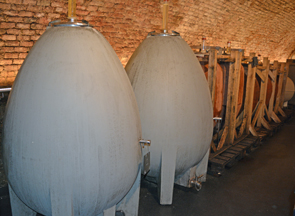
Cement tanks at Domäne Wachau in Austria’s Wachau wine region
Our last day of our two week visit to Hungary and Austria was completed when we visited Domäne Wachau and later F. J. Gritsch in Austria.
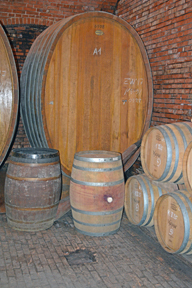
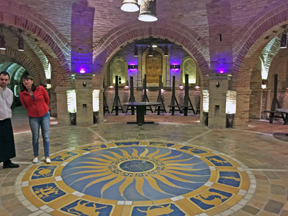
Our first winery of the day was Domäne Wachau, a large winery consisting of a group of wine growers. The winery has a special history with old cellars and a special historic building now used for events. The wine cellar includes old and modern winemaking equipment including stainless steel tanks, cement eggs and old casks. The tasting room is modern. During our wine tasting, we noticed that the floor has a large image of the renowned Danube River embedded in it.
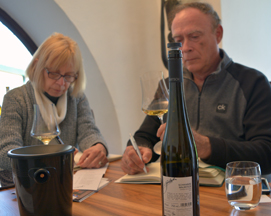
Tasting wines at F. J. Gritsch winery in Austria
We then traveled to a small Austrian town. After parking, we walked past a large church and entered a small walkway leading past the F. J. Gritsch tasting room. Nearby was the home of the current winemaker.
At Gritsch we learned the Gritsch family has been involved in the wine industry for seven generations. The house where the winemaking began dates back to the end of the 13th century. After learning the history of Gritsch, we entered the tasting room to enjoy several wines.
After an enjoyable time, it was time to travel to our Vienna hotel, to prepare for our return flight to the US.
Many thanks to all of the Hungarians and Austrians we met during our visit! We hope to return again to discover more about the wine industry and culture of both countries.
Watch for our complete articles about the wineries and more on the Wine Trail Traveler website.
Cheers!
Kathy and Terry
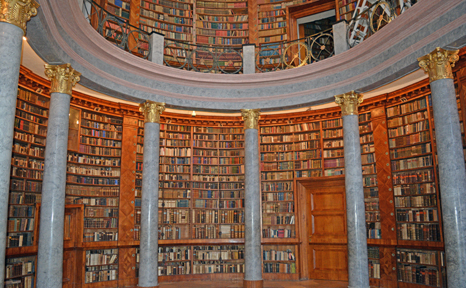
Our last Hungarian winery to visit was at the Benedictine Pannonhalma Archabbey. We received a tour of the Abbey established in 996. The Ottomans occupied the abbey three times. For the past 200 years education has been the emphasis of the abbey. We had a guided tour of many of the historic parts of the abbey including the magnificent library, two stories tall with thousands of books. One book dates back to 886; unfortunately for us, the book is locked away in a safe. The elegance of the library appeared to prove that education was very important at the abbey.
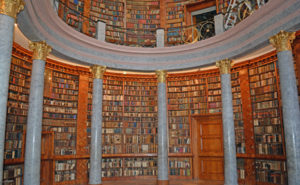
Benedictine Abbey Library
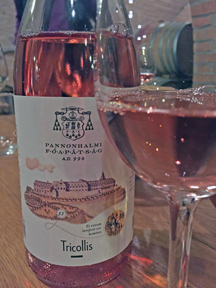
Apátság wine
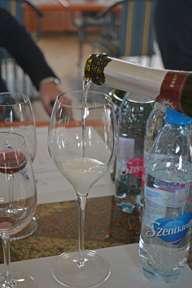
A short time later we were guided to the winery on the abbey property. The winery is named Apátság meaning abbey. A document shows winemaking taking place since 996.
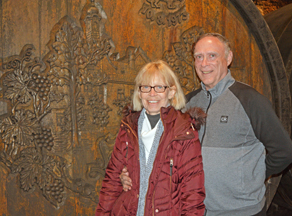
Nikolaihof has several old ornate oak casks.
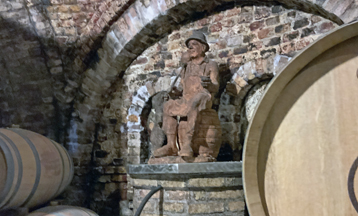
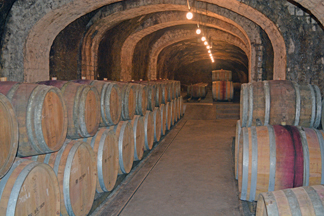
Later in the day, our driver escorted us past the Hungarian border into Austria’s famed Wachau wine region. Our first Austrian winery visit was at Nikolaihof where enjoyed a tour and wine tasting of Grüner Veltliner and Riesling wines. The wine cellar was a crypt built at a Roman garrison 2000 years ago. Now it is used for oak casks to age wines. The heads of the casks have beautiful wood carvings.

Grapevines weeping at Pfeffel
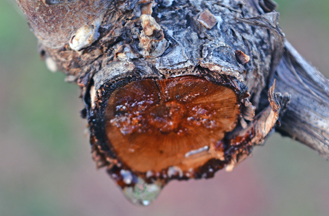
Our last winery of the day was also the location of our lodging, Pfeffel. Also located in the Wachau region, the small vineyard and the hotel hug the cliffs with great views of the Danube river. On a stroll through the vineyard we found vines weeping.
We left Hungary with many fond memories and on day 12 we were beginning to form colorful memories in Austria.
Cheers,
Kathy and Terry
-1.5in.jpg)



Day 11 of Visiting Hungarian Wineries
Pálffy in Hungary
On Thursday, our 11th day of visiting Hungary, we stopped at Pálffy Since and visited with Mr. Gyula Pálffy, who is the owner and winemaker. The winery is a boutique style. We walked to a small knoll where Gyula provided with us with a detailed description of the region. He commented that the land was once under the sea. One of his best comments was, “You just don’t sit down and drink wine, you have to work.” After viewing the landscape, we entered the cozy tasting room where he showed us rocks embedded with fossils from the area. We also enjoyed tasting a few of his wines.
Kreinbacher Estate
We then traveled to the second smaller wine region of Hungary, Somló, to learn about the Kreinbacher cellar in this region. At this modern-style winery we tasted wines and enjoyed lunch. In the Somló region, the main grape variety is Juhfark, a white grape variety. The Somló wine region is in the upper part of the Lake Balaton located about 30 kilometers from Lake Balaton.
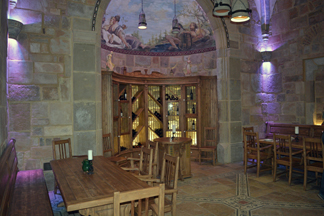
Later we traveled to Villa Tolnay winery to taste wines. This winery is located in the Badacsony wine region. The enthusiastic owner and winemaker is originally from Switzerland and decided that vineyards and winemaking were more rewarding than the technology (IT) industry. As dusk was about to descend, we walked to the higher vineyards and viewed the vineyards and landscape surrounding the winery. Returning to the tasting room, we tasted several of the Villa Tolnay wines. Then we visited the old wine caves.
Villa Tolnay in Hungary
We returned to Hotel Zenit for another restful night. We knew that our last winery to visit was located at a Benedictine Abbey. Little did we know in advance what magnificent library we would also see.
Cheers!
Kathy and Terry